
🚀 宇宙の記憶・カレンダー検索
🚀 象徴的な写真:
APOD第1回
🚀 創造の柱
🚀 スピリット火星着陸
🚀 ハッブル超深宇宙
🚀 地球へようこそ|ブルー・マーブル
🚀 エンケラドス
🚀 ベテルギウス
🚀 火星着陸
🚀 青い夕焼け
🚀 冥王星のハート
🚀 皆既日食
🚀 アースライズ再構築
🚀 ブラックホール
🚀 ウェッブ初画像
🚀 アポロ11着陸
APOD30周年(2025年6月16日)
土星の北極付近のオーロラ
Aurora around Saturn's North Pole
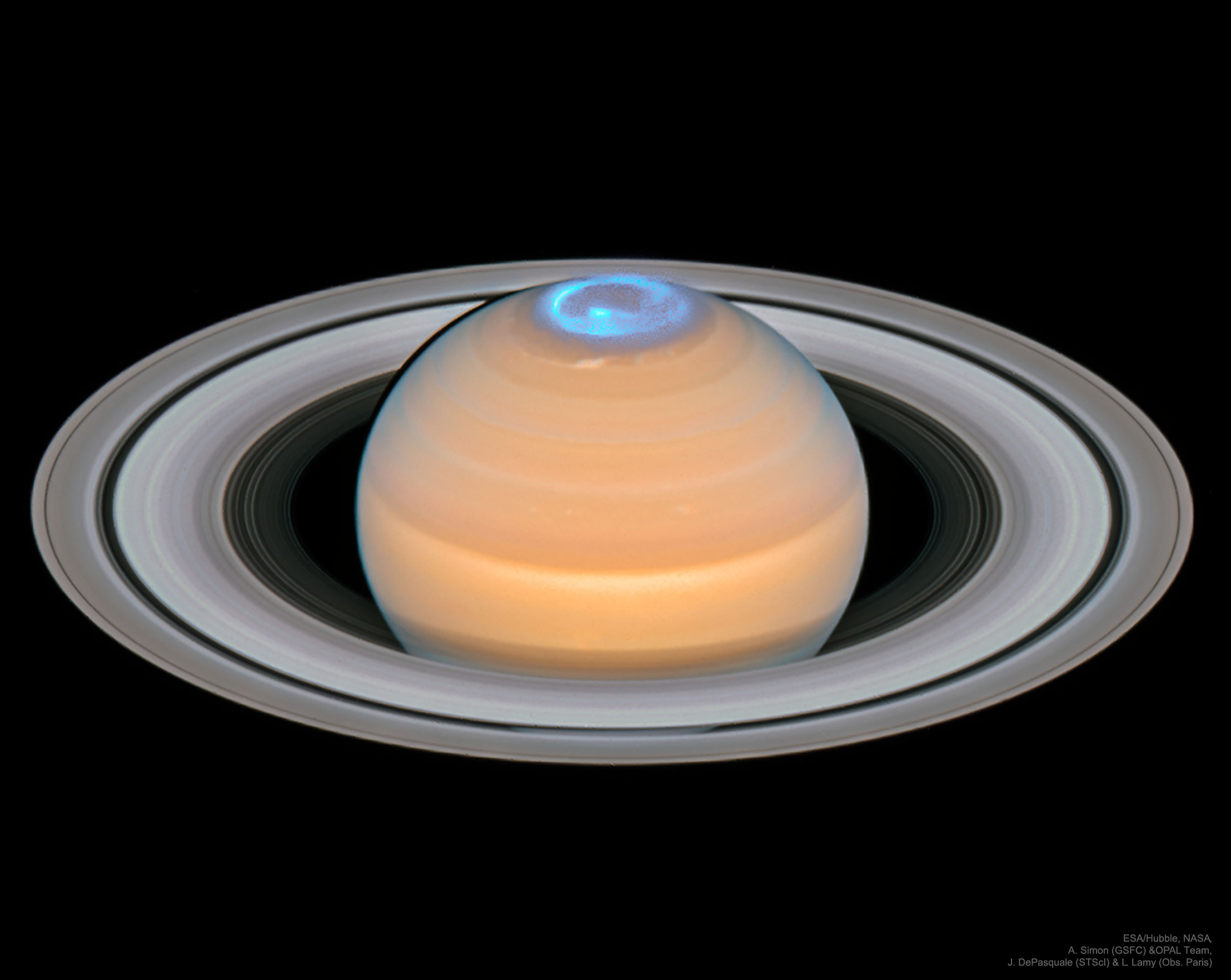
土星のオーロラは地球のオーロラに似ているのでしょうか?この疑問に答えるため、ハッブル宇宙望遠鏡とカッシーニ探査機は、2017年9月にカッシーニが巨大ガス惑星の周回軌道を最後に回った際に、土星の北極を同時に観測しました。この間、土星の傾きにより、北極が地球からはっきりと見えるようになりました。掲載されている画像は、ハッブルが最近撮影したオーロラの紫外線画像と土星の雲と環の光学画像を合成したものです。地球と同様に、土星の北極のオーロラは、極の周りに完全な環または部分的な環を形成することがあります。しかし、地球とは異なり、土星のオーロラはしばしば螺旋状で、真夜中と夜明けの直前に明るさがピークに達する傾向があります。木星のオーロラとは対照的に、土星のオーロラは、土星の内部磁場と近くの変動する太陽風との関連性が強いようです。土星の南極オーロラも同様に、2004年に撮影されました。当時、土星の南極は地球からはっきりと見えていました。教師向け:教室でAPOD(今日の天体写真)を活用しよう
原文(English)
Are Saturn's auroras like Earth's? To help answer this question, the Hubble Space Telescope and the Cassini spacecraft monitored Saturn's North Pole simultaneously during Cassini's final orbits around the gas giant in September 2017. During this time, Saturn's tilt caused its North Pole to be clearly visible from Earth. The featured image is a composite of ultraviolet images of aurora and optical images of Saturn's clouds and rings, all taken recently by Hubble. Like on Earth, Saturn's northern auroras can make total or partial rings around the pole. Unlike on Earth, however, Saturn's auroras are frequently spirals -- and more likely to peak in brightness just before midnight and dawn. In contrast to Jupiter's auroras, Saturn's auroras appear better related to connecting Saturn's internal magnetic field to the nearby, variable, solar wind. Saturn's southern auroras were similarly imaged back in 2004 when the planet's South Pole was clearly visible to Earth. Teachers: APOD in the Classroom
\ この感動を宇宙仲間にシェア /
宇宙をXでシェア
© NASA / APOD