
🚀 宇宙の記憶・カレンダー検索
🚀 象徴的な写真:
APOD第1回
🚀 創造の柱
🚀 スピリット火星着陸
🚀 ハッブル超深宇宙
🚀 地球へようこそ|ブルー・マーブル
🚀 エンケラドス
🚀 ベテルギウス
🚀 火星着陸
🚀 青い夕焼け
🚀 冥王星のハート
🚀 皆既日食
🚀 アースライズ再構築
🚀 ブラックホール
🚀 ウェッブ初画像
🚀 アポロ11着陸
APOD30周年(2025年6月16日)
軽やかで埃っぽい夜
A Light and Dusty Night
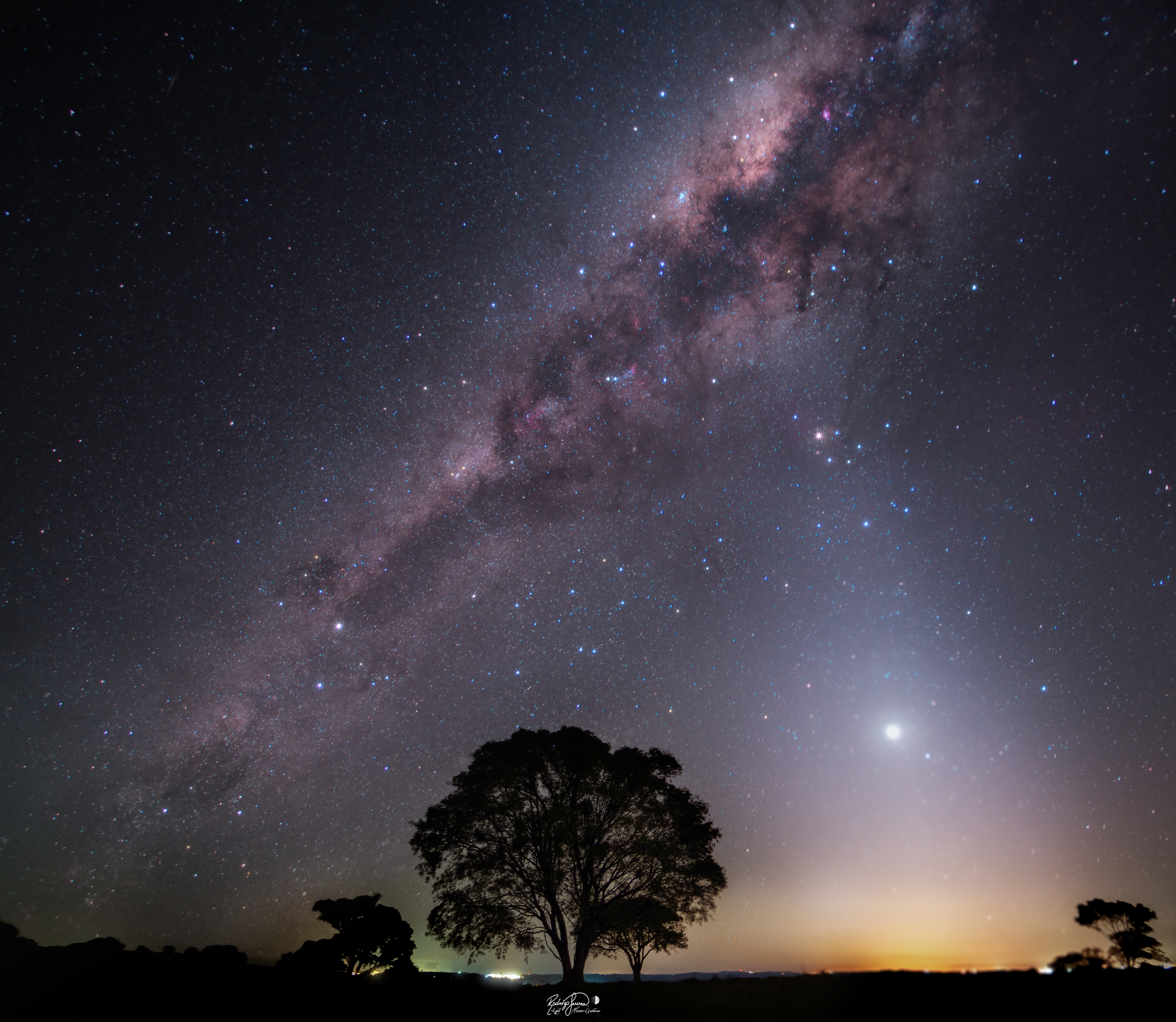
輝く宵の明星のように、金星は南半球の早春の夜空の西の地平線近くに位置している。この合成画像を作成するために、9月25日にブラジル南部のカスカベルで、空を追尾し前景を固定した露出撮影が行われた。日没後、金星は黄道面に沿って太陽系の塵から散乱した太陽光である黄道光の円錐に包まれているように見える。実際、地球のどちらの半球からでも、黄道光は春分付近の日没後(または秋分付近の日の出前)に最もよく見え、その光の弧は地平線に対して急な角度になっている。この夜、日没の上空に伸びる黄道光は、天の川銀河の中心の膨らみにある豊かな星野と巨大な星間塵の雲に向かって伸びている。天の川銀河の中心の膨らみから地平線に向かって辿っていくと、太陽に最も近い恒星系であるアルファ・ケンタウリが見えるでしょう。その距離はわずか4.37光年です。
原文(English)
Posing as a brilliant evening star, Venus lies near the western horizon in this southern hemisphere, early spring, night skyscape. To create the composite view exposures tracking the sky and fixed for the foreground were taken on September 25 from Cascavel in southern Brazil. In view after sunset, Venus appears immersed in a cone of zodiacal light, sunlight scattered from dust along the Solar System's ecliptic plane. In fact from either hemisphere of planet Earth, zodiacal light is most visible after sunset near a spring equinox, (or before sunrise near an autumn equinox) when its luminous arc lies at steep angles to the horizon. Extending above the sunset on this night, the zodiacal light reaches toward rich starfields and immense interstellar dust clouds in the bulge of the central Milky Way. Follow along the Milky Way from the central bulge back toward the horizon and you'll spot the closest star system to the Sun, Alpha Centauri, a mere 4.37 light-years away.
\ この感動を宇宙仲間にシェア /
宇宙をXでシェア
© Rodrigo Guerra / APOD