アイランド・ユニバース、コズミック・サンド
Island Universe, Cosmic Sand
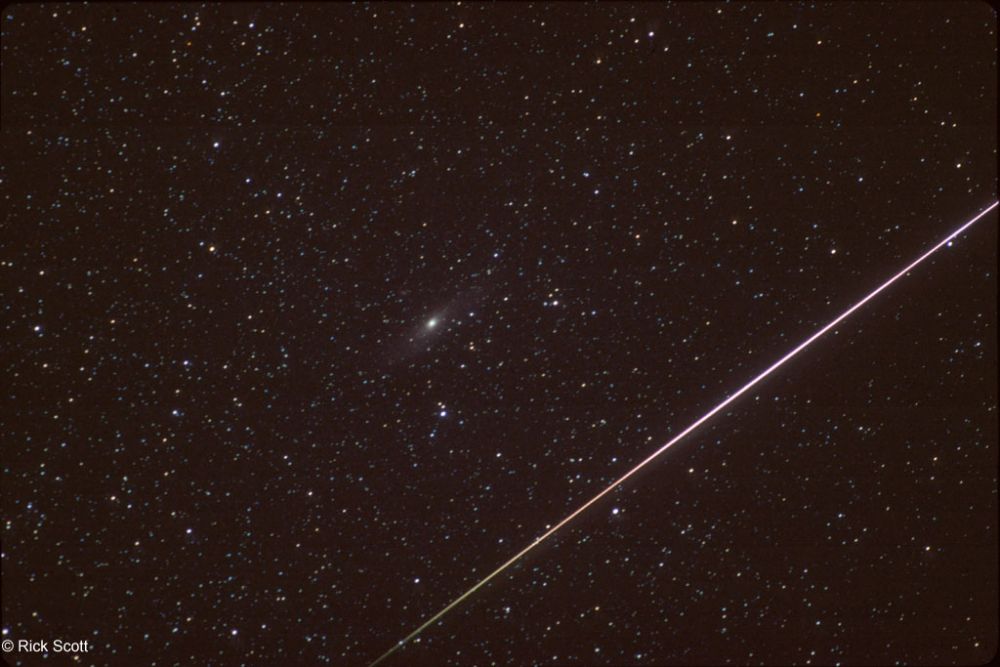
2002年8月13日、アリゾナの暗い早朝の空の下でペルセウス座流星群を数えていたリック・スコットは、はかなくとも燃え盛る流星の軌跡を撮影しようと出発した。彼が使用した機材には望遠レンズと高感度カラーフィルムが含まれていた。21枚の写真を撮った後、彼は2つの流星しか捉えることができなかったが、幸運にもこれがそのうちの1つだった。空を追跡しながら、10分間の長時間露光で、私たちの天の川銀河にある多くの星のフィールドが写っている。そのほとんどは肉眼では見えないほど暗い。左下から右上に閃光を放つ明るい流星は、地球の大気との摩擦によって宇宙の砂粒、つまりスウィフト・タットル彗星からの塵の粒が蒸発したため、肉眼では簡単に見ることができたはずだ。中央のすぐ上と左、天の川の星々のはるか彼方には、M31またはアンドロメダ銀河として知られる島宇宙がある。肉眼で見える流星の軌跡は、地球表面から約100キロメートル上空から始まり、空に見える最も近い天体の一つです。一方、約200万光年離れたアンドロメダ銀河は、肉眼で容易に見える最も遠い天体です。
原文(English)
On August 13, 2002, while counting Perseid meteors under dark, early morning Arizona skies, Rick Scott set out to photograph their fleeting but fiery trails. The equipment he used included a telephoto lens and fast color film. After 21 pictures he'd caught only two meteors, but luckily this was one of them. Tracking the sky, his ten minute long exposure shows a field of many stars in our own Milky Way galaxy, most too faint to be seen by the unaided eye. Flashing from lower left to upper right, the bright meteor would have been an easy eyeful though, as friction with Earth's atmosphere vaporized the hurtling grain of cosmic sand, a piece of dust from Comet Swift-Tuttle. Just above and left of center, well beyond the stars of the Milky Way, lies the island universe known as M31 or the Andromeda galaxy. The visible meteor trail begins about 100 kilometers above Earth's surface, one of the closest celestial objects seen in the sky. In contrast, Andromeda, about 2 million light-years away, is the most distant object easily visible to the naked-eye.
\ この感動を宇宙仲間にシェア /
宇宙をXでシェア
© Rick Scott / APOD