ウェッブ宇宙望遠鏡の最初の深宇宙探査領域
Webb's First Deep Field
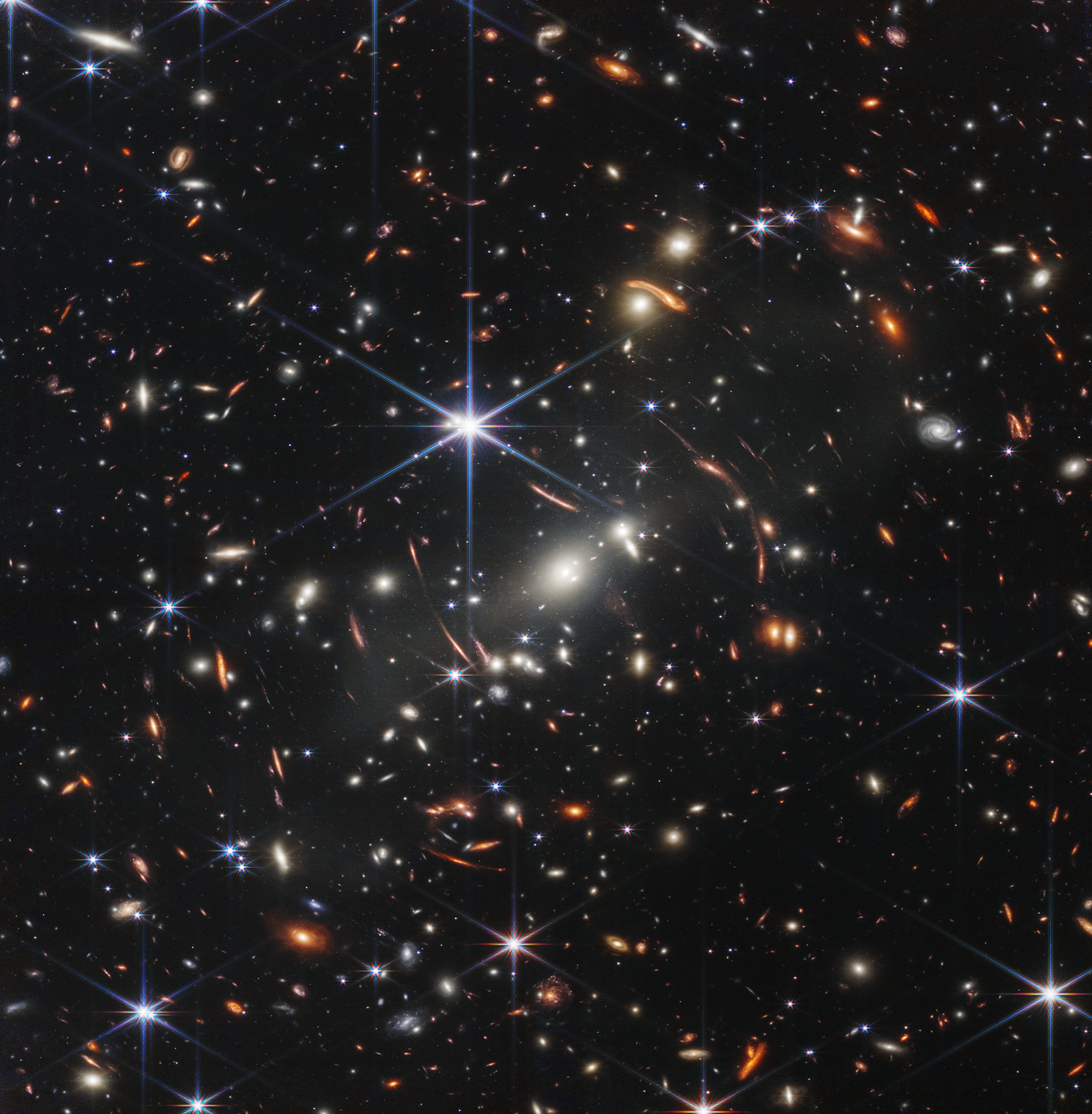
これは、これまでに撮影された宇宙の赤外線画像の中で最も深く、最も鮮明な画像です。南天の星座ヴォランスの方角にある初期宇宙の姿は、ジェームズ・ウェッブ宇宙望遠鏡のNIRCam装置を用いて12.5時間の露光で撮影されました。もちろん、6つのスパイクが見える星々は、私たちの銀河系の中にあります。それらの回折パターンは、直径6.5メートルの主鏡として機能しているウェッブ望遠鏡の18個の六角形の鏡片の特徴です。視野を埋め尽くす何千もの銀河は、約46億光年離れた遠方の銀河団SMACS0723-73のメンバーです。しかし、この深い視野に溢れているように見える光り輝く弧は、さらに遠い銀河です。それらの画像は、銀河団の暗黒物質が支配的な質量によって歪み、拡大されています。これは重力レンズ効果として知られています。明るく尖った星の下にある2つの弧状の光を分析した結果、ウェッブ宇宙望遠鏡のNIRISS装置は、これらの弧がどちらも同じ背景銀河の像であることを示した。そして、その銀河の光がジェームズ・ウェッブ宇宙望遠鏡に到達するまでに約95億年かかったという。
原文(English)
This is the deepest, sharpest infrared image of the cosmos so far. The view of the early Universe toward the southern constellation Volans was achieved in 12.5 hours of exposure with the NIRCam instrument on the James Webb Space Telescope. Of course the stars with six visible spikes are well within our own Milky Way. Their diffraction pattern is characteristic of Webb's 18 hexagonal mirror segments operating together as a single 6.5 meter diameter primary mirror. The thousands of galaxies flooding the field of view are members of the distant galaxy cluster SMACS0723-73, some 4.6 billion light-years away. Luminous arcs that seem to infest the deep field are even more distant galaxies though. Their images are distorted and magnified by the dark matter dominated mass of the galaxy cluster, an effect known as gravitational lensing. Analyzing light from two separate arcs below the bright spiky star, Webb's NIRISS instrument indicates the arcs are both images of the same background galaxy. And that galaxy's light took about 9.5 billion years to reach the James Webb Space Telescope.
\ この感動を宇宙仲間にシェア /
宇宙をXでシェア
© NASA / APOD