プレアデス星団からエリダヌス座ループまで
From the Pleiades to the Eridanus Loop
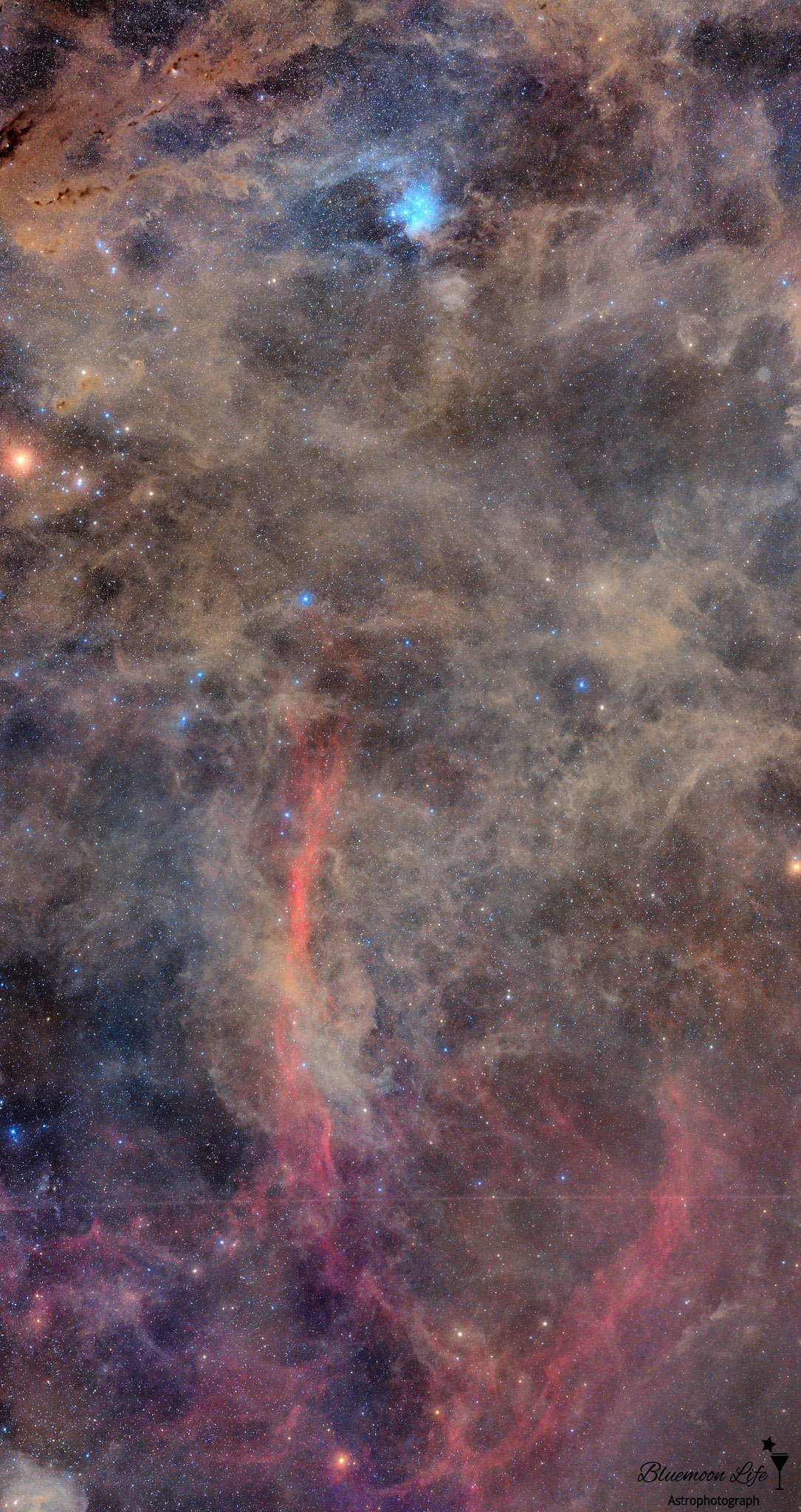
興味深い空の領域をじっと見つめていると、見え方が変わるでしょうか?プレアデス星団とヒアデス星団、そしてその周辺領域の場合、答えは「はい、かなり違って見えます」です。長時間露光のカメラによって、これまで肉眼では見えなかっただけでなく、低露光画像でも見えなかった、複雑に絡み合った星間塵とガスのネットワークが明らかになりました。掲載されている広角・深層モザイク画像では、塵が際立って見え、画像上部近くの青い領域としておなじみのプレアデス星団が見えます。青はプレアデス星団で最も質量の大きい星の色で、その特徴的な光が近くの微細な塵に反射しています。左上には、明るいオレンジ色の前景星アルデバランを取り囲むヒアデス星団があります。画像の下部には、エリダヌスループとして知られる湾曲した垂直の赤いリボンを含む、赤く輝く輝線星雲が目を引きます。広範囲に広がる塵の雲は、一般的に薄茶色で、無関係な星が点在しています。Almost Hyperspace: Random APOD Generator
原文(English)
If you stare at an interesting patch of sky long enough, will it look different? In the case of Pleiades and Hyades star clusters -- and surrounding regions -- the answer is: yes, pretty different. Long duration camera exposures reveal an intricate network of interwoven interstellar dust and gas that was previously invisible not only to the eye but to lower exposure images. In the featured wide and deep mosaic, the dust stands out spectacularly, with the familiar Pleaides star cluster visible as the blue patch near the top of the image. Blue is the color of the Pleiades' most massive stars, whose distinctive light reflects from nearby fine dust. On the upper left is the Hyades star cluster surrounding the bright, orange, foreground-star Aldebaran. Red glowing emission nebula highlight the bottom of the image, including the curving vertical red ribbon known as the Eridanus Loop. The pervasive dust clouds appear typically in light brown and are dotted with unrelated stars. Almost Hyperspace: Random APOD Generator
\ この感動を宇宙仲間にシェア /
宇宙をXでシェア
© Hirofumi Okubo / APOD