ベテルギウスの斑点模様の表面
The Spotty Surface of Betelgeuse
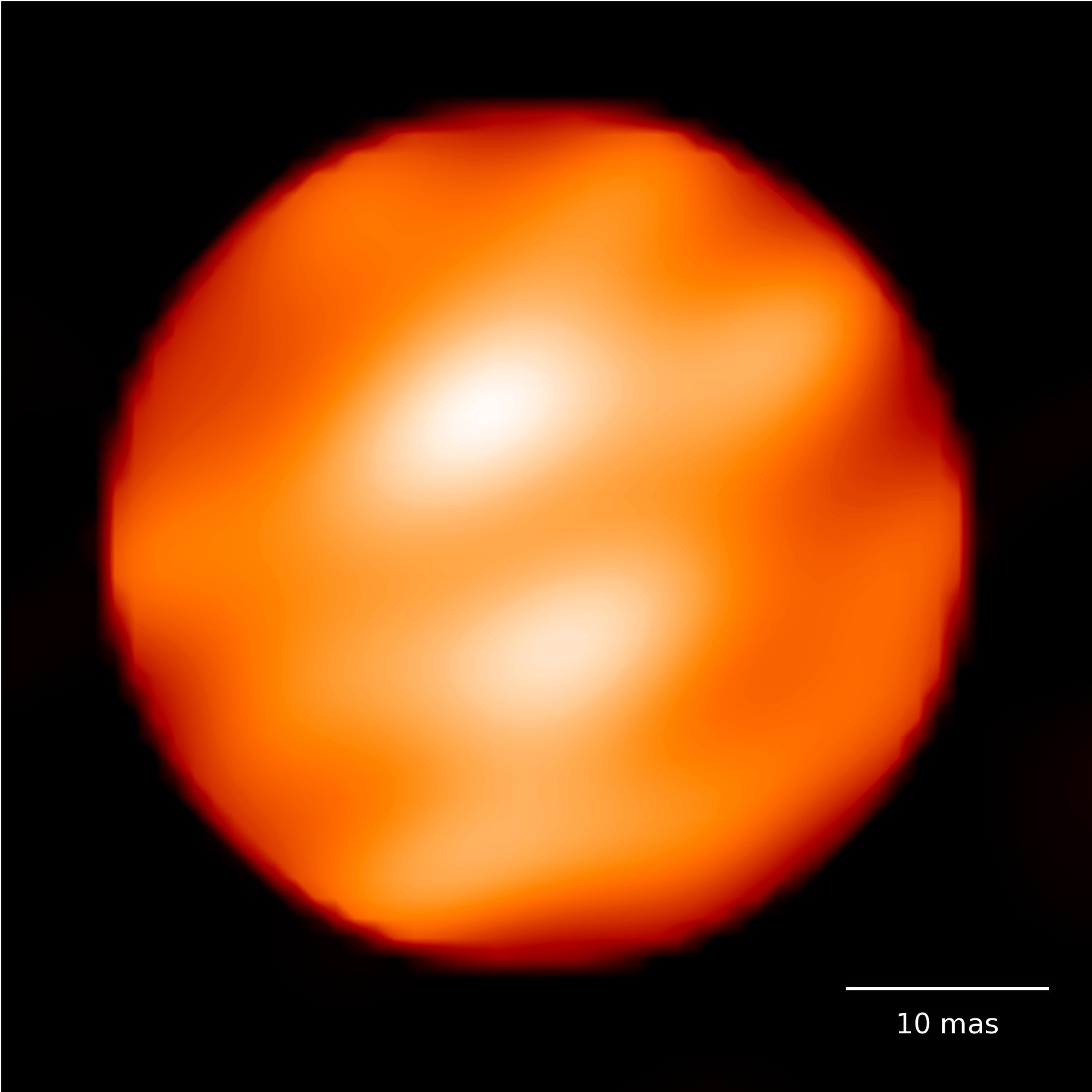
ベテルギウスは実に大きな星です。太陽系の中心に置いたとしたら、木星の軌道まで届くほどの大きさになります。しかし、太陽以外のすべての星と同様に、ベテルギウスは非常に遠いため、大型望遠鏡でも通常は一点の光としてしか見えません。それでも、赤外線波長での干渉計を用いる天文学者たちは、ベテルギウスの表面を分解して、この赤色超巨星の画像を再構築しました。興味深い画像には、大きくて明るい2つの星の黒点が写っています。これらの黒点は、超巨星の表面の下から上昇する巨大な対流セルを表している可能性があります。黒点が明るいのは、表面の他の部分よりも温度が高いからですが、黒点も表面も太陽よりは温度が低いのです。アルファ・オリオン座としても知られるベテルギウスは、地球から約600光年離れています。注:APOD編集者が、1月8日(金)にニューヨーク市アメリカ自然史博物館で開催されるニューヨークアマチュア天文協会主催のイベントで、2009年の天文画像をレビューします。
原文(English)
Betelgeuse really is a big star. If placed at the center of our Solar System it would extend to the orbit of Jupiter. But like all stars except the Sun, Betelgeuse is so distant it usually appears as a single point of light, even in large telescopes. Still, astronomers using interferometry at infrared wavelengths can resolve the surface of Betelgeuse and reconstructed this image of the red supergiant. The intriguing picture shows two, large, bright, star spots. The spots potentially represent enormous convective cells rising from below the supergiant's surface. They are bright because they're hotter than the rest of the surface, but both spots and surface are cooler than the Sun. Also known as Alpha Orionis, Betelgeuse is about 600 light-years away. Note: An APOD editor will review astronomy images of 2009, hosted by the Amateur Astronomers Association of New York on Friday, January 8 at the American Museum of Natural History, NYC.
\ この感動を宇宙仲間にシェア /
宇宙をXでシェア
© NASA / APOD