小マゼラン雲の尾
The Tail of the Small Magellanic Cloud
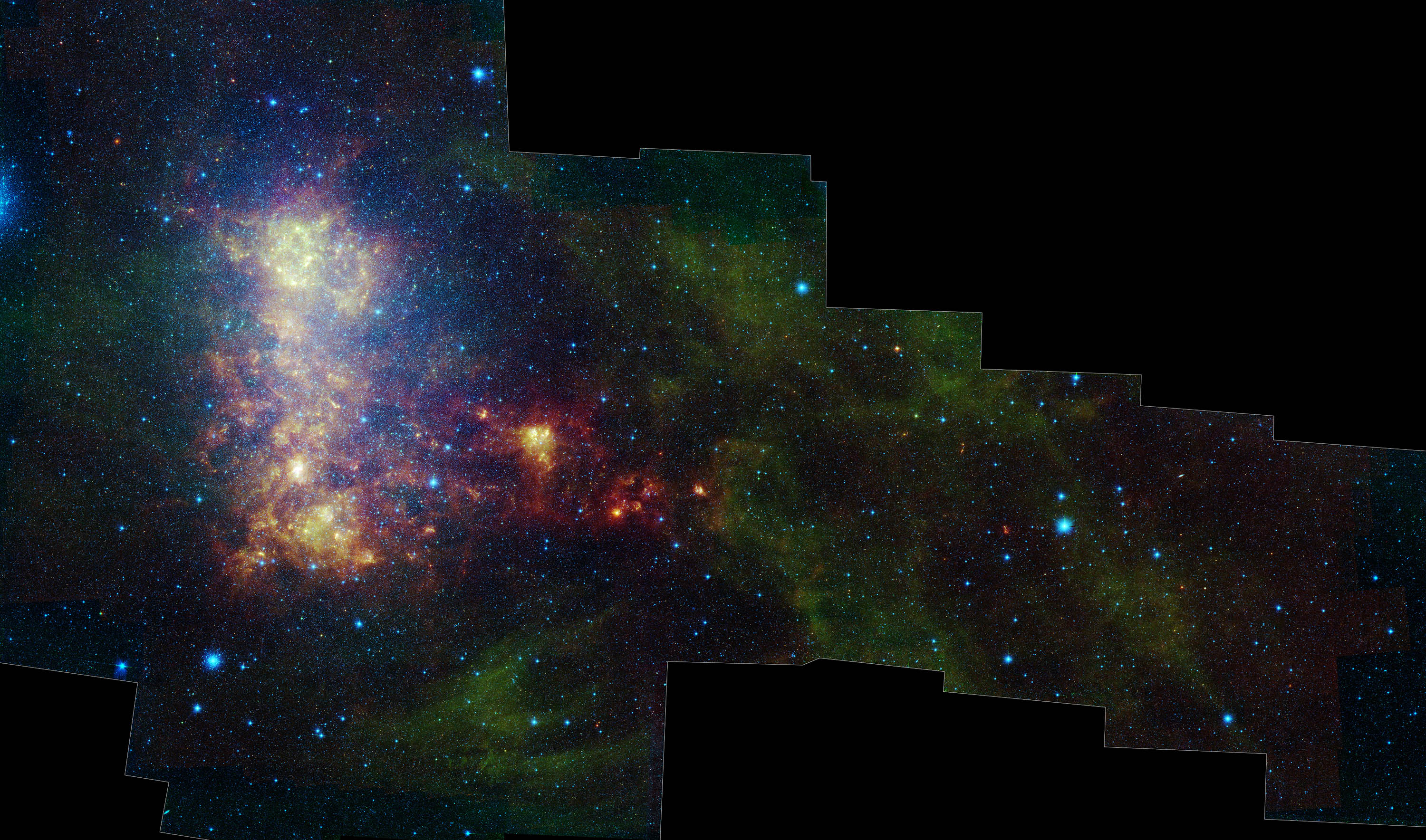
天の川銀河の伴銀河である小マゼラン雲は、16世紀のポルトガル人世界一周航海士フェルディナンド・マゼランにちなんで名付けられた、南天の驚異です。トゥカナ座に位置し、地球から約20万光年離れたこの小さな不規則銀河は、棒状構造と伸びた「翼」に沿って星、ガス、塵が分布しており、光学望遠鏡の画像ではよく知られています。しかし、この銀河には尾も存在します。スピッツァー宇宙望遠鏡によるこの擬似カラー赤外線モザイク画像では、尾はよく知られている棒状構造と翼の右側に伸びています。重力潮汐によって銀河から剥ぎ取られたと思われる尾には、主にガス、塵、そして新しく形成された星が含まれています。尾には、周囲の誕生時の塵雲を温めている新しく形成された星の2つの集団が赤い斑点として見られます。注:APODの編集者が、2009年に撮影された天体写真をレビューします。このレビューは、ニューヨークアマチュア天文協会主催で、1月8日(金)にニューヨーク市のアメリカ自然史博物館で開催されます。
原文(English)
A satellite galaxy of our Milky Way, the Small Magellanic Cloud is wonder of the southern sky, named for 16th century Portuguese circumnavigator Ferdinand Magellan. Some 200,000 light-years distant in the constellation Tucana, the small irregular galaxy's stars, gas, and dust that lie along a bar and extended "wing", are familiar in images from optical telescopes. But the galaxy also has a tail. Explored in this false-color, infrared mosaic from the Spitzer Space Telescope, the tail extends to the right of the more familiar bar and wing. Likely stripped from the galaxy by gravitational tides, the tail contains mostly gas, dust, and newly formed stars. Two clusters of newly formed stars, warming their surrounding natal dust clouds, are seen in the tail as red spots. Note: An APOD editor will review astronomy images of 2009, hosted by the Amateur Astronomers Association of New York on Friday, January 8 at the American Museum of Natural History, NYC.
\ この感動を宇宙仲間にシェア /
宇宙をXでシェア
© NASA / APOD