消えゆく星の謎
The Mystery of the Fading Star
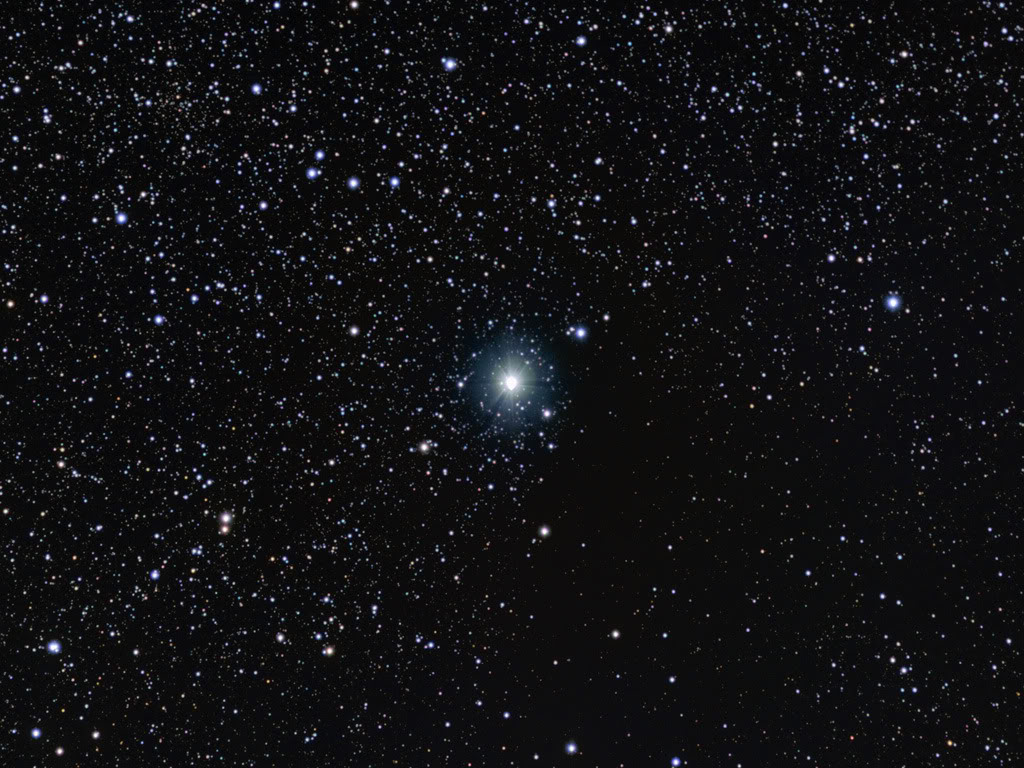
27年ごとに、イプシロン・アウリガエは暗くなり、約2年間暗いままで、その後再び明るくなります。19世紀以来、天文学者たちはこの謎の星を研究し、最終的に、この望遠鏡で見た空の中心にあるイプシロン・アウリガエは、実際には暗い伴星による長い食を受けていると主張しました。しかし、伴星の性質や、明るい星自体の状態さえも、観測によって特定することはできませんでした。証拠を集め続けているシチズン・スカイ(プロとアマチュアの天文学者からなるチーム)は、イプシロン・アウリガエの現在の食を研究しており、2009年8月に始まり、12月下旬には最も深い食に達したと報告しています。イプシロン・アウルは2010年中は暗いままで、2011年には急速に通常の明るさを取り戻すと予想されています。一方、スピッツァー宇宙望遠鏡による最近の赤外線データは、イプシロン・アウルを、寿命の終わりに近い、質量は小さいが大きな恒星で、塵の円盤に埋め込まれた単一の星によって周期的に食されているという、謎めいた連星系のモデルを支持しています。円盤の半径は約4天文単位(地球と太陽の距離の4倍)、厚さは約0.5天文単位と推定されています。注:APOD編集者が、今夜ニューヨーク市のアメリカ自然史博物館で開催されるニューヨークアマチュア天文協会主催のイベントで、2009年の天体画像をレビューします。
原文(English)
very 27 years Epsilon Aurigae fades, remaining dim for roughly two years before growing bright again. Since the 19th century, astronomers have studied the mystery star, eventually arguing that Epsilon Aur, centered in this telescopic skyview, was actually undergoing a long eclipse by a dark companion object. But the nature of the companion and even the state of bright star itself could not be pinned down by observations. Continuing to collect evidence, Citizen Sky, a team of professional and amateur astronomers, is studying the current eclipse of Epsilon Aur, reporting that it began in August 2009 and by late December had reached its deepest point. Epsilon Aur is now expected to remain dim for all of 2010, before rapidly regaining normal brightness in 2011. Meanwhile, recent infrared data from the Spitzer Space Telescope supports a model for the enigmatic system that identifies Epsilon Aur as a large but lower mass star near the end of its life, periodically eclipsed by a single star embedded in a dusty disk. The disk is estimated to have a radius of about 4 AU, or 4 times the Earth-Sun distance, and to be about 0.5 AU thick. Note: An APOD editor will review astronomy images of 2009, hosted by the Amateur Astronomers Association of New York tonight at the American Museum of Natural History, NYC.
\ この感動を宇宙仲間にシェア /
宇宙をXでシェア
© Alson Wong / APOD