アンドロメダ島宇宙
Andromeda Island Universe
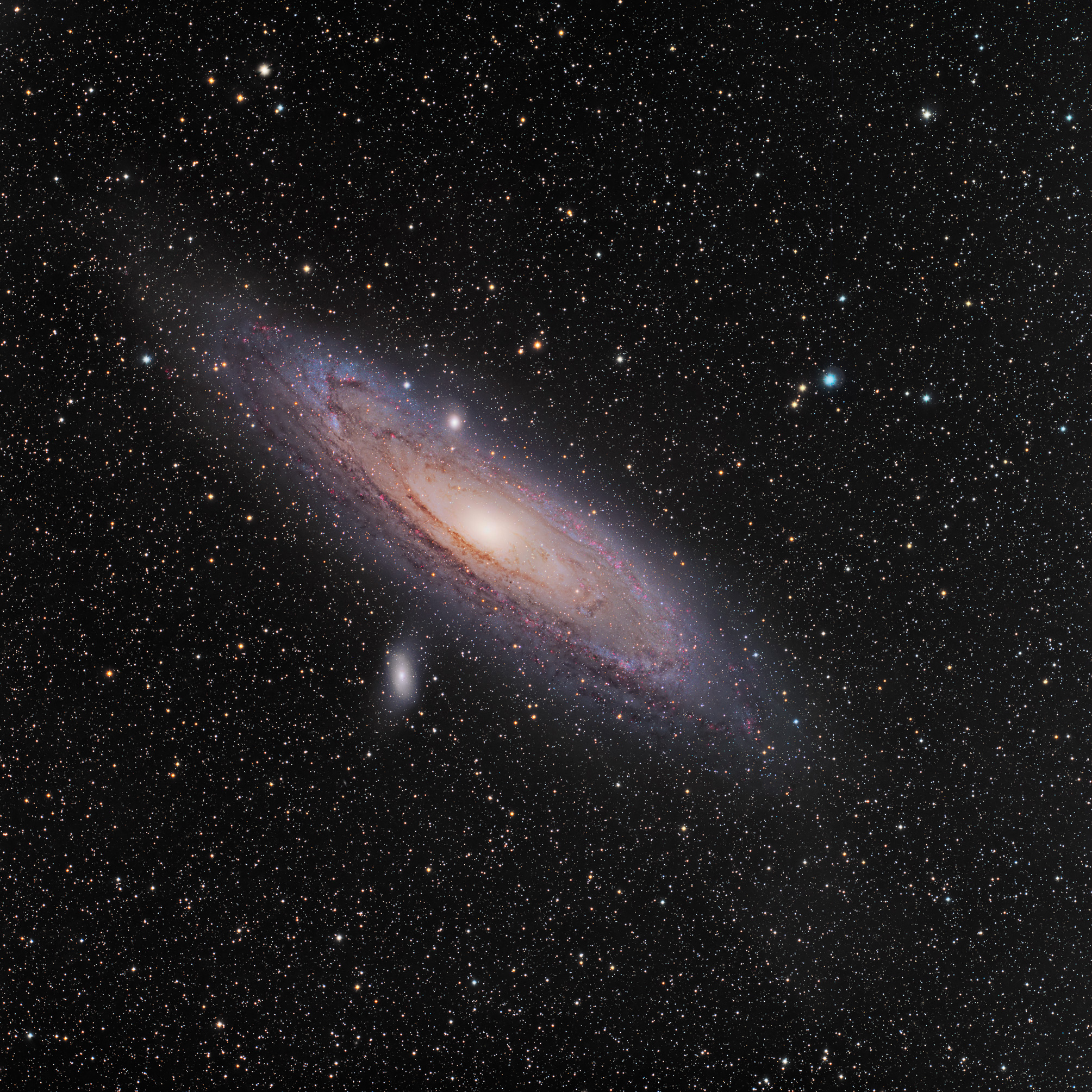
肉眼で容易に見える最も遠い天体は、約250万光年離れた巨大なアンドロメダ銀河M31です。しかし、望遠鏡がなければ、20万光年以上にも及ぶこの巨大な渦巻銀河でさえ、アンドロメダ座のぼんやりとした星雲のように見えます。対照的に、このデジタル望遠鏡画像では、明るい黄色の核と暗く曲がりくねった塵の帯の詳細が明らかになります。水素原子からの放射を記録した狭帯域画像データは、美しい青い渦状腕と若い星団に点在する赤みがかった星形成領域を示しています。今では、M31のような遠方の銀河がたくさんあるという知識に、趣味で空を眺める人でも刺激を受けていますが、20世紀には天文学者たちはこの基本的な概念について真剣に議論していました。これらの「渦巻星雲」は、単に私たちの天の川銀河の外縁部にある構成要素なのか、それとも天の川銀河自体に匹敵する遠方の星系である「島宇宙」なのか?この疑問は、1920年の有名なシャプレー=カーティス論争の中心であり、後にM31の観測によってアンドロメダ銀河が島宇宙であるという説が支持され、決着がついた。注:APOD編集者が1月14日(木)にミシガン州ホートンで素晴らしい宇宙画像をレビューします。
原文(English)
The most distant object easily visible to the eye is M31, the great Andromeda Galaxy some two and a half million light-years away. But without a telescope, even this immense spiral galaxy - spanning over 200,000 light years - appears as a faint, nebulous cloud in the constellation Andromeda. In contrast, details of a bright yellow nucleus and dark winding dust lanes, are revealed in this digital telescopic image. Narrow band image data recording emission from hydrogen atoms, shows off the reddish star-forming regions dotting gorgeous blue spiral arms and young star clusters. While even casual skygazers are now inspired by the knowledge that there are many distant galaxies like M31, astronomers seriously debated this fundamental concept in the 20th century. Were these "spiral nebulae" simply outlying components of our own Milky Way Galaxy or were they instead "island universes" -- distant systems of stars comparable to the Milky Way itself? This question was central to the famous Shapley-Curtis debate of 1920, which was later resolved by observations of M31 in favor of Andromeda, island universe. Note: An APOD editor will review great space images on Thursday, January 14, in Houghton, Michigan.
\ この感動を宇宙仲間にシェア /
宇宙をXでシェア
© Martin Pugh / APOD