光は回転するだけでなく、ねじれることもある
Light Can Twist as Well as Spin
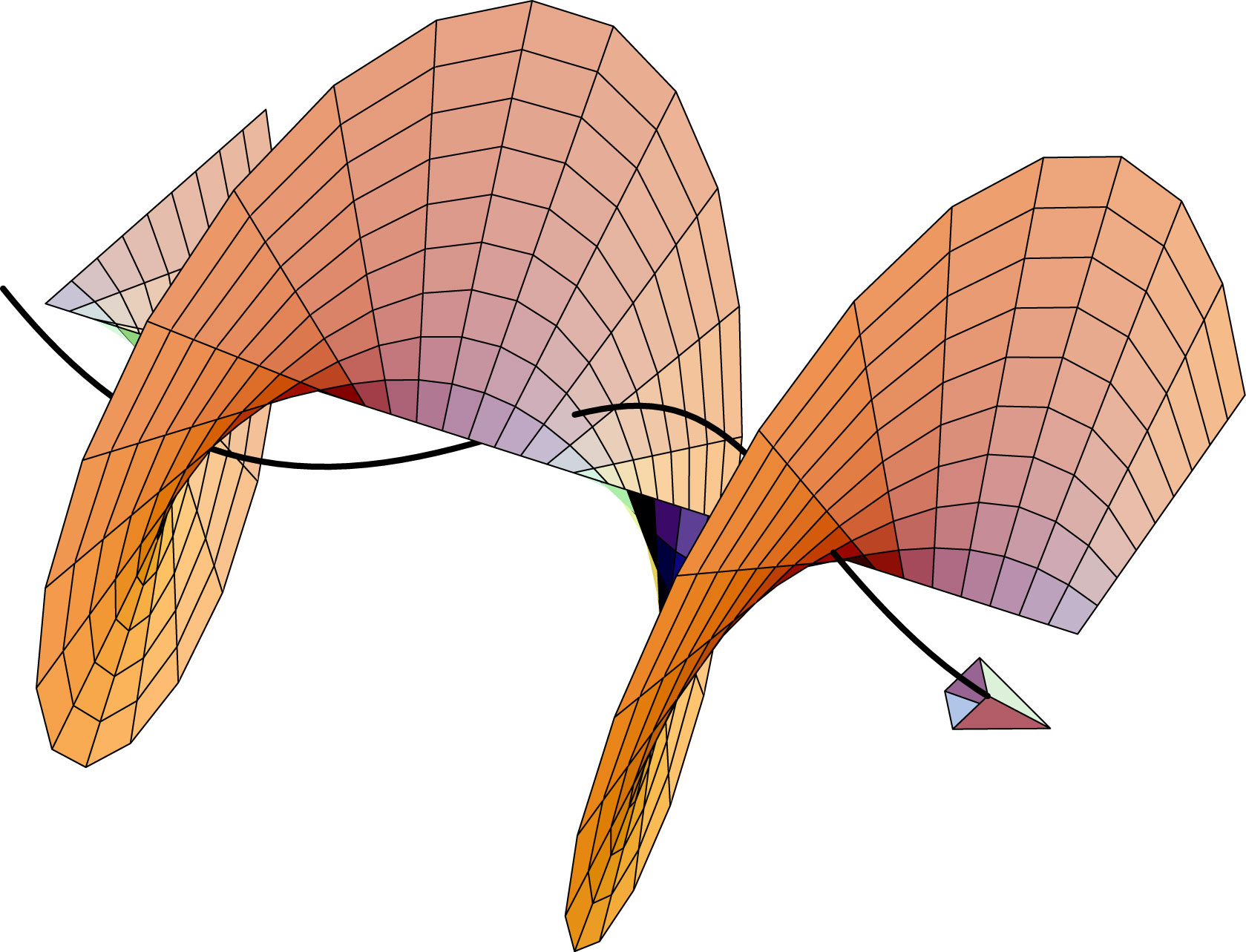
光は私たちが考えていたよりも複雑です。天文学者が光を測定する際、通常は方向、エネルギー、そして(場合によっては)スピン偏光に関心を寄せます。しかし近年、光子には軌道角運動量(OAM)も存在することが広く認識されるようになりました。これは、地球が太陽の周りを公転し、自転しているのと古典的に類似した特性です。上の図は、OAMを持つ光子の波面がねじれている様子を示しています。これは、OAMを持たない光の平面とは対照的です。OAMを持つ光は、通信の情報量を増やしたり、特定の種類の天体源を識別したりするために利用できる可能性があります。一般的なレンズを通過すると、OAMを持たない光は一点に集束しますが、OAMを持つ光はリング状に集束します。しかし、宇宙を飛び交うほとんどの光はOAMが非常に小さい(あるいはゼロである)ため、生成されるリングは小さすぎて測定できません。他の有望な測定方法があったとしても、天文学的発見のためにOAMを利用することは、理論的な可能性だけでなく、観測の実用性の問題でもあるかもしれません。 APOD最新情報:APODのミラーサイトがポーランドからオンラインになり、アーカイブはポーランド語で提供されています。
原文(English)
Light is more complicated than we thought. When astronomers measure light, they are usually concerned with its direction, energy, and spin polarization (sometimes). Recently, however, it has been more broadly realized that photons can also have orbital angular momentum (OAM), an attribute classically analogous to the Earth orbiting the Sun as well as spinning on its axis. Pictured above, the wave-front of a photon with OAM is shown to be twisted, in contrast to the flat plane of zero OAM light. Light with OAM might be used to increase the information content of communication or to discern specific types of astronomical sources. Passing through a common lens, light without OAM focuses to a point, whereas light with OAM focuses to a ring. Most light bouncing around the cosmos, however, is expected to have so little (or zero) OAM that the created ring is too small to measure. Even given other promising methods for measurement, exploiting OAM for astronomical discovery might be as much an issue of observational practicality as theoretical possibility. APOD Update: APOD mirror now on-line from Poland with archive in Polish.
\ この感動を宇宙仲間にシェア /
宇宙をXでシェア
© M. J. Padgett, J. Leach
(U. Glasgow) et al.,
Royal Society / APOD