まばらな流星群から見る、遅咲きのしし座流星群
A Late Leonid from a Sparse Shower
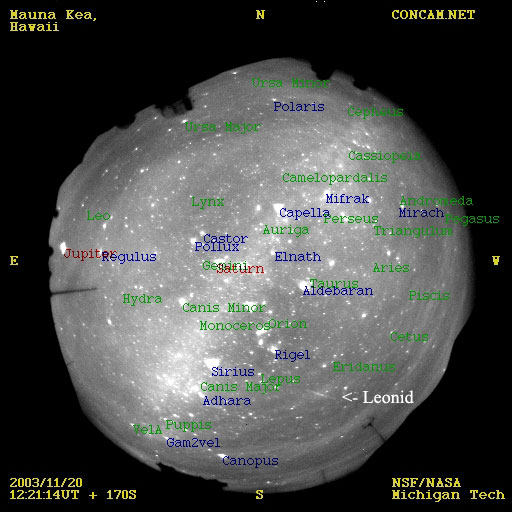
2003年のしし座流星群は、比較的流星の数が少なかった。予想通り、そしてここ数年とは異なり、地球は太陽を周回するテンペル・タットル彗星が残した高密度の粒子流星群を通過しなかった。予備報告では、好条件の場所と好条件の時間帯でも、ピーク時の流星数は1分間に1個程度の比較的暗い流星にとどまった。上の写真は、2003年のしし座流星群の中でも明るい流星の1つで、世界的な「Night Sky Live」プロジェクトの常時稼働する夜空ウェブカメラ(CONCAM)の1つで撮影された。魚眼レンズで撮影されたこの画像は、アメリカ合衆国ハワイ州マウナケアの地平線から地平線までの夜空を捉えている。画像には、いくつかの明るい星と惑星が注釈として付けられている。この流星は、他のしし座流星群と同様に、左上にラベル付けされたしし座から飛来しているように見える。今年のしし座流星群のピークは11月19日だったが、この流星は翌晩に空を駆け抜けた。
原文(English)
The 2003 Leonids Meteor Shower contained relatively few meteors. As expected and unlike the last few years, the Earth just did not pass through any dense particle streams left over by the Sun-orbiting Comet Tempel-Tuttle. Preliminary reports had the peak meteor rates only as high as about one relatively faint meteor a minute even from good locations at good times. Pictured above is one of the brighter Leonids of 2003, caught by one of the continuously operating night sky web cameras (CONCAMs) of the global Night Sky Live project. The fisheye image shows the night sky from horizon to horizon above Mauna Kea, Hawaii, USA. The image is annotated with several bright stars and planets. Note that this meteor, as do all Leonids, appears to emanate from the constellation Leo, labeled on the upper left. Although the peak of the Leonids this year was on November 19, this meteor flashed through the sky the next night.
\ この感動を宇宙仲間にシェア /
宇宙をXでシェア
© NASA / APOD