初期宇宙における銀河団
Galaxy Cluster in the Early Universe
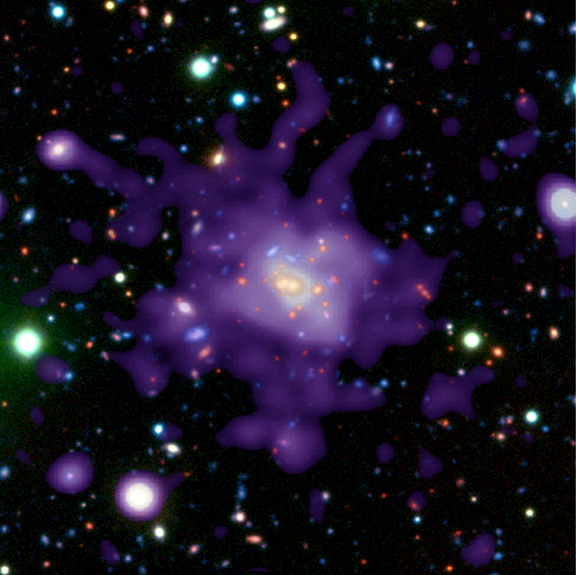
中世の錬金術師が卑金属を金に変える夢を見るずっと前から、RDCS 1252.9-2927 としてカタログ化されているこの巨大な銀河団の恒星炉は、軽い元素を重い元素に変えていました。擬似カラー合成画像では、個々の銀河団銀河が可視光と近赤外線波長で赤、黄、緑の色で表示されています。X 線データ (紫色) は、重い元素が豊富な高温の銀河団内ガスを示しています。軌道上のチャンドラ X 線望遠鏡と XMM-ニュートン X 線望遠鏡、ハッブル宇宙望遠鏡、地上の VLT を使用する天文学者の注目を集めているこの銀河団は、約 90 億光年離れたところにあり、宇宙が 50 億歳未満だった時代に存在していました。測定された質量は太陽の 200 兆倍以上で、この銀河団は宇宙がまだ若かった頃に発見された最も質量の大きい天体です。星団の元素存在量は、ほとんどの重元素が初期の宇宙で大質量星によって合成されたという考えと一致するが、現在の理論では、そのような大質量星団は初期宇宙では稀であるはずだと示唆されている。
原文(English)
Long before medieval alchemists dreamed of transmuting base metals to gold, stellar furnaces in this massive cluster of galaxies - cataloged as RDCS 1252.9-2927 - had transformed light elements into heavy ones. In the false-color composite image individual cluster galaxies can be seen at optical and near-infrared wavelengths, shown in red, yellow, and green colors. X-ray data (in purple) reveal the hot intracluster gas, enriched in heavy elements. Attracting the attention of astronomers using the orbiting Chandra and XMM-Newton x-ray telescopes, as well as the Hubble Space Telescope and ground based VLT, the galaxy cluster lies nearly 9 billion light-years away ... and so existed at a time when the Universe was less than 5 billion years old. A measured mass of more than 200 trillion Suns makes this galaxy cluster the most massive object ever found when the Universe was so young. The cluster elemental abundances are consistent with the idea that most heavy elements were synthesized early on by massive stars, but current theories suggest that such a massive cluster should be rare in the early Universe.
\ この感動を宇宙仲間にシェア /
宇宙をXでシェア
© NASA / APOD