珍しい金星の金環日食
A Rare Annular Venusian Solar Eclipse
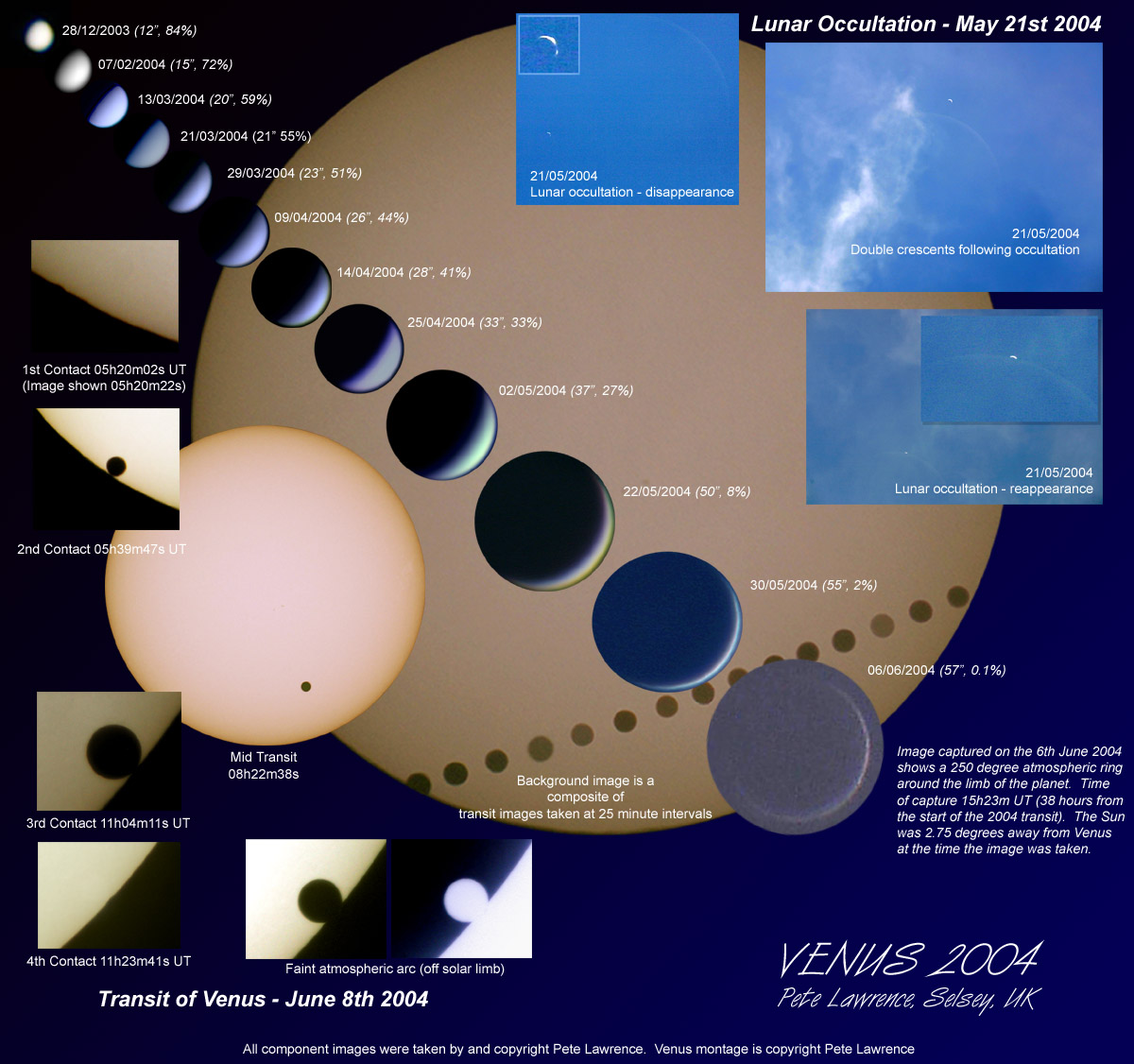
先週、珍しいタイプの皆既日食が発生しました。通常、太陽を覆い隠すのは地球の月ですが、先週は100年以上ぶりに金星が日食を起こしました。月食のように、金星が太陽と一直線に並ぶにつれて、金星の位相は次第に細くなり、三日月形になっていきました。最終的に太陽と完全に一直線に並び、金星の位相はゼロになりました。金星の暗い部分が太陽を横切ったのです。この現象は、非常に大きな火の輪を伴う金星の金環日食と表現できるでしょう。金星の厚い雲頂の上空から見ると、地球は満月のように輝いており、昨年8月に地球から見た火星よりも明るく見えました。数時間後、金星が軌道を周回し続けると、再びわずかな三日月形が現れました。次の金星の皆既日食は2012年に起こる予定です。
原文(English)
An unusual type of solar eclipse occurred last week. Usually it is the Earth's Moon that eclipses the Sun. Last week, for the first time in over 100 years, the planet Venus took a turn. Like a solar eclipse by the Moon, the phase of Venus became a continually thinner crescent as Venus became increasingly better aligned with the Sun. Eventually the alignment became perfect and the phase of Venus dropped to zero. The dark spot of Venus crossed our parent star. The situation could technically be labeled a Venusian annular eclipse with an extraordinarily large ring of fire. From above the thick cloud tops of Venus, the Earth appeared in its fullest phase, brighter in the Venusian sky than even Mars appeared from Earth last August. Hours later, as Venus continued in its orbit, a slight crescent phase appeared again. The next Venusian solar eclipse will occur in 2012.
\ この感動を宇宙仲間にシェア /
宇宙をXでシェア
© :
Peter Lawrence / APOD