ケプラー宇宙望遠鏡が捉えた超新星残骸のX線画像
Kepler's Supernova Remnant in X-Rays
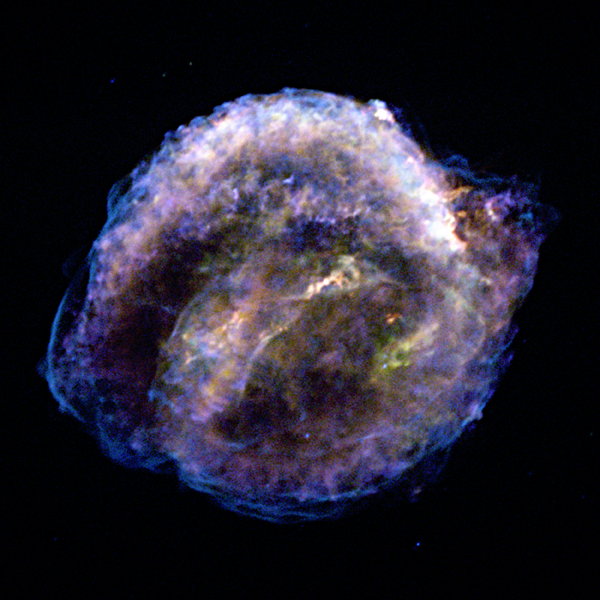
この混乱の原因は何だったのでしょうか?何らかの星が爆発して、ケプラーの超新星残骸として知られる異常な形状の星雲ができたのですが、一体どの種類の星だったのでしょうか?このエネルギーに満ちた宇宙の雲を作り出した恒星爆発からの光が、地球上で初めて観測されたのは、わずか400年前の1604年10月のことでした。この超新星は、17世紀初頭の空にへびつかい座の中に明るい新星を生み出しました。天文学者ヨハネス・ケプラーとその同時代人は、望遠鏡の恩恵を受けることなく、この天体の出現の説明を求めて研究しました。恒星進化に関する現代的な理解を武器に、21世紀初頭の天文学者たちは、拡大し続ける残骸の雲の探査を続けており、現在では軌道上の宇宙望遠鏡を使用して、スペクトル全体にわたってケプラーの超新星残骸(SNR)を調査することができます。軌道上のチャンドラX線観測衛星が撮影したケプラー超新星残骸の最新のX線データと画像は、Ia型超新星に典型的な相対元素存在量を示しており、その前駆星は白色矮星であり、物質を過剰に集積してチャンドラセカール限界を超えたために爆発したことを示唆している。約1万3000光年離れたケプラー超新星は、天の川銀河内で観測された最も新しい恒星爆発である。
原文(English)
What caused this mess? Some type of star exploded to create the unusually shaped nebula known as Kepler's supernova remnant, but which type? Light from the stellar explosion that created this energized cosmic cloud was first seen on planet Earth in October 1604, a mere four hundred years ago. The supernova produced a bright new star in early 17th century skies within the constellation Ophiuchus. It was studied by astronomer Johannes Kepler and his contemporaries, with out the benefit of a telescope, as they searched for an explanation of the heavenly apparition. Armed with a modern understanding of stellar evolution, early 21st century astronomers continue to explore the expanding debris cloud, but can now use orbiting space telescopes to survey Kepler's supernova remnant (SNR) across the spectrum. Recent X-ray data and images of Kepler's supernova remnant taken by the orbiting Chandra X-ray Observatory has shown relative elemental abundances more typical of a Type Ia supernova, indicating that the progenitor was a white dwarf star that exploded when it accreted too much material and went over Chandrasekhar's limit. About 13,000 light years away, Kepler's supernova represents the most recent stellar explosion seen to occur within our Milky Way galaxy.
\ この感動を宇宙仲間にシェア /
宇宙をXでシェア
© NASA / APOD