おおぐま座のM81
M81 in Ursa Major
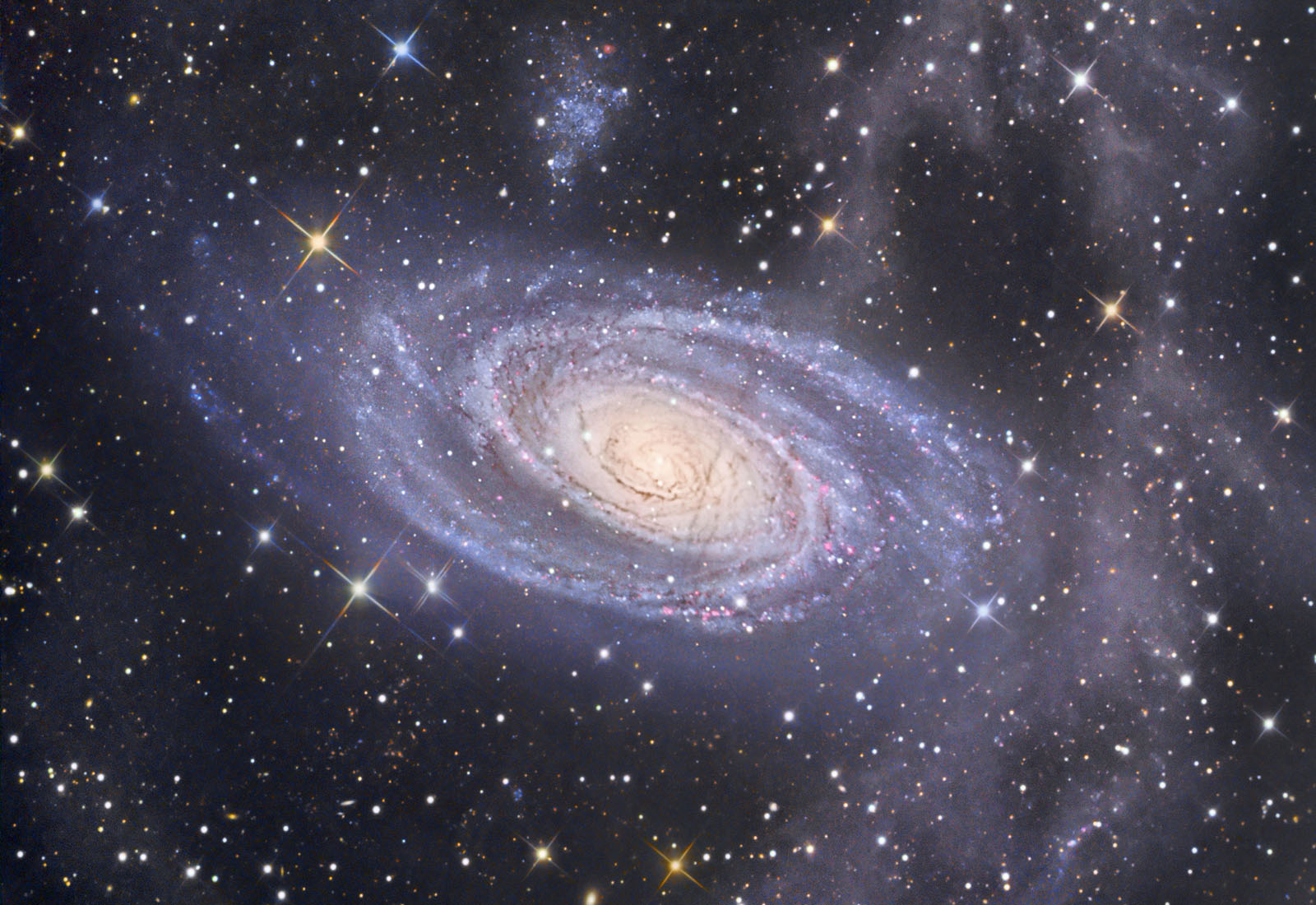
地球の空で最も明るい銀河の1つで、天の川銀河とほぼ同じ大きさの、大きくて美しい渦巻銀河M81は、北の星座であるおおぐま座の方向に1180万光年離れたところにあります。この領域の驚くほど深い画像は、明るい黄色の中心部の詳細を明らかにしていますが、同時に、銀河の美しい青い渦巻き腕と広がるダストレーンに沿ったより淡い特徴も追跡しています。M81の上には、上部近くに大きなピンク色の星形成領域を持つ矮小伴銀河ホルムベルクIXがあります。M81とホルムベルクIXは、私たちの天の川銀河の手前の星を通して見ていますが、ここでは、はるかに淡いダスト雲の複合体を通して見ています。比較的未調査のこの雲は、おそらく数百光年しか離れておらず、私たちの銀河面のはるか上空にあります。画像全体に、特に右側に散在する塵の雲は、天の川の星々の光を反射しており、統合フラックス星雲と呼ばれている。
原文(English)
One of the brightest galaxies in planet Earth's sky and similar in size to the Milky Way, big, beautiful spiral M81 lies 11.8 million light-years away in the northern constellation Ursa Major. This remarkably deep image of the region reveals details in the bright yellow core, but at the same time follows fainter features along the galaxy's gorgeous blue spiral arms and sweeping dust lanes. Above M81 lies a dwarf companion galaxy, Holmberg IX, sporting a large, pinkish star-forming region near the top. While M81 and Holmberg IX are seen through a foreground of stars in our own Milky Way galaxy, they are also seen here through a much fainter complex of dust clouds. The relatively unexplored clouds are likely only some hundreds of light-years distant and lie high above our galaxy's plane. Scattered through the image, especially at the the right, the dust clouds reflect the combined light of the Milky Way's stars and have been dubbed integrated flux nebulae.
\ この感動を宇宙仲間にシェア /
宇宙をXでシェア
© Tony Hallas / APOD