カリーナ星雲の塵の柱
Dust Pillar of the Carina Nebula
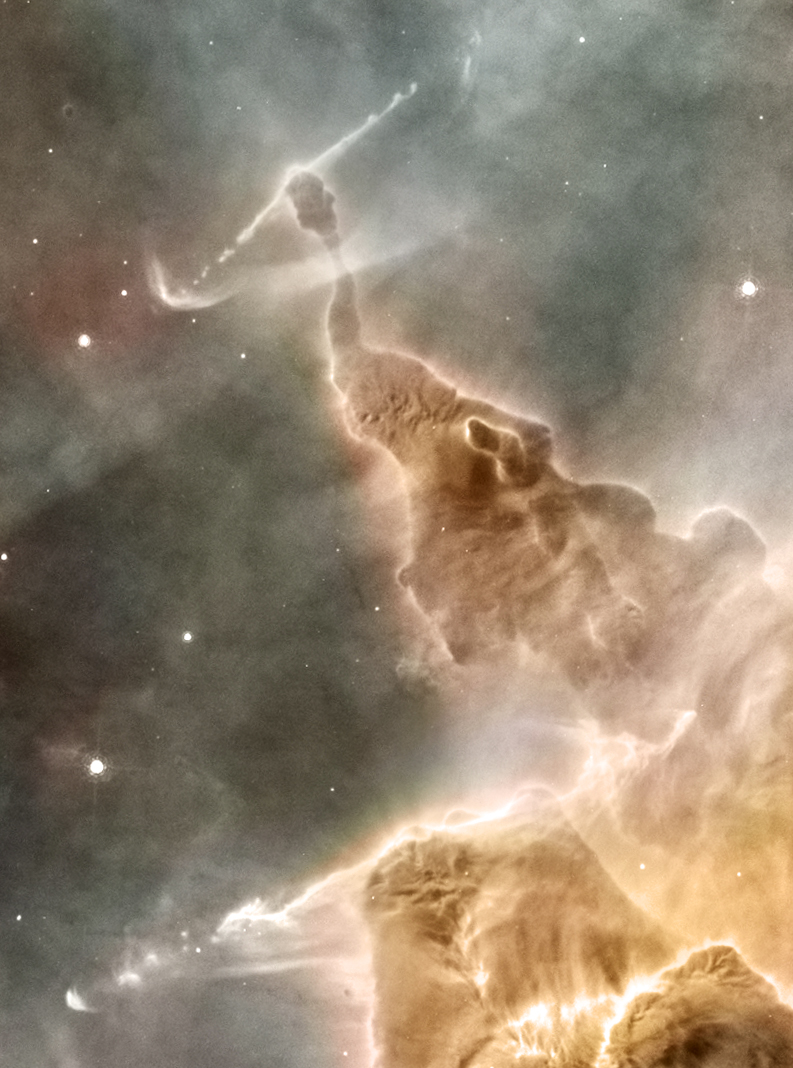
この星間怪物の頭部内部には、ゆっくりと怪物を破壊している星があります。この怪物は実際にはガスと塵の無生物の柱で、長さは1光年を超えます。不透明な塵を通して見えない星は、高エネルギーの粒子ビームを放出することによって部分的に噴出しています。同様の壮大な戦いは、星形成が行われているカリーナ星雲全体で繰り広げられています。最終的には星が勝利し、今後10万年かけて創造の柱を破壊し、新しい散開星団が生まれます。ピンク色の点は、誕生の怪物からすでに解放された新しく形成された星です。上の画像は、ハッブル宇宙望遠鏡が撮影し、先週公開されたカリーナ星雲の非常に詳細なパノラマモザイクのほんの一部です。恒星ジェットの専門用語はハービッグ・ハロー天体です。恒星がどのようにしてハービッグ・ハロー・ジェットを生成するのかは現在も研究が続けられているテーマだが、中心星の周囲を渦巻く降着円盤が関与している可能性が高い。より大きな画像の下部には、もう一つ印象的なハービッグ・ハロー・ジェットが見られる。
原文(English)
Inside the head of this interstellar monster is a star that is slowly destroying it. The monster, actually an inanimate pillar of gas and dust, measures over a light year in length. The star, not itself visible through the opaque dust, is bursting out partly by ejecting energetic beams of particles. Similar epic battles are being waged all over the star-forming Carina Nebula. The stars will win in the end, destroying their pillars of creation over the next 100,000 years, and resulting in a new open cluster of stars. The pink dots are newly formed stars that have already been freed from their birth monster. The above image is only a small part of a highly detailed panoramic mosaic of the Carina Nebula taken by the Hubble Space Telescope and released last week. The technical name for the stellar jets are Herbig-Haro objects. How a star creates Herbig-Haro jets is an ongoing topic of research, but it likely involves an accretion disk swirling around a central star. A second impressive Herbig-Haro jet is visible across the bottom of a larger image.
\ この感動を宇宙仲間にシェア /
宇宙をXでシェア
© NASA / APOD