CTA 1のダークパルサー
A Dark Pulsar in CTA 1
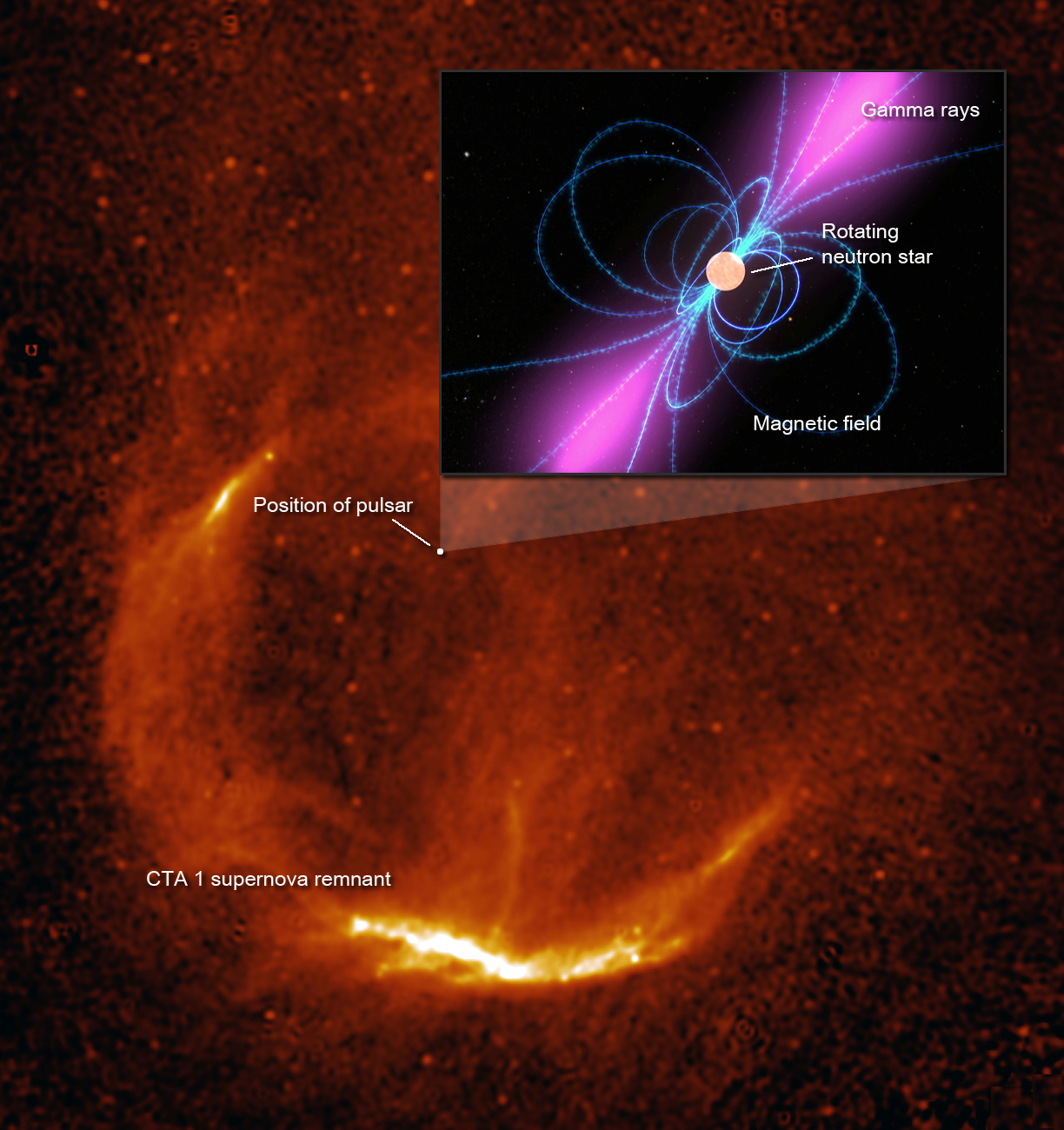
パルサーはどこにあるのか? 以前、星雲CTA 1には膨張する超新星残骸、ジェット、そしてパルサー(電波エネルギーでパルスを放出する回転する中性子星)であると予想される点源が見られました。しかし、電波パルスは検出されませんでした。今回、NASAが最近展開したフェルミ宇宙望遠鏡が、初期観測でこの点源がガンマ線エネルギーでパルスを放出していることを示し、この謎を解明しました。この奇妙な光源は、「ダークパルサー」と呼ばれる可能性のある種類の最初のもので、高エネルギー放射線でのみパルスを放出しているように見える回転する中性子星です。このようなパルサーは、地球から見えない狭いビームに放射線を放出する場合、電波や可視光では検出できない可能性があります。これが事実であれば、私たちの銀河にはフェルミが発見するべきパルサーがまだ残っているかもしれません。パルサーのガンマ線特性を研究することは、中性子星の放射領域の物理学に関する貴重な手がかりとなります。この図では、パルサーの位置が、より広い範囲に広がるCTA 1超新星残骸の中に示されています。挿入図には、パルサーがガンマ線エネルギーを放射している様子を描いた想像図が示されています。
原文(English)
Where's the pulsar? Previously, the nebula CTA 1 showed an expanding supernova remnant, a jet, and a point source expected to be a pulsar -- a rotating neutron star producing pulses at radio energies. But no radio pulses were detected. Now NASA's recently deployed Fermi Space Telescope has solved the mystery with some of its initial observations indicating that the point source is pulsing at gamma-ray energies. The strange source is the first of a class that might be dubbed "dark pulsars", rotating neutron stars that appear to pulse only in high-energy radiations. Such pulsars might not be detectable in radio or visible light if they emit those radiations into a narrow beam not seen from Earth. If true, our Galaxy might have more pulsars left for Fermi to discover. Studying the gamma-ray properties of pulsars gives valuable clues to physics of the emission regions on neutron stars. In this graphic, the pulsar's position is indicated in the wider CTA 1 supernova remnant. An artist's illustration of the pulsar beaming at gamma-ray energies is shown in the inset.
\ この感動を宇宙仲間にシェア /
宇宙をXでシェア
© NASA / APOD