ルリン彗星が接近中
Comet Lulin Approaches
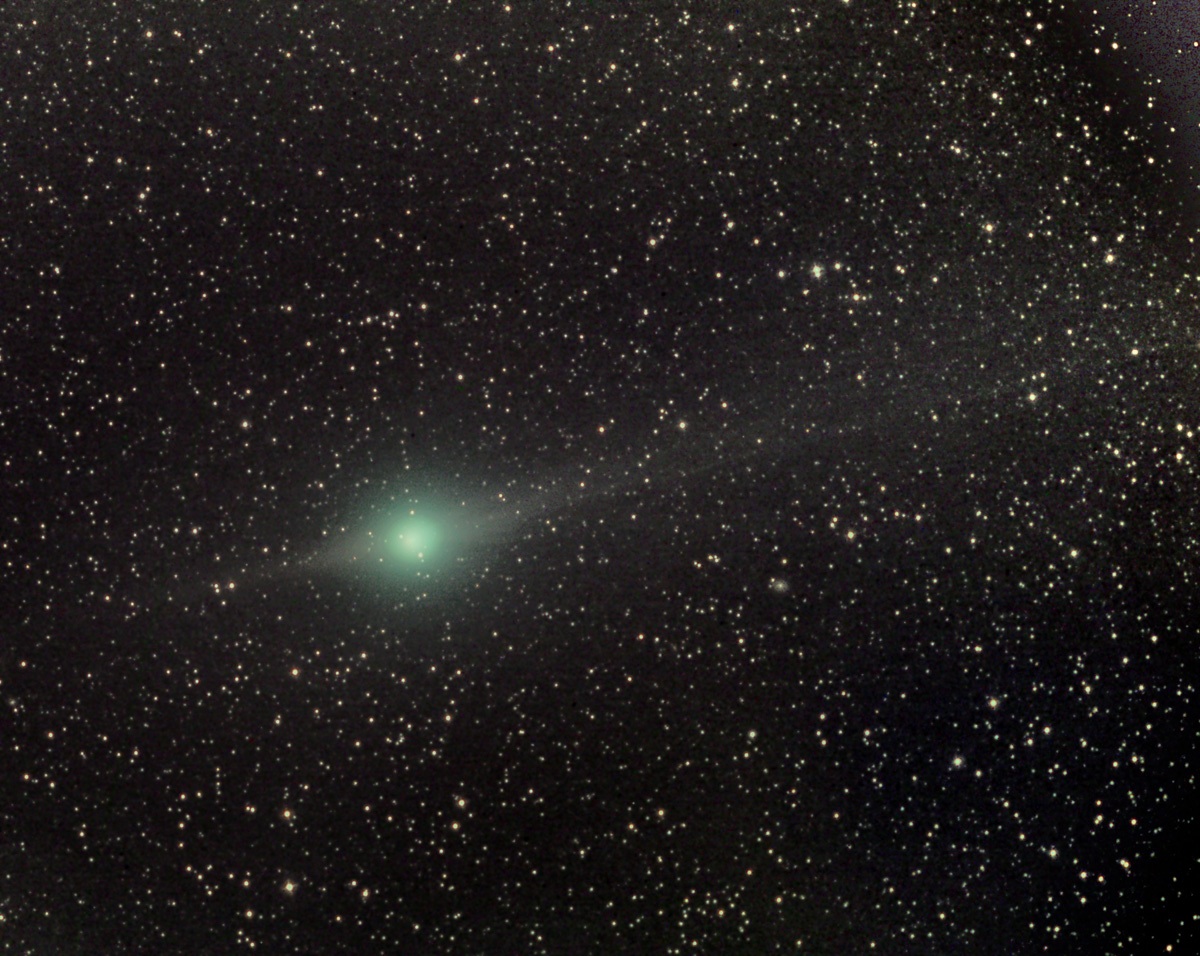
ルリン彗星はどれくらい明るくなるのでしょうか?誰も確かなことは知りません。新しく発見された彗星の明るさを正確に予測することは非常に難しいことで知られていますが、ルリン彗星は今月末には肉眼で見えるようになるかもしれません。ルリン彗星は2月中旬に北の空に移動し、真夜中頃に昇るので、少なくとも双眼鏡と良い星図があれば彗星観測者によって発見されるはずです。追跡観測によると、正式にC/2007 N3(ルリン)と命名された彗星は、すでに太陽のそばを通過し、2月下旬には地球と太陽の距離の半分以内に入る軌道で地球に接近しています。ルリン彗星の軌道は、これが彗星が太陽系の内側に初めて入ったものである可能性が高いことを示しています。この彗星は、国立中央大学の魯林天文台の林志勝氏が取得した画像から、中山大学の葉全志氏によって発見されました。この写真は先週金曜日にイタリアで撮影されたもので、ルリン彗星のコマと尾が写っている。尾の一つは太陽とは反対方向を向いており、もう一つは反尾と呼ばれる、彗星の軌道に沿って続く塵の塊で、太陽の方を向いているように見える。
原文(English)
How bright will Comet Lulin become? No one knows for sure. Although it is notoriously difficult to accurately predict the brightness of newly discovered comets, Comet Lulin could well become visible to the unaided eye later this month. As Comet Lulin moves into the northern sky in mid February to rise around midnight, it should at least be spotted by comet watchers with binoculars and a good sky chart. Tracking observations indicate that the comet officially designated C/2007 N3 (Lulin) has now swung by the Sun and is approaching Earth on a trajectory that will bring it within half the Earth-Sun distance in late February. Comet Lulin's orbit indicates that this is likely the comet's first trip into the inner Solar System. The comet was discovered by Quanzhi Ye of Sun Yat-sen University on images obtained by Chi-Sheng Lin at the Lu-Lin Observatory of National Central University. In this picture, taken from Italy last Friday, are Comet Lulin's coma and tails, one tail pointing away from the Sun, and an anti-tail -- dust that trails the comet in its orbit and may appear to point toward the Sun.
\ この感動を宇宙仲間にシェア /
宇宙をXでシェア
© Paolo Candy / APOD