彗星とオリオン座
Comet and Orion
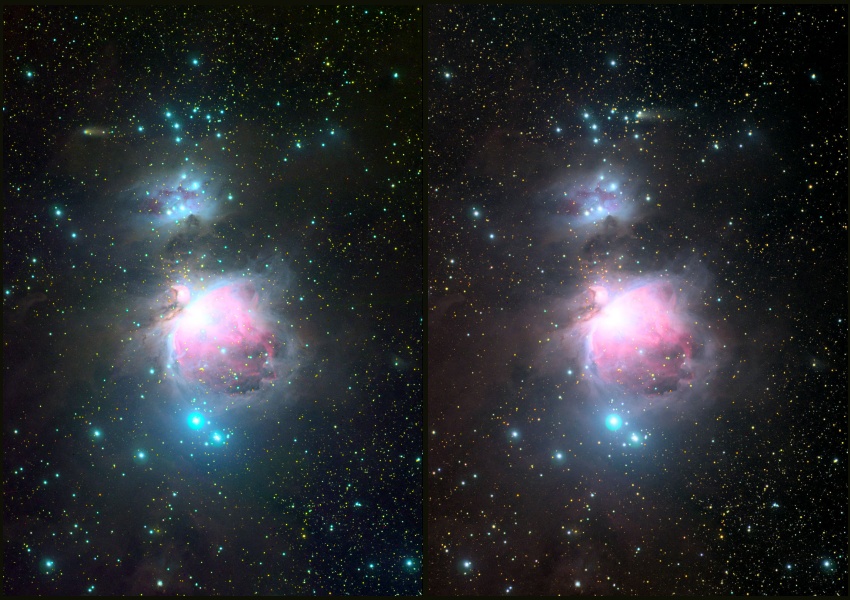
これらの色鮮やかなパネルには、おなじみの天体現象であるオリオン大星雲が写っています。また、星雲が豊富な夜空の興味深い、そしてあまり知られていないディテール、つまり通過する彗星も写っています。ニューメキシコ州で遠隔操作望遠鏡を使って今週末に撮影されたこの画像のうち、右側の画像は9月26日、左側の画像は9月27日に撮影されました。彗星217Pリニアは、長く伸びた緑がかった尾を持ち、両方の画像の上部近くにある青みがかったランニングマン反射星雲の上に位置しています。近くを高速で夜空を移動するこの彗星の位置は、宇宙の星雲や背景の星々に対して、夜ごとに明らかに変化しています。実際、9月27日には彗星はわずか5光分の距離にあり、オリオン大星雲までの距離1,500光年と比べると非常に近い距離でした。彗星217Pリニアは、肉眼では非常に暗く、公転周期が約8年の小型周期彗星です。太陽から最も遠い地点では、彗星の軌道は木星の軌道を超えると計算されています。太陽に最も近い地点でも、彗星は地球の軌道のすぐ外側に位置しています。
原文(English)
These colorful panels both feature a familiar astronomical sight: the stellar nursery known as the Great Orion Nebula. They also offer an intriguing and unfamiliar detail of the nebula rich skyscape -- a passing comet. Recorded this weekend with a remotely operated telescope in New Mexico, the right hand image was taken on September 26 and the left on September 27. Comet 217P Linear sports an extended greenish tail and lies above the bluish Running Man reflection nebula near the top of both frames. Nearby and moving rapidly through the night sky, the comet's position clearly shifts against the cosmic nebulae and background stars from one night to the next. In fact, the comet was a mere 5 light-minutes away on September 27, compared to 1,500 light-years for the Orion Nebula. Much too faint to be seen with the unaided eye, Comet 217P Linear is a small periodic comet with an orbital period of about 8 years. At its most distant point from the Sun, the comet's orbit is calculated to reach beyond the orbit of Jupiter At its closest point to the Sun, the comet still lies just beyond the orbit of planet Earth.
\ この感動を宇宙仲間にシェア /
宇宙をXでシェア
© CARA Project / APOD