JKCS041:これまで観測された中で最も遠い銀河団
JKCS041: The Farthest Galaxy Cluster Yet Measured
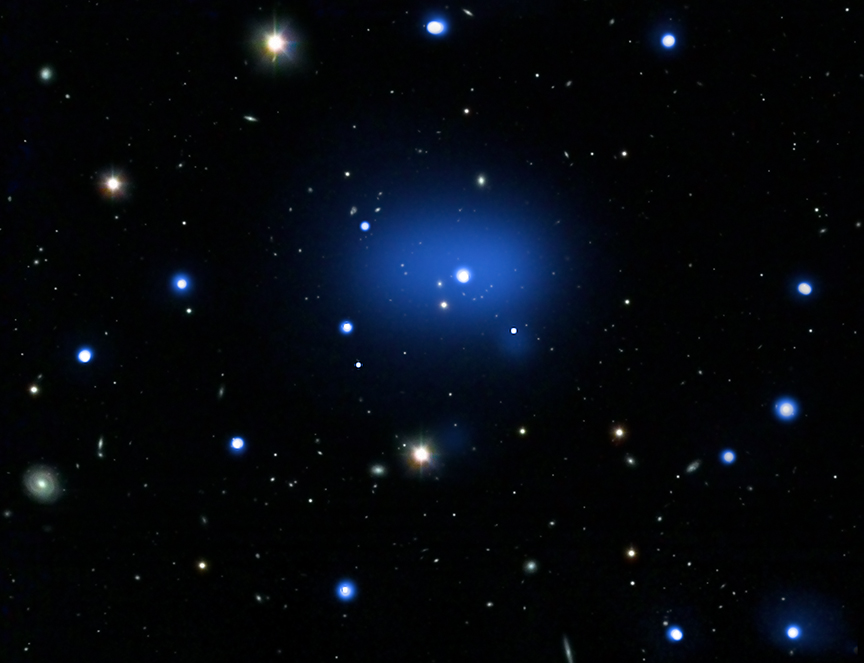
宇宙の始まりまで遡って見ることができたらどうでしょう?光が宇宙を横断するのに宇宙の年齢がかかるため、それは可能です。したがって、遠方の天体を観測することで、宇宙がかつてどのような状態であったか、その始まりに近い頃でさえも知ることができます。望遠鏡は時間ポータルでもあるため、遠方の銀河団の観測は、例えば、これらの巨大な銀河の集合体がいつ、どのように形成されたかを調べるために使用できます。これまで、銀河団の赤方偏移の記録は約1.5で、これは約90億光年の距離に相当します。最近、軌道上のチャンドラX線観測衛星からのX線画像を含むデータを使用して、新たな最遠の銀河団が特定されました。上に示したJKCS041は赤方偏移1.9で観測され、これは以前の記録保持者よりも約10億光年遠いことに相当します。見かけ上の銀河の集まりが真の銀河団であることを確認した高温のX線ガスは、多くの前景の星を示す光学画像に重ねて、拡散した青色で上図に示されています。 JKCS041は、現在の宇宙年齢のわずか4分の1の時点での姿で今日観測されている。
原文(English)
What if we could see back to the beginning of the universe? We can -- since it takes the age of the universe for light to cross the universe. Peering at distant objects, therefore, tells us about how the universe used to be, even near its beginning. Since telescopes are therefore also time portals, observations of distant clusters can be used, for example, to investigate when and how these huge galaxy conglomerations formed. Previously, the redshift record for a galaxy cluster was about 1.5, corresponding to about nine billion light years distant. Recently, using data including X-ray images from the orbiting Chandra X-Ray Observatory, a new farthest cluster was identified. Shown above, JKCS041 is seen at redshift 1.9, corresponding to nearly one billion light years farther than the previous record holder. The hot X-ray gas that confirmed the apparent galaxy grouping as a true cluster of galaxies is shown above in diffuse blue, superposed on an optical image showing many foreground stars. JKCS041 is seen today as it appeared at only one quarter of the present age of the universe.
\ この感動を宇宙仲間にシェア /
宇宙をXでシェア
© NASA / APOD