南のふたご座
Southern Geminids
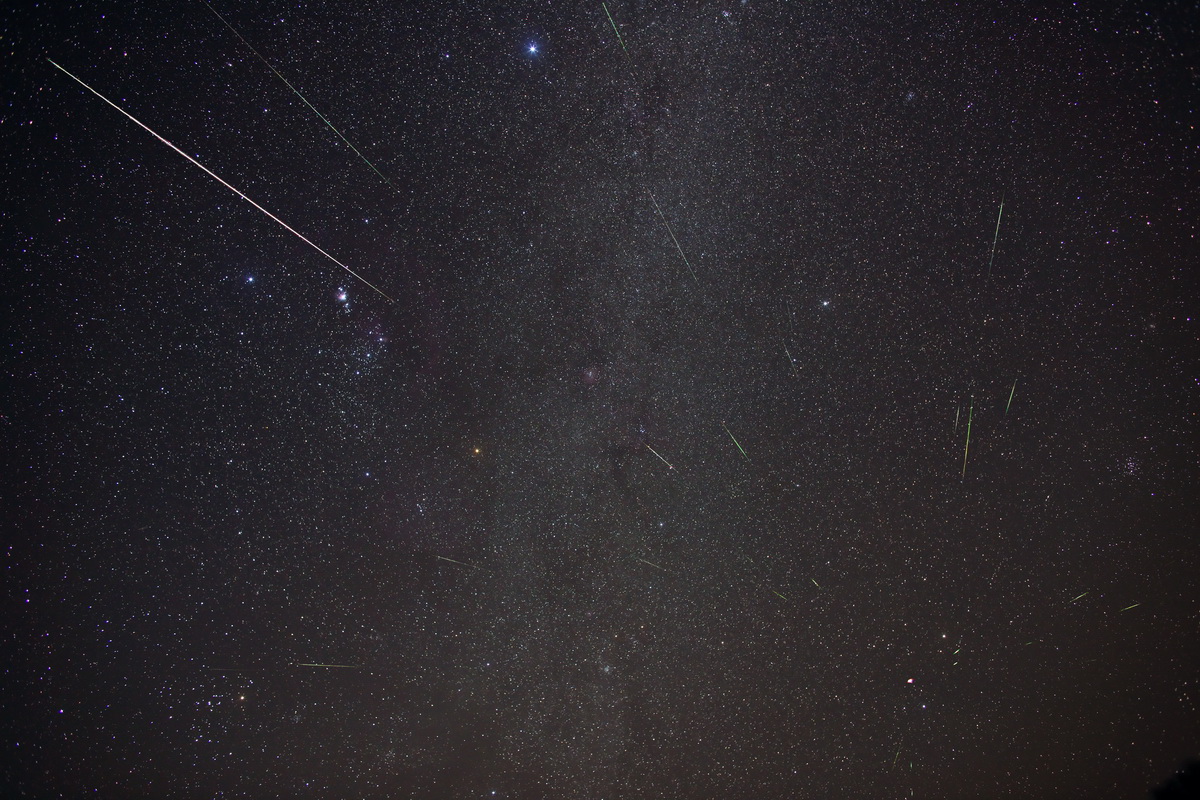
毎年恒例のふたご座流星群でオーストラリアの空に降り注ぐ流星のうち、少なくとも34個がこの合成画像に写っています。消滅した彗星ファエトンの軌道に沿って連なる塵粒子が地球の大気圏を通過する際に蒸発し、この印象的な光景を生み出します。粒子は互いに平行に移動していますが、結果として生じる流星の筋は、右下にあるふたご座の双子星カストルとポルックス付近の空の一点から放射状に広がっているように見えます。この放射効果は遠近法によるもので、平行な軌跡が遠くで収束しているように見えるためです。12月14日の朝に2時間かけて撮影されたこの画像は、個々の流星の筋を記録した短い露光と、背景の星々を示す1枚の長い露光を合成したもので、上部にはシリウス、左側にはオリオン座が写っています。天の川の淡い星や星雲がフレームの中央を横切っています。ふたご座の放射点付近にある余分な星は、実際にはほぼ正面から見た流星の閃光である。
原文(English)
At least 34 meteors are included in this composite image as they rain through Australian skies during the annual Geminid Meteor shower. Dust particles strung out along the orbit of extinct comet Phaethon vaporize when they plow through planet Earth's atmosphere causing the impressive display. Although the particles are traveling parallel to each other, the resulting streaks clearly seem to radiate from a single point on the sky near Gemini's twin stars Castor and Pollux at the lower right. The radiant effect is due to perspective, as the parallel tracks appear to converge at a distance. Taken over a period of 2 hours on the morning of December 14, short exposures recording individual meteor streaks were combined with a single long exposure to show the background stars, with Sirius at the top, and the constellation Orion at left. Faint stars and nebulae of the Milky Way track through the center of the frame. Near the radiant point, an extra star in Gemini is actually the flash of a meteor seen almost head-on.
\ この感動を宇宙仲間にシェア /
宇宙をXでシェア
© Phil Hart / APOD