火星エクスプレスによるフォボス
Phobos from Mars Express
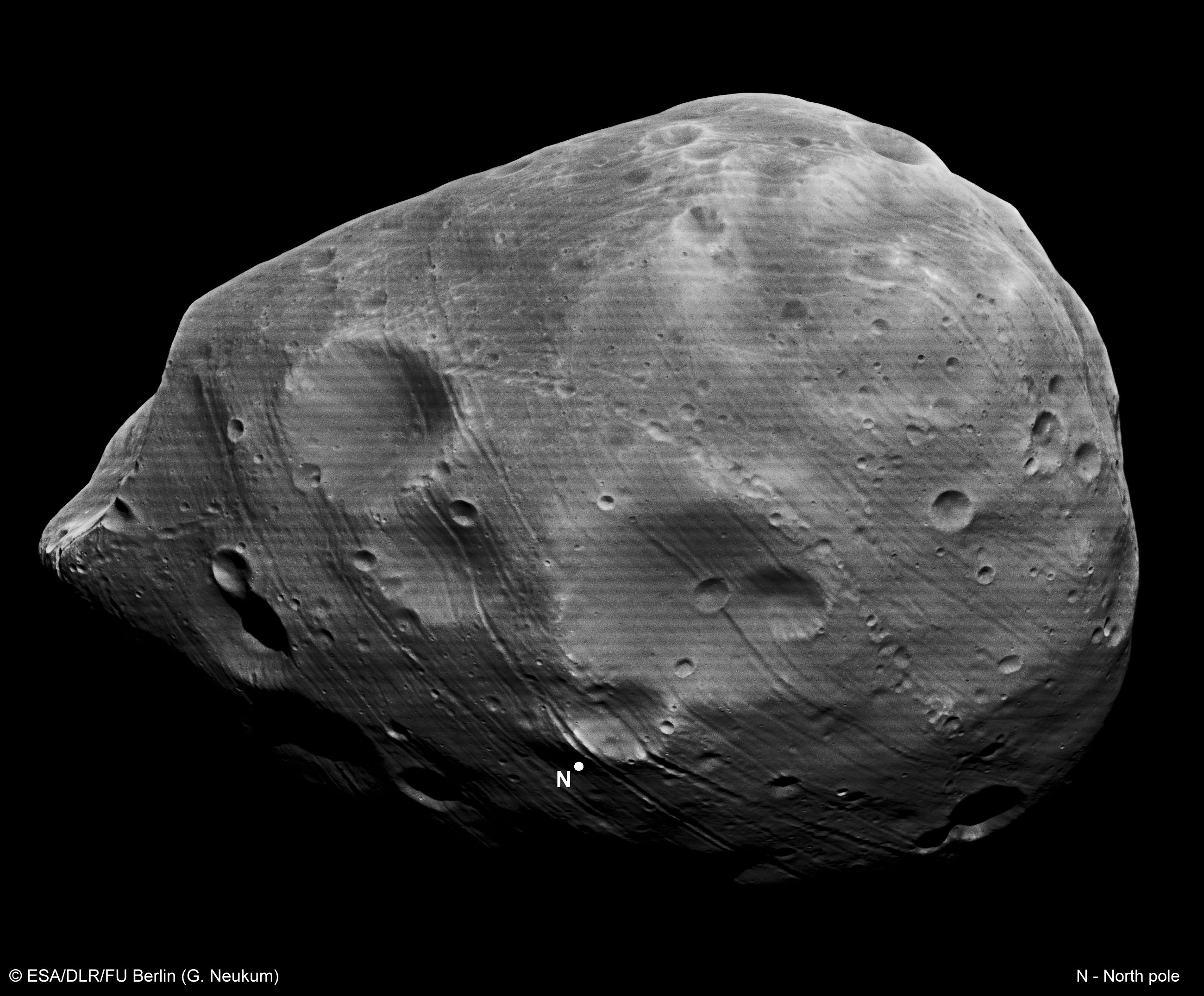
なぜこの小さな天体が火星を周回しているのでしょうか? 火星を周回する2つの衛星のうち大きい方のフォボスの起源は未だ不明です。フォボスとダイモスはC型小惑星に非常によく似ていますが、そのような小惑星を重力で捕らえ、軌道を円形にして火星の赤道面に引きずり込むことは考えにくいようです。上の写真は、2003年に火星の周回を開始したESAの火星探査機マーズ・エクスプレスが先週フォボスをフライバイした際に撮影したものです。フォボスの不規則な形状、奇妙なほど暗い地形、数多くの珍しい溝、そして画像の中心を横切る壮大なクレーターの列が詳細に写っています。フォボスは長さが約25キロメートルしかなく、球状に圧縮するほどの重力はありません。フォボスは火星に非常に近い軌道を周回しているため、今後2000万年以内に潮汐減速によってこの岩石衛星はリング状に分裂し、その破片がゆっくりと螺旋状に火星に落下して衝突すると考えられている。ロシアの探査機「フォボス・グルント」は来年、フォボスへの着陸と打ち上げを予定している。
原文(English)
Why is this small object orbiting Mars? The origin of Phobos, the larger of the two moons orbiting Mars, remains unknown. Phobos and Deimos appear very similar to C-type asteroids, yet gravitationally capturing such asteroids, circularizing their orbits, and dragging them into Mars' equatorial plane seems unlikely. Pictured above is Phobos as it appeared during last week's flyby of ESA's Mars Express, a robotic spacecraft that began orbiting Mars in 2003. Visible in great detail is Phobos' irregular shape, strangely dark terrain, numerous unusual grooves, and a spectacular chain of craters crossing the image center. Phobos spans only about 25 kilometers in length and does not have enough gravity to compress it into a ball. Phobos orbits so close to Mars that sometime in the next 20 million years, tidal deceleration will break up the rubble moon into a ring whose pieces will slowly spiral down and crash onto the red planet. The Russian mission Phobos-Grunt is scheduled to launch and land on Phobos next year.
\ この感動を宇宙仲間にシェア /
宇宙をXでシェア
© NASA / APOD