冷たい塵の中にある近くの天の川
The Nearby Milky Way in Cold Dust
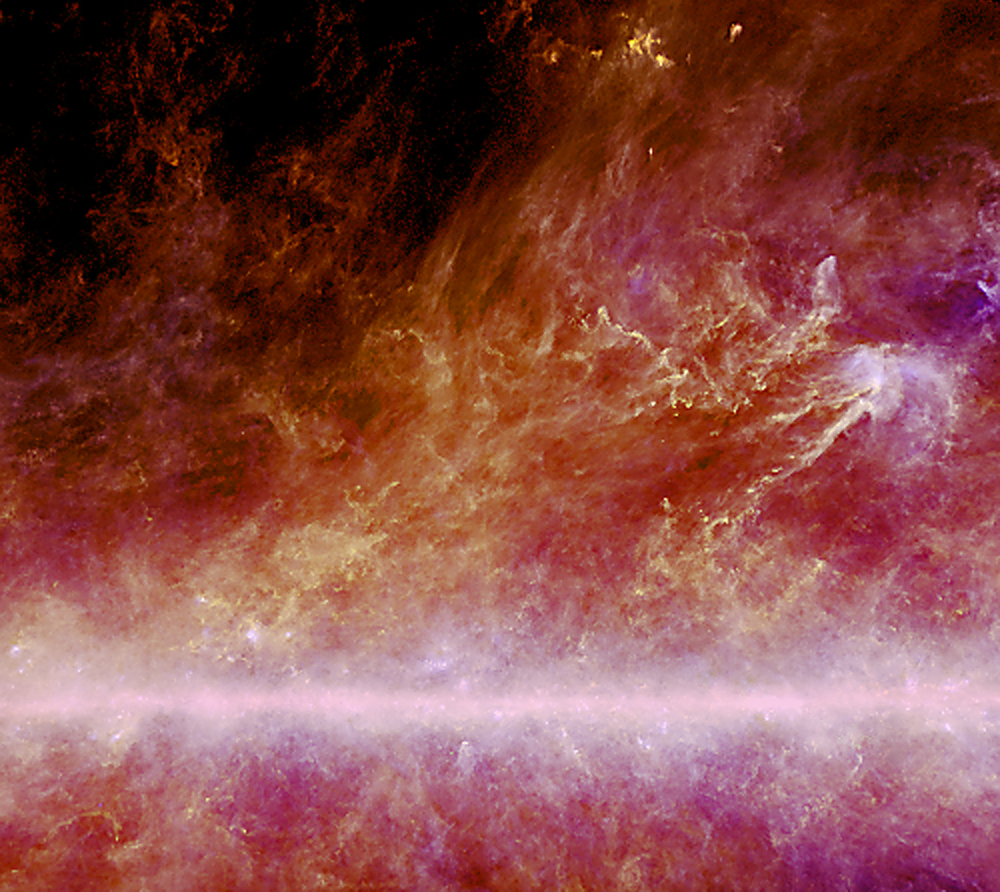
近くの天の川銀河の驚くべき塵のタペストリーを形作っているものは何でしょうか?誰も確かなことは知りません。上に示した複雑な構造は、欧州宇宙機関のプランク衛星が遠赤外線で撮影した広範囲の空域で最近新たに詳細に解明されました。上の画像は、3つの赤外線カラーをデジタル合成したものです。2つはプランクが高解像度で撮影したもので、もう1つは現在運用を終了したIRAS衛星が撮影した古い画像です。これらの色では、空は地球からわずか500光年以内の非常に冷たいガスの微かな輝きで支配されています。上の画像では、赤は絶対零度より10ケルビン高い温度に対応し、白は40ケルビンの暖かいガスに対応します。画像の下部を横切るピンク色の帯は、銀河面内に閉じ込められた暖かいガスです。明るい領域は通常、ゆっくりと収縮して星を形成している高密度の分子雲があり、暗い領域は通常、巻雲として知られる拡散した星間ガスと塵です。これらの領域が、大小さまざまなスケールで共通する複雑なフィラメント状の形状を持つ理由は、依然として研究対象となっている。塵の起源と進化に関する今後の研究は、銀河系の近年の歴史、そして太陽系のような惑星系がどのように誕生したのかを理解する上で役立つ可能性がある。
原文(English)
What shapes the remarkable dust tapestry of the nearby Milky Way Galaxy? No one knows for sure. The intricate structures, shown above, were resolved in new detail recently in a wide region of the sky imaged in far infrared light by the European Space Agency's Planck satellite. The above image is a digital fusion of three infrared colors: two taken at high resolution by Planck, while the other is an older image taken by the now defunct IRAS satellite. At these colors, the sky is dominated by the faint glow of very cold gas within only 500 light years of Earth. In the above image, red corresponds to temperatures as cold as 10 degrees Kelvin above absolute zero, while white corresponds to gas as warm at 40 Kelvins. The pink band across the lower part of the image is warm gas confined to the plane of our Galaxy. The bright regions typically hold dense molecular clouds that are slowly collapsing to form stars, whereas the dimmer regions are most usually diffuse interstellar gas and dust known as cirrus. Why these regions have intricate filamentary shapes shared on both large and small scales remains a topic of research. Future study of the origin and evolution of dust may help in the understanding the recent history of our Galaxy as well as how planetary systems such as our Solar System came to be born.
\ この感動を宇宙仲間にシェア /
宇宙をXでシェア
© NASA / APOD