ヘシオドスの日の出の光
Hesiodus Sunrise Ray
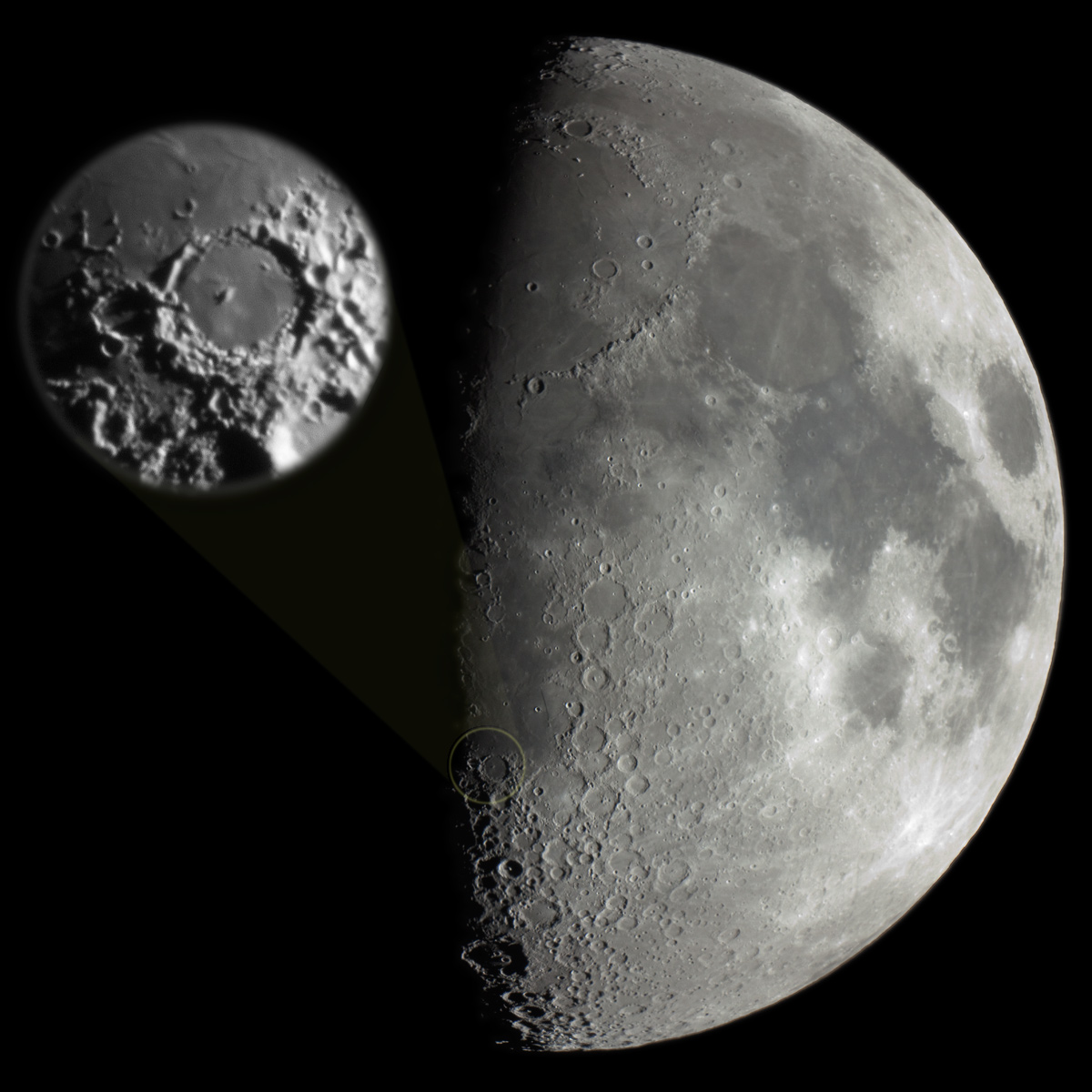
この望遠鏡画像では、月の明暗境界線、つまり昼と夜の境界線に沿って、山やクレーターの壁のくっきりとした影が際立っています。もちろん、明暗境界線付近の月面から見れば、太陽は昇り始めており、まだ月の地平線に近い位置にあります。しかし、左側の挿入図は、より捉えにくい月の日の出現象を強調しています。直径45キロメートルのヘシオドス・クレーターの東壁の隙間から差し込む低い角度の太陽光線が、影になっているクレーターの底に沿って長い日の出の光芒を生み出しています。日の出の光芒は短時間しか続かないため、望遠鏡を持つ月愛好家にとっては見つける価値のあるものです。ヘシオドス・クレーターや他のクレーターで見られるこの光芒のタイミングは、観測者の位置に基づいて計算することができます。この上弦の月の写真は、2月22日23時45分(協定世界時)にドイツのシュトゥットガルトで撮影されました。挿入図の右側には、より大きなクレーターであるピタトゥスが写っています。場所を示すため、ヘシオドスとピタトゥスは写真の下部に丸で囲まれている。
原文(English)
Stark shadows of mountains and crater walls stand out along the lunar terminator, or shadow line between night and day, in this telescopic image. Of course, if viewed from the lunar surface near the terminator line, the Sun would be rising and still close to the lunar horizon. But the picture's inset at the left highlights a more elusive lunar sunrise phenomenon. Streaming through a gap in the eastern wall of 45 kilometer wide Hesiodus crater, the low-angle sunlight produces a long sunrise ray playing along the otherwise shadowed crater floor. Sunrise rays are short-lived and can be rewarding to spot for Moon enthusiasts with telescopes. Seen in Hesiodus and other craters, the ray timing can be calculated based on the observer's location. This picture of a first quarter Moon was recorded at 23:45 UT on February 22nd from Stuttgart, Germany. In the inset, the larger crater Pitatus is at the right. For location, Hesiodus and Pitatus are circled at the bottom of the picture.
\ この感動を宇宙仲間にシェア /
宇宙をXでシェア
© Stefan Seip / APOD