ボイジャー1号に照射された宇宙線
Cosmic Rays at Voyager 1
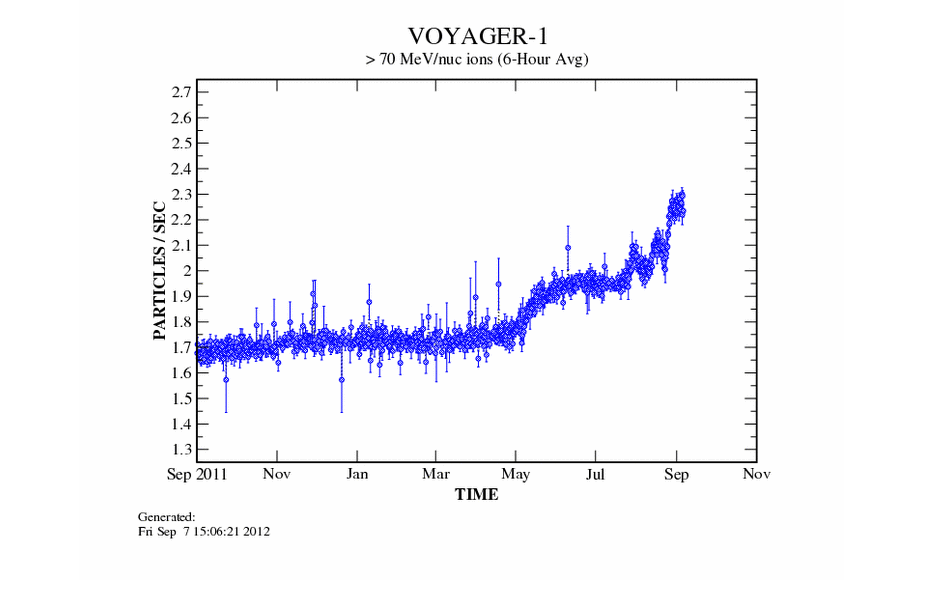
1977年に外惑星探査の壮大な旅に出発した双子のボイジャー探査機は、幸運にも、近くの恒星に対する太陽の運動方向とほぼ同じ方向に向かっていました。35年後、ボイジャー1号は太陽の太陽圏と星間空間の境界に近づいているようです。もちろん、太陽圏は太陽風と太陽の磁場の影響によって定義される太陽の領域です。しかし、探査機が境界を越えて星間空間に入ったことをどうやって知ることができるのでしょうか? 一つの手がかりは、高エネルギー宇宙線の検出が急激に増加することです。高エネルギー粒子は、銀河系内の遠方の超新星によって加速されて星間空間を流れますが、通常は太陽圏によって偏向または減速されます。12か月間(2011年9月から2012年)を対象としたこのグラフは、ボイジャー1号探査機による過去数か月間の宇宙線粒子の検出率が劇的に増加していることを示しています。ボイジャー1号は現在、太陽から180億キロメートル(17光時間、122天文単位)の距離にあり、まもなく地球から発せられた最初の宇宙船として恒星の領域に到達する可能性がある。
原文(English)
Launched on a grand tour of the outer planets in 1977, by good fortune the twin Voyager spacecraft were also headed in the general direction of the Sun's motion relative to nearby stars. Thirty five years later, Voyager 1 appears to be nearing the boundary of the Sun's heliosphere and interstellar space. Of course the heliosphere is the realm of the Sun defined by the influence of the solar wind and the Sun's magnetic field. But how can you tell when your spacecraft crosses the boundary into interstellar space? One clue would be a sudden increase in the detection of energetic cosmic rays. The high energy particles stream through interstellar space accelerated by distant supernovae in our galaxy, but are normally deflected or slowed by the heliosphere. Covering a 12 month period (September 2011 to 2012), this plot does show a dramatic increase in the rate of cosmic ray particle detection in past months by the Voyager 1 spacecraft. Voyager 1 is now 18 billion kilometers (17 light hours, 122 Astronomical Units) from the Sun and may soon be the first spacecraft from Earth to enter the realm of the stars.
\ この感動を宇宙仲間にシェア /
宇宙をXでシェア
© NASA / APOD