シメイス147:超新星残骸
Simeis 147: Supernova Remnant
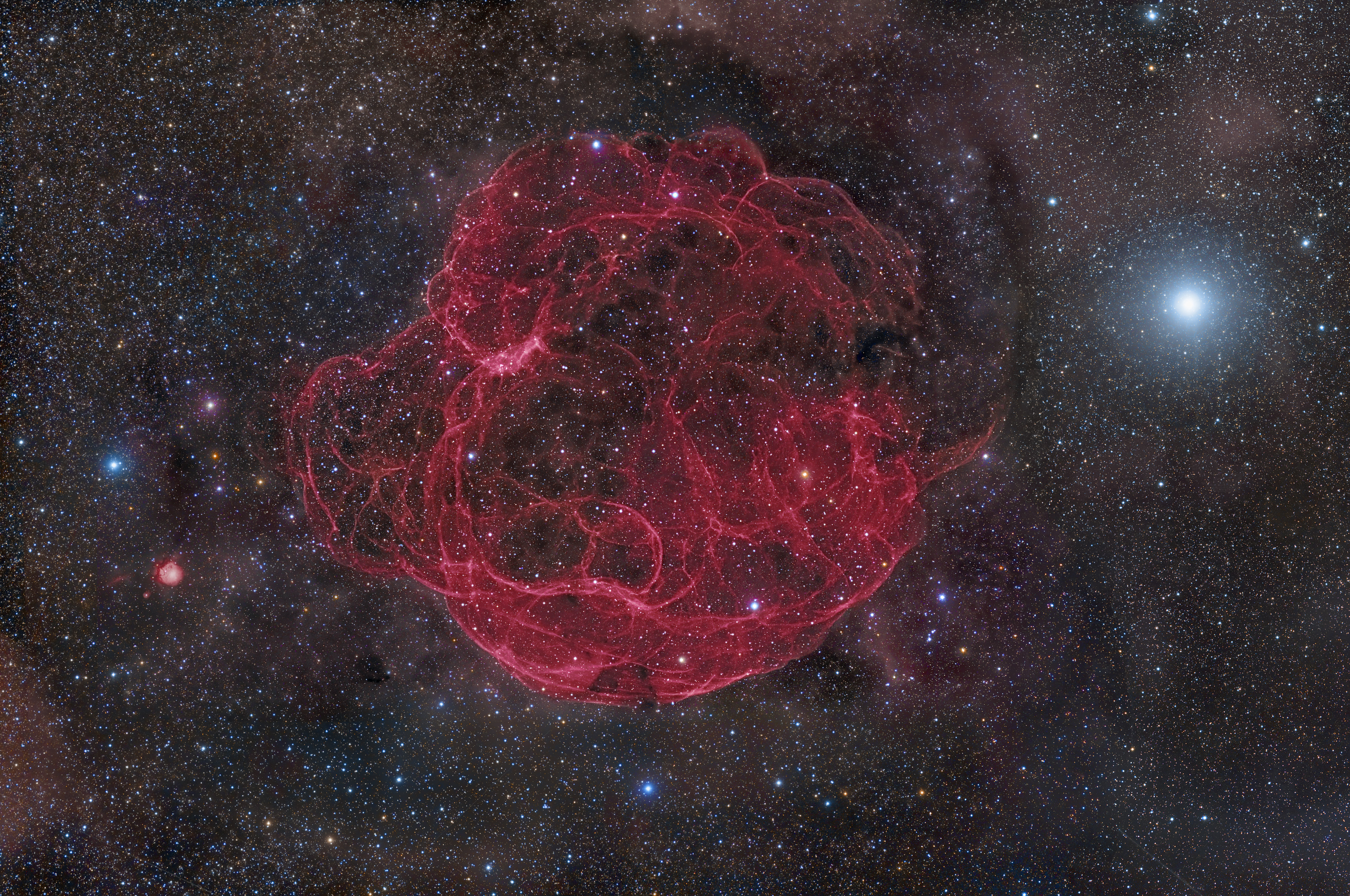
かすかな超新星残骸シメイス147(S147)のこの詳細なモザイク画像では、複雑なフィラメントを追うのに迷いやすい。Sh2-240としてもカタログ化されているこの残骸は、空で約3度、つまり満月6個分に相当する大きさである。これは、恒星残骸雲の推定距離3,000光年で、約150光年に相当する。右側のフレームの基準となる明るい星エルナト(ベータ・タウリ)は、おうし座とぎょしゃ座の境界付近、地球の空では銀河中心のほぼ真反対の位置に見える。この鮮明な合成画像には、衝撃を受けて輝くガスをトレースする水素原子からの放射を強調するために、狭帯域フィルターを通して撮影された画像データが含まれている。この超新星残骸の推定年齢は約4万年であり、これは巨大な恒星爆発からの光が4万年前に初めて地球に到達したことを意味する。しかし、膨張する残骸だけがその余波ではない。この宇宙規模の大惨事は、回転する中性子星、すなわちパルサーも残した。これは、元の恒星の核の残骸である。
原文(English)
It's easy to get lost following the intricate filaments in this detailed mosaic image of faint supernova remnant Simeis 147 (S147). Also cataloged as Sh2-240, it covers nearly 3 degrees or 6 full moons on the sky. That's about 150 light-years at the stellar debris cloud's estimated distance of 3,000 light-years. Anchoring the frame at the right, bright star Elnath (Beta Tauri) is seen towards the boundary of the constellations Taurus and Auriga, almost exactly opposite the galactic center in planet Earth's sky. This sharp composite includes image data taken through a narrow-band filter to highlight emission from hydrogen atoms tracing the shocked, glowing gas. The supernova remnant has an estimated age of about 40,000 years, meaning light from the massive stellar explosion first reached Earth 40,000 years ago. But the expanding remnant is not the only aftermath. The cosmic catastrophe also left behind a spinning neutron star or pulsar, all that remains of the original star's core.
\ この感動を宇宙仲間にシェア /
宇宙をXでシェア
© Rogelio Bernal Andreo / APOD