地球上空のオーロラ
Aurorae over Planet Earth
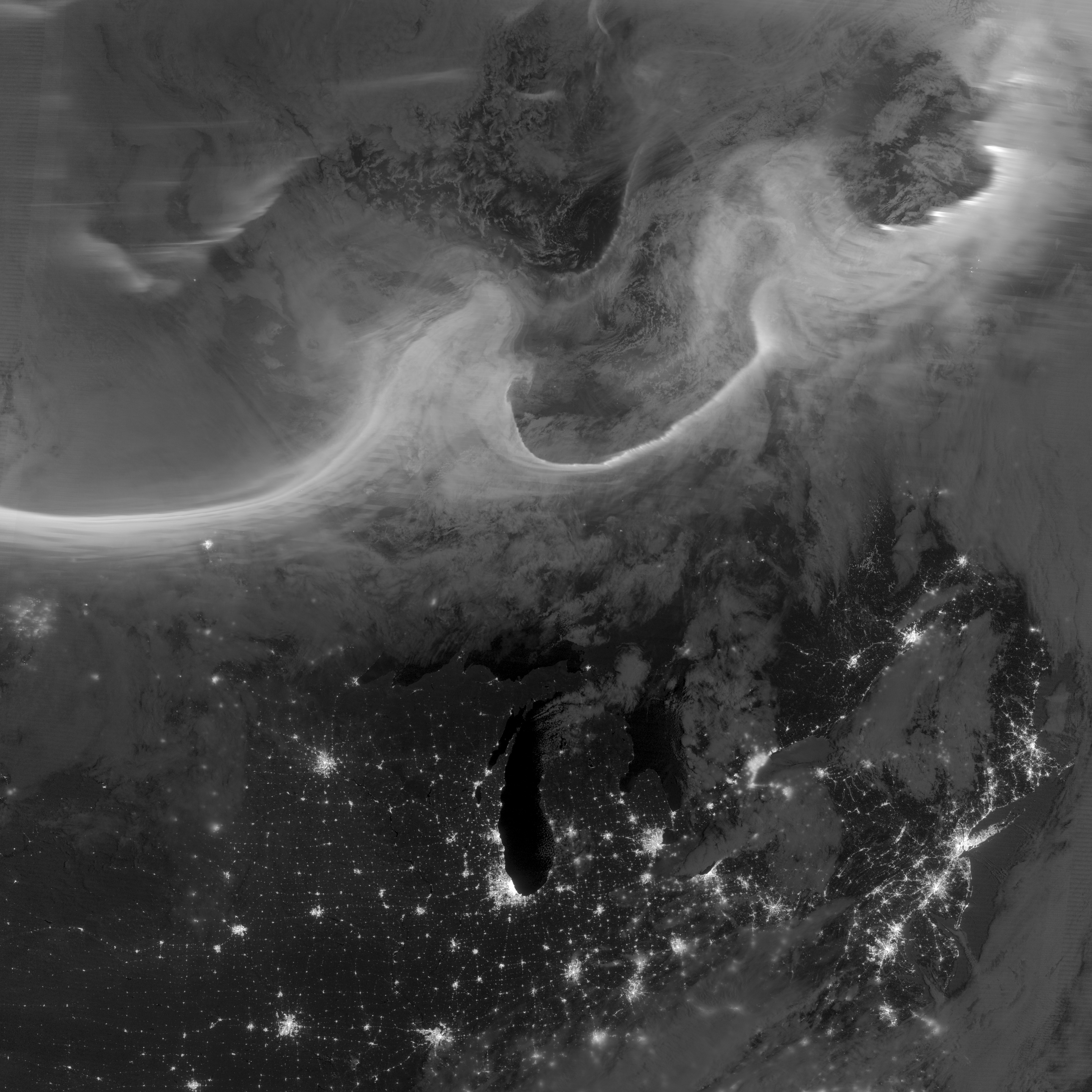
10月8日にスオミNPP衛星が撮影した、軌道上からのこの地球の眺めでは、夜の北アメリカが容易に識別できます。フレームの上半分にあるカナダのケベック州とオンタリオ州の上空に広がる壮大な可視光の波は、オーロラ、つまり北極光です。極を囲み、低緯度まで広がる、ここ数日見られる印象的なオーロラは、強力な地磁気嵐によるものです。この嵐は、10月4日/5日に発生した太陽コロナ質量放出によって引き起こされ、約3日後に地球の磁気圏に衝突しました。地表から100キロメートル以上上空に輝く光のカーテンは、磁気圏で加速された荷電粒子が上層大気の酸素と窒素を励起することによって形成されます。
原文(English)
North America at night is easy to recognize in this view of our fair planet from orbit, acquired by the Suomi-NPP satellite on October 8. The spectacular waves of visible light emission rolling above the Canadian provinces of Quebec and Ontario in the upper half of the frame are the Aurora Borealis or northern lights. Encircling the poles and extending to lower latitudes, impressive aurorae seen during the past few days are due to strong geomagnetic storms. The storms were triggered by a solar coronal mass ejection on October 4/5, impacting Earth's magnetosphere some three days later. The curtains of light, shining well over 100 kilometers above the surface, are formed as charged particles accelerated in the magnetosphere excite oxygen and nitrogen in the upper atmosphere.
\ この感動を宇宙仲間にシェア /
宇宙をXでシェア
© NASA / APOD