星R Sculptorisを取り囲む渦巻星雲
A Spiral Nebula Surrounding Star R Sculptoris
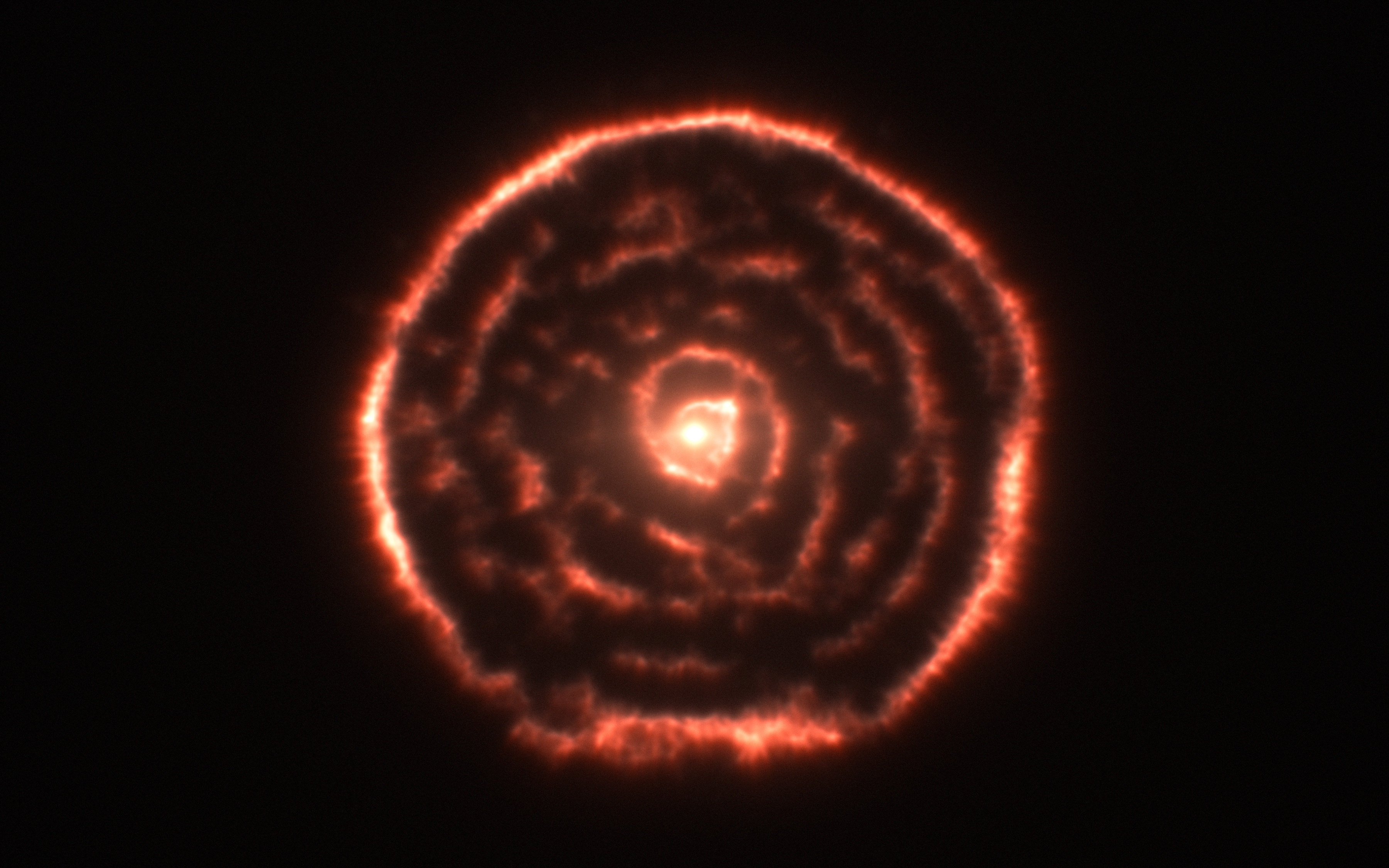
その星の周りで何が起こっているのでしょうか? 天の川銀河の星、彫刻座の方向約1500光年にある赤色巨星R彫刻座の周囲に、珍しい螺旋構造が発見されました。この星は、赤色光よりはるか遠く、マイクロ波や電波より手前の波長域であるミリ波付近を観測する最も強力な望遠鏡アレイである、新しいアタカマ大型ミリ波サブミリ波干渉計(ALMA)で観測されました。ALMAの観測データを使用して、星のすぐ周囲のガスと塵の3D可視化を作成しました。このデータのデジタルスライスは、予想外の螺旋構造を示しました。珍しいものの、同様の螺旋パターンは最近、LLペガススの周囲で可視光で発見されています。データを分析した結果、彫刻座の赤色巨星が、目に見えない連星伴星に向かってガスを噴出している可能性があるという仮説が立てられました。このシステムのダイナミクスは、巨大な星がその寿命の終わりにどう進化し、構成要素の一部を星間物質に放出して新たな星が形成されるのかについての手がかりを与えてくれる可能性があるため、特に興味深いものとなるかもしれない。
原文(English)
What's happening around that star? An unusual spiral structure has been discovered around the Milky Way star R Sculptoris, a red giant star located about 1,500 light years away toward the constellation of the Sculptor (Sculptoris). The star was observed with the new Atacama Large Millimeter/submillimeter Array (ALMA), the most powerful telescopic array observing near millimeter wavelengths, that part of the spectrum situated well beyond red light but before microwaves and radio waves. Data from ALMA observations was used to create a 3D visualization of the gas and dust immediately surrounding the star. A digital slice through this data showed the unexpected spiral structure. Although unusual, a similar spiral pattern was discovered in visible light recently around LL Pegasi. Upon analyzing the data, a hypothesis was drawn that the red giant star in R Sculptoris might be puffing gas toward an unseen binary companion star. The dynamics of this system might be particularly insightful because it may be giving clues as to how giant stars evolve toward the end of their lives -- and so release some constituent elements back to the interstellar medium so that new stars may form.
\ この感動を宇宙仲間にシェア /
宇宙をXでシェア
© NASA / APOD