惑星状星雲 PK 164 +31.1
Planetary Nebula PK 164 +31.1
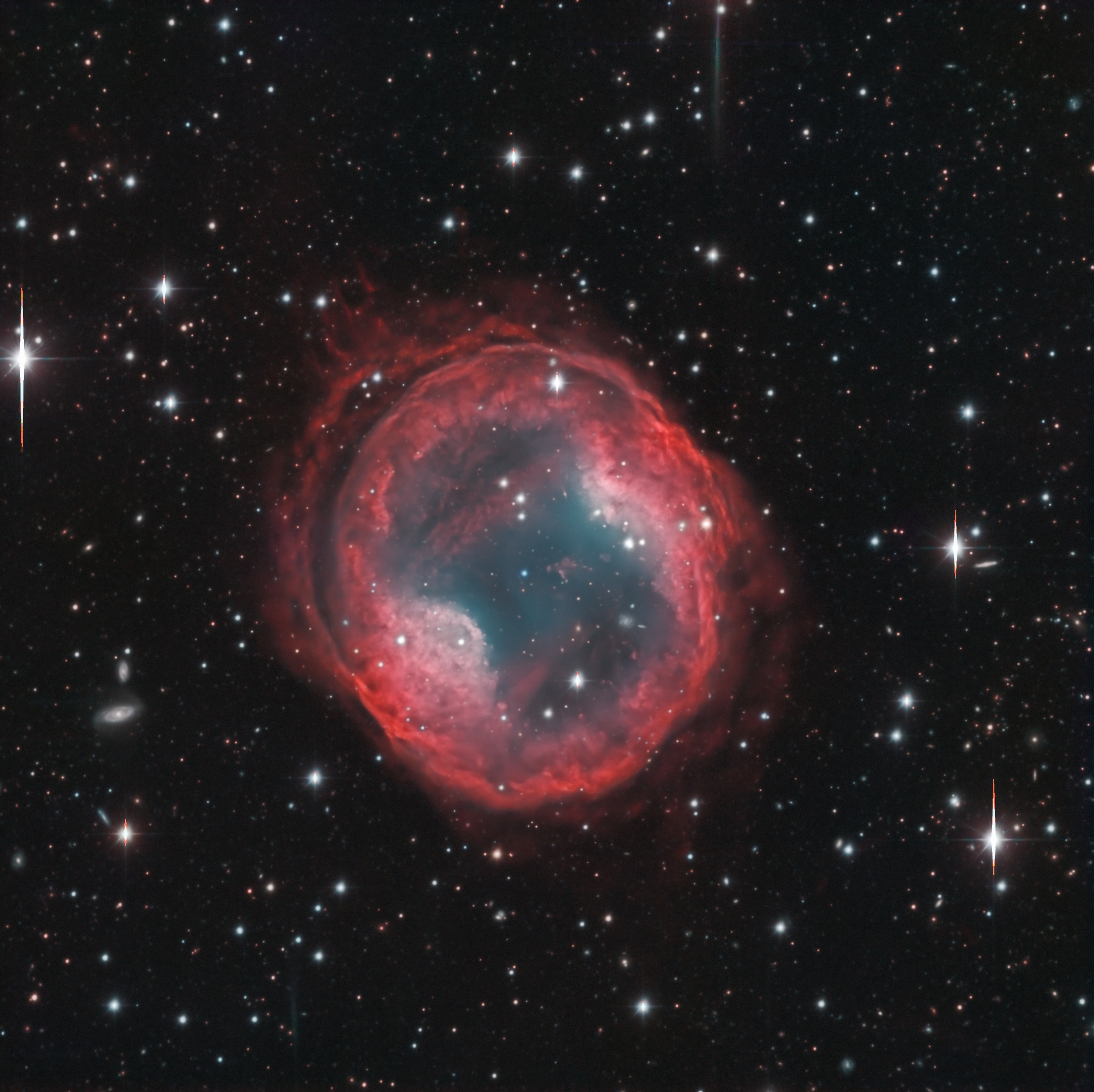
これが私たちの太陽の未来の姿でしょうか? 十分にあり得ます。上に示した膨張するガスの泡は惑星状星雲 PK 164 +31.1 で、核融合可能な中心水素の供給が枯渇した太陽のような星の大気の残骸です。星雲の中心付近には、中心核そのものの残骸である青く高温の白色矮星が見えます。この特に写真映えする惑星状星雲は、星の終焉の終わりに異なる時期に放出されたと思われる複雑なガスの殻を示しており、その構造は完全には解明されていません。スペインのカラール・アルト天文台による PK 164 +31.1 のこの深宇宙画像には、私たちの天の川銀河の他の多くの星や、遠くにあるいくつかの銀河も写っています。 PK 164 +31(ジョーンズ・エンバーソン1とも呼ばれる)は、ヤマネコ座の方向に約1600光年離れたところに位置しています。その暗さ(17等級)と低い表面輝度のため、この天体は大型の望遠鏡でしか観測できません。膨張する星雲は今後数千年で消滅するでしょうが、中心にある白色矮星は数十億年も存続する可能性があり、その頃には宇宙は今とは全く異なる姿になっているかもしれません。
原文(English)
Is this what will become of our Sun? Quite possibly. The bubble of expanding gas pictured above is the planetary nebula PK 164 +31.1, the remnants of the atmosphere of a Sun-like star expelled as its supply of fusion-able core hydrogen became depleted. Visible near the center of the nebula is what remains of the core itself -- a blue-hot white dwarf star. This particularly photogenic planetary nebula shows intricate shells of gas likely expelled at different times toward the end the star's demise, and whose structure is not fully understood. This deep image of PK 164 +31.1 from the Calar Alto Observatory in Spain shows many other stars from our own Milky Way Galaxy as well as several galaxies far in the distance. PK 164 +31, also known as Jones-Emberson 1, lies about 1,600 light years away toward the constellation of the Wildcat (Lynx). Due to its faintness (magnitude 17) and low surface brightness, the object is only visible with a good-sized telescope. Although the expanding nebula will fade away over the next few thousand years, the central white dwarf may well survive for billions of years -- to when our universe may be a very different place.
\ この感動を宇宙仲間にシェア /
宇宙をXでシェア
© Descubre Foundation,
CAHA,
OAUV,
DSA,
Vicent Peris (OAUV),
Jack Harvey (SSRO),
PixInsight / APOD