散開星団M35とNGC 2158
Open Star Clusters M35 and NGC 2158
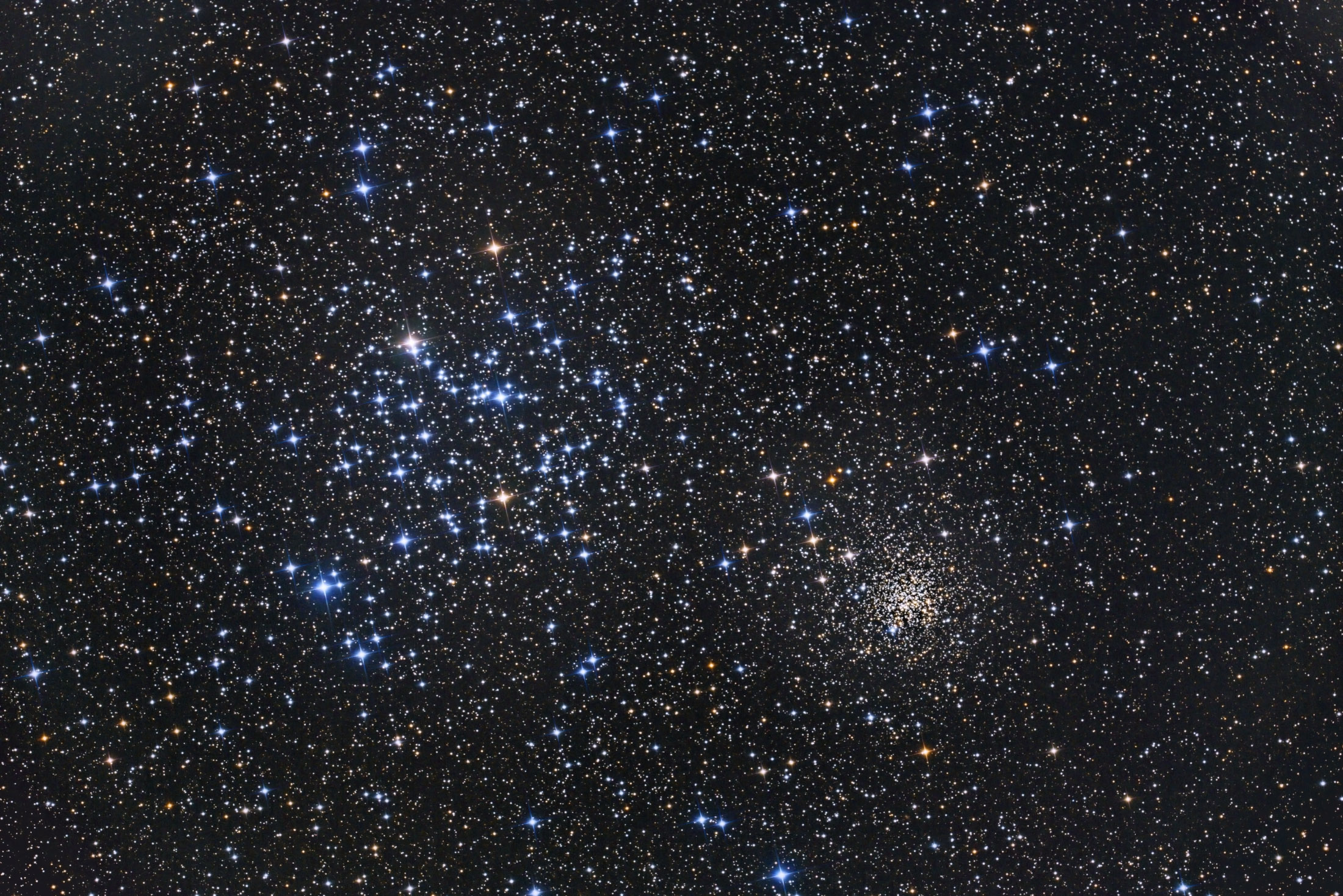
散開星団は、近くにあるものも遠くにあるものも、若いものも古いものも、拡散しているものも密集しているものも様々です。天の川銀河の面付近に位置する散開星団は、100個から10,000個の星から構成され、それらはすべてほぼ同時期に形成されました。明るい青色の星は、若い散開星団の特徴をよく表しています。左上のM35は、2800光年と比較的近く、1億5000万年と比較的若く、直径30光年の範囲に約2500個の星が散在しており、比較的拡散しています。右下には、より古く、より密集した散開星団NGC 2158があります。NGC 2158はM35よりも4倍遠く、10倍以上古く、ほぼ同じ空間に多くの星が密集しており、はるかに密集しています。NGC 2158の明るい青色の星は自滅し、星団の光はより古く、より黄色い星によって支配されています。どちらの星団もふたご座の方向に見られます。 APOD編集者が講演:RJNは1月3日にフィラデルフィアで、JTBは1月4日にニューヨーク市で講演
原文(English)
Open clusters of stars can be near or far, young or old, and diffuse or compact. Found near the plane of our Milky Way galaxy, they contain from 100 to 10,000 stars, all of which formed at nearly the same time. Bright blue stars frequently distinguish younger open clusters. M35, on the upper left, is relatively nearby at 2800 light years distant, relatively young at 150 million years old, and relatively diffuse, with about 2500 stars spread out over a volume 30 light years across. An older and more compact open cluster, NGC 2158, is at the lower right. NGC 2158 is four times more distant than M35, over 10 times older, and much more compact with many more stars in roughly the same volume of space. NGC 2158's bright blue stars have self-destructed, leaving cluster light to be dominated by older and yellower stars. Both clusters are seen toward the constellation of Gemini. APOD Editors to Speak: RJN in Philadelphia on Jan. 3 & JTB in New York City on Jan. 4
\ この感動を宇宙仲間にシェア /
宇宙をXでシェア
© Dieter Willasch / APOD