バーナード氏がNGC 2170を見つめる
Barnard Stares at NGC 2170
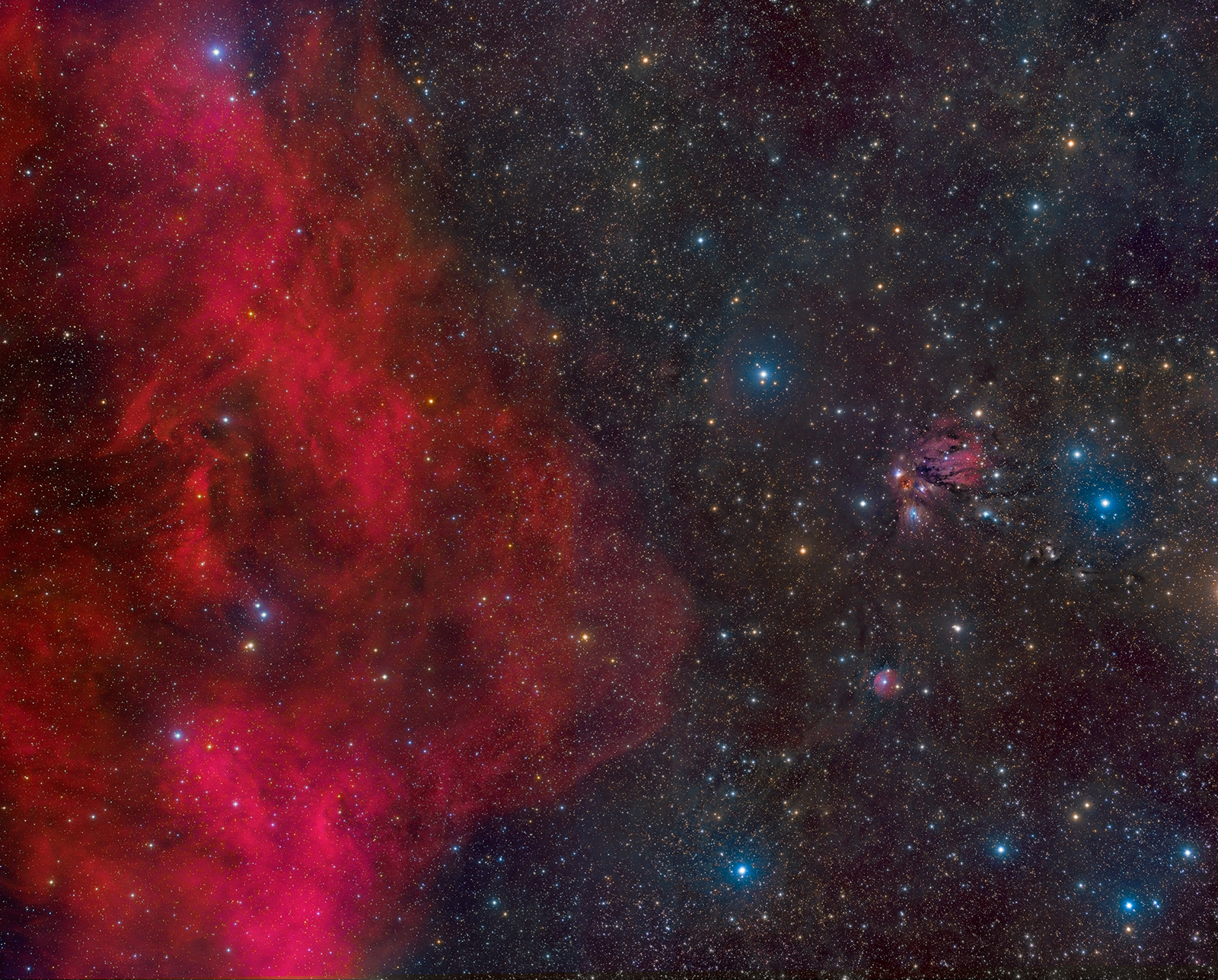
宇宙のスカイスケープを一瞥したこの望遠鏡モザイクは、存在するものの絶え間ない美しさを明らかにします。この印象的な光景は、地球の空で約6度、つまり満月12個分に相当します。左側には、赤く輝くガスの褶曲が、300光年にも及ぶ巨大な弧のごく一部です。バーナードループとして知られるこの構造は、肉眼では見えないほどかすかで、はるか昔に起こった超新星爆発と巨大な星からの恒星風によって形作られ、水素原子の光によって今もなお受け継がれています。バーナードループは、オリオン座の分子雲の端にある星形成領域であるオリオン大星雲を中心として、約1500光年離れたところに位置しています。しかし、その向こうには、私たちの天の川銀河の平面上に、他にも多くの豊かな星野が広がっています。右側の長時間露光合成画像には、約2400光年離れた近隣の分子雲の近くにある、塵に覆われた星雲の複合体であるNGC 2170が写っている。
原文(English)
A gaze across a cosmic skyscape, this telescopic mosaic reveals the continuous beauty of things that are. The evocative scene spans some 6 degrees or 12 Full Moons in planet Earth's sky. At the left, folds of red, glowing gas are a small part of an immense, 300 light-year wide arc. Known as Barnard's loop, the structure is too faint to be seen with the eye, shaped by long gone supernova explosions and the winds from massive stars, and still traced by the light of hydrogen atoms. Barnard's loop lies about 1,500 light-years away roughly centered on the Great Orion Nebula, a stellar nursery along the edge of Orion's molecular clouds. But beyond lie other fertile star fields in the plane of our Milky Way Galaxy. At the right, the long-exposure composite finds NGC 2170, a dusty complex of nebulae near a neighboring molecular cloud some 2,400 light-years distant.
\ この感動を宇宙仲間にシェア /
宇宙をXでシェア
© John Davis / APOD