回折限界において
At the Limit of Diffraction
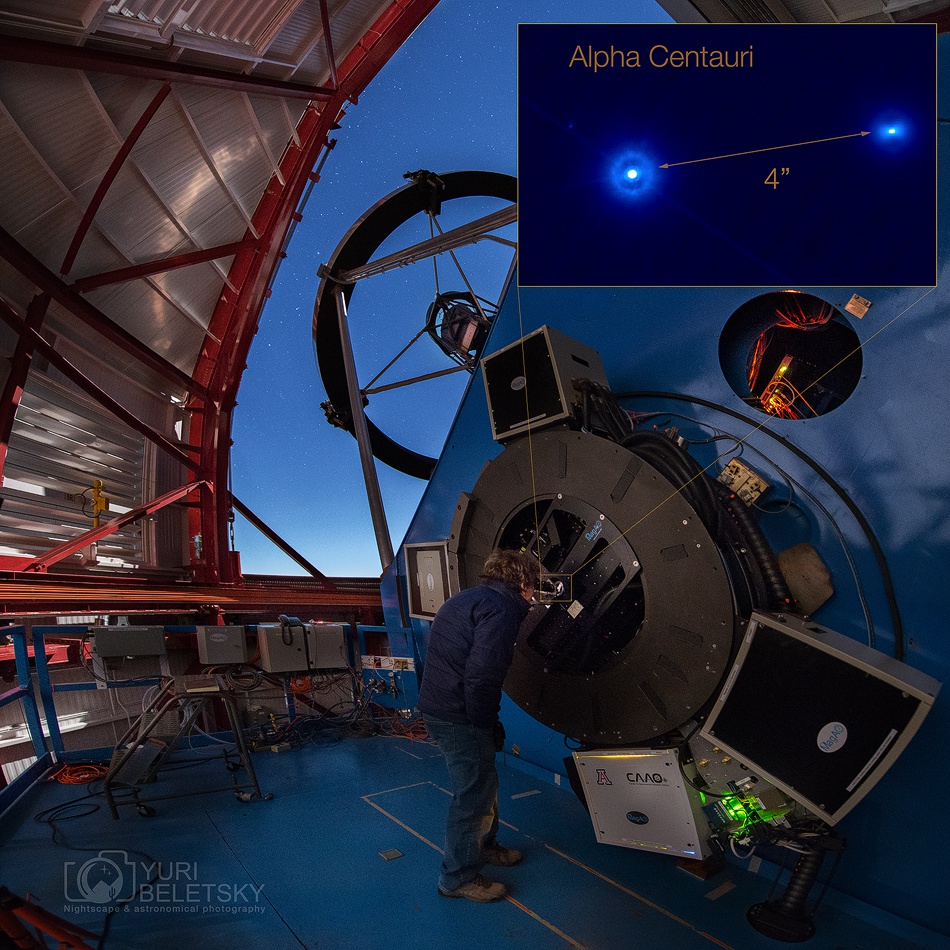
宇宙にある大型望遠鏡の接眼レンズを通して見たいと思ったことはありませんか?それができれば、回折限界の鮮明な像を見ることができるでしょう。地上の観測者を悩ませる大気によるぼやけの影響を受けないため、回折限界の像の角度分解能は、光の波長と望遠鏡のレンズまたはミラーの直径によってのみ決まります。直径が大きいほど、像は鮮明になります。しかし、この地上での作業中のスナップショットでは、有名な二重星系アルファ・ケンタウリの視覚観測で大気によるぼやけを打ち消すために、新しいアクティブ補償光学システム(MagAO)が使用されています。ラス・カンパナス天文台の直径6.5メートルのマゼラン・クレイ望遠鏡の接眼レンズでシステムをテストしている天文学者のレアード・クローズは、低地球軌道に行くことなく、歴史的な回折限界の像(挿入図)と近接連星系の広い見かけ上の分離を楽しんでいます。
原文(English)
Did you ever want to just look through the eyepiece of a large telescope in space? If you could, you would see a sharp view that was diffraction limited. Unaffected by atmospheric blurring that ultimately plagues earthbound observers, the angular resolution of your diffraction limited view would be determined only by the wavelength of light and diameter of the telescope lens or mirror; the larger the diameter, the sharper the image. Still, in this working earth-based snapshot a new active adaptive optics system (MagAO) is being used to cancel out the atmospheric blurring in a visual observation of famous double star system Alpha Centauri. Testing the system at the eyepiece of the 6.5 meter diameter Magellan Clay Telescope at Las Campanas Observatory, astronomer Laird Close is enjoying a historic diffraction limited view (inset) and the wide apparent separation of the close binary star system ... without traveling to low earth orbit.
\ この感動を宇宙仲間にシェア /
宇宙をXでシェア
© Yuri Beletsky / APOD