準惑星、明るい点
Dwarf Planet, Bright Spot
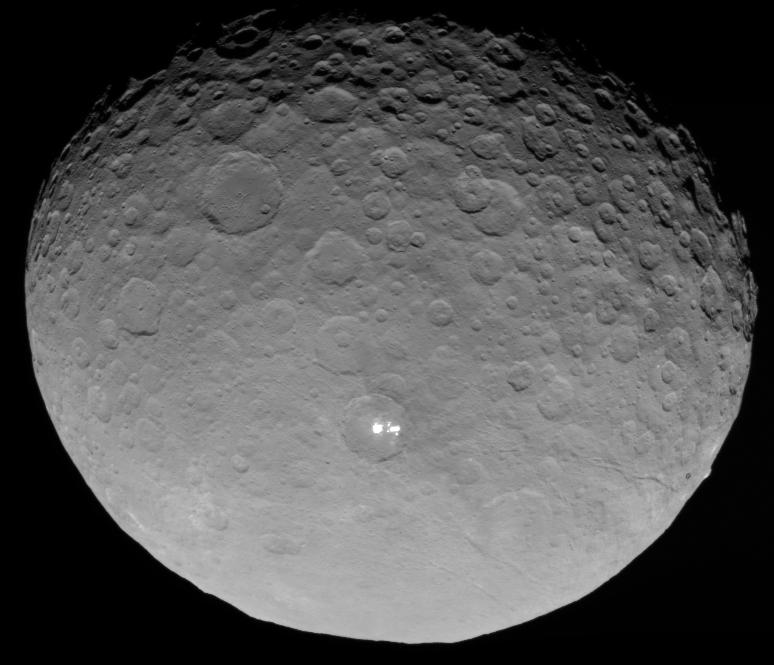
現在ケレスにいるドーン探査機のカメラは、5月4日にこの準惑星の北半球と謎の明るい斑点の1つをより近くで撮影した。直径約950キロメートルの小さく暗い世界の太陽光に照らされたこの画像は、太陽光発電で動く探査機が15日間かけて13,600キロメートル(8,400マイル)の距離で周回するRC3マッピング軌道から撮影された計画された一連の画像の一部である。アニメーションシーケンスは、フレームの上部に北極があるケレスの自転を示している。2004年にハッブル宇宙望遠鏡によって撮影され、その後2015年にケレスに接近したドーン探査機によって撮影された明るい斑点自体は、太陽光にきらめく氷である可能性のある、より小さな反射物質の斑点から構成されていることが明らかになった。土曜日、探査機ドーンのイオン推進システムが作動し、探査機は6月6日までに地球から4,350キロメートルのより近い軌道へと螺旋状に進路を変えた。もちろん、もう一つの未探査の準惑星である冥王星には、7月中旬までに地球からの探査機ニュー・ホライズンズが到着する予定だ。
原文(English)
Now at Ceres, Dawn's camera recorded this closer view of the dwarf planet's northern hemisphere and one of its mysterious bright spots on May 4. A sunlit portrait of a small, dark world about 950 kilometers in diameter, the image is part of a planned sequence taken from the solar-powered spacecraft's 15-day long RC3 mapping orbit at a distance of 13,600 kilometers (8,400 miles). The animated sequence shows Ceres' rotation, its north pole at the top of the frame. Imaged by Hubble in 2004 and then by Dawn as it approached Ceres in 2015, the bright spot itself is revealed to be made up of smaller spots of reflective material that could be exposed ice glinting in the sunlight. On Saturday, Dawn's ion propulsion system was turned on to spiral the spacecraft into a closer 4,350-kilometer orbit by June 6. Of course another unexplored dwarf planet, Pluto, is expecting the arrival of a visitor from Earth, the New Horizons spacecraft, by mid-July.
\ この感動を宇宙仲間にシェア /
宇宙をXでシェア
© NASA / APOD