彗星67Pにそびえ立つ崖
A Cliff Looming on Comet 67P
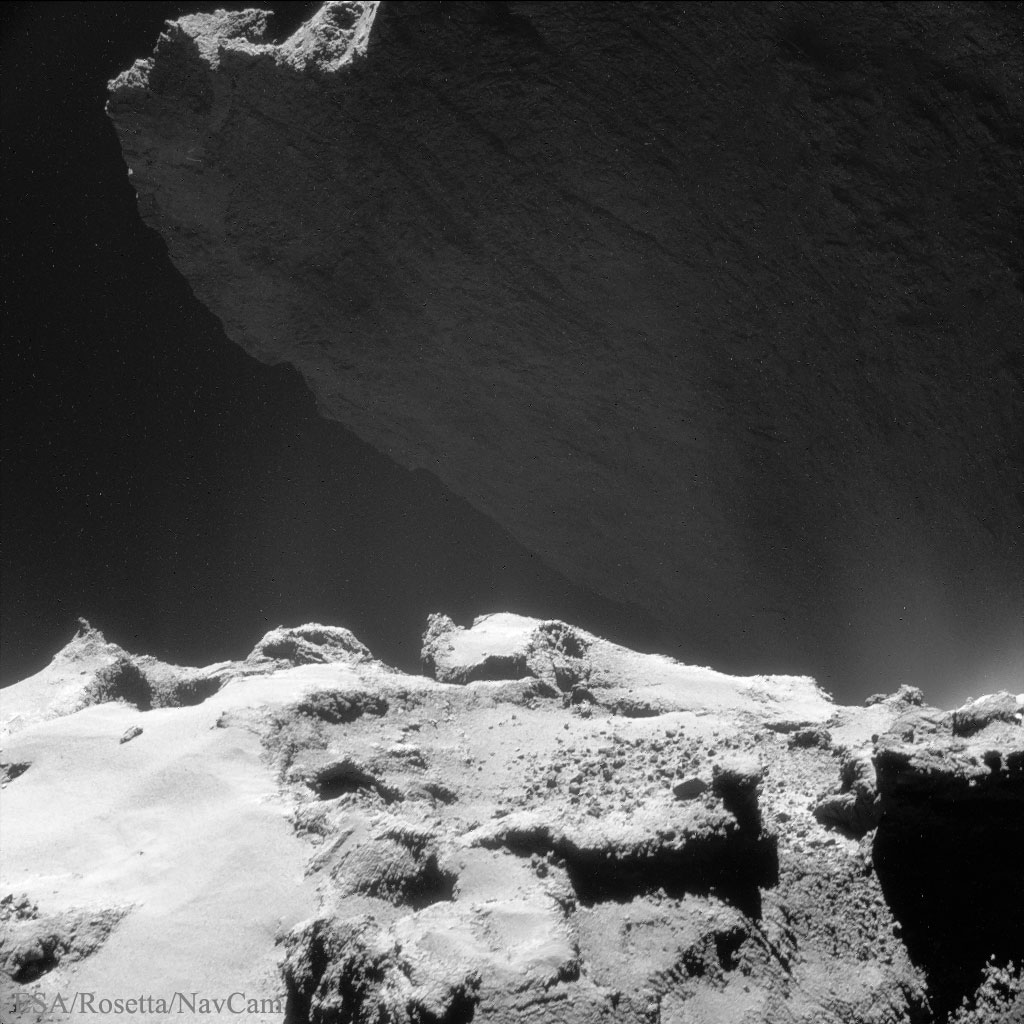
チュリュモフ・ゲラシメンコ彗星の砂利が散乱する丘の背後にそびえ立つものは何でしょうか?それはギザギザの崖です。チュリュモフ・ゲラシメンコ彗星(67P)の珍しい二重ローブ状の核は、他に類を見ない劇的な景観を生み出しており、昨年9月に彗星に到着したロゼッタ探査機もその一つを捉えました。昨年10月に撮影され、デジタル処理が施されたこの彗星の風景は、幅約850メートルに及びます。一方、チュリュモフ・ゲラシメンコ彗星は、8月に太陽に最接近するにつれて、噴出を続けています。その間、ロゼッタは、昨年11月に核に着陸したものの、未知の表面位置に跳ね返った探査機フィラエからの信号を受信し続けます。フィラエが再び太陽光にさらされれば、ロゼッタに信号を送るのに十分なエネルギーを取り戻す可能性があります。宇宙を巡る:ランダムAPODジェネレーター
原文(English)
What's that looming behind this gravel-strewn hill on Comet Churyumov�Gerasimenko? A jagged cliff. The unusual double-lobed nucleus of Comet 67P/Churyumov�Gerasimenko lends itself to unusual and dramatic vistas, another of which has been captured by the Rosetta spacecraft that arrived at the comet last September. The featured cometscape, taken last October and digitally enhanced, spans about 850 meters across. Meanwhile, Comet Churyumov�Gerasimenko continues to sprout jets as it nears its closest approach to the Sun in August. Along the way, Rosetta will continue listening for signals from Philae, a probe that landed on the nucleus but rebounded to an unknown surface location last November. If newly exposed to sunlight, Philae might regain enough energy to again signal Rosetta. Click Through the Universe: Random APOD Generator
\ この感動を宇宙仲間にシェア /
宇宙をXでシェア
© NASA / APOD