超新星1994Dと予期せぬ宇宙
Supernova 1994D and the Unexpected Universe
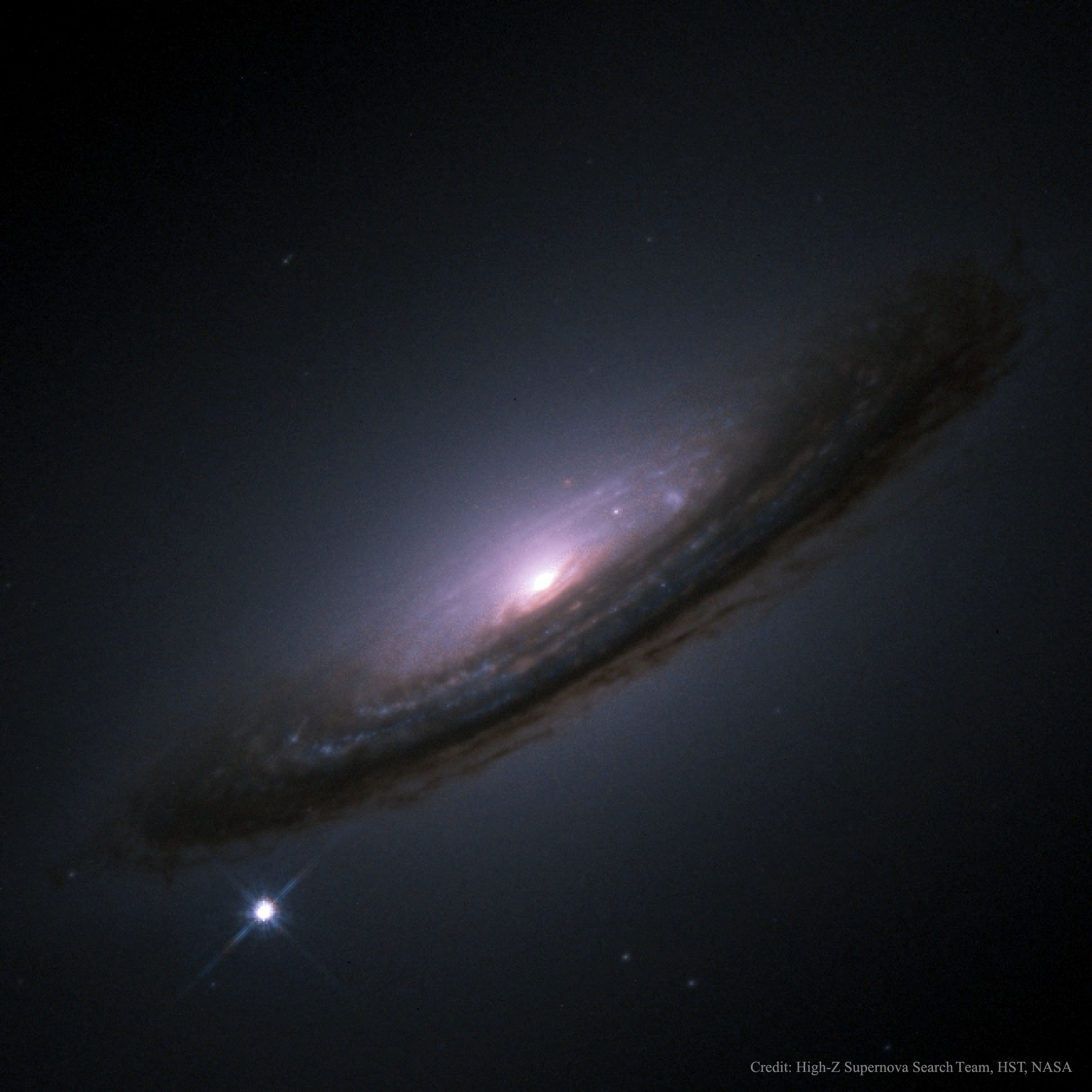
遠い昔、はるか彼方の宇宙で、星が爆発しました。左下の明るい点として見える超新星1994Dは、円盤銀河NGC 4526の外縁部で発生しました。超新星1994Dが注目されたのは、他の超新星とどれほど異なっていたかではなく、むしろどれほど似ていたかという点でした。実際、爆発後数週間にわたって放出された光によって、この超新星はよく知られているIa型超新星という名称を与えられました。すべてのIa型超新星が同じ固有の明るさを持つとすれば、超新星が暗く見えるほど、その超新星は遠くにあるはずです。天文学者は、明るさと距離の正確な関係を較正することで、宇宙の膨張率(ハッブル定数でパラメータ化される)だけでなく、私たちが住む宇宙の幾何学的構造(オメガとラムダでパラメータ化される)も推定することができます。過去数年間に測定された超新星の数の多さと、それらまでの距離の遠さは、他の観測結果と合わせて考えると、私たちがこれまで予想されていなかった宇宙に住んでいることを示唆していると解釈されている。
原文(English)
Long ago, far away, a star exploded. Supernova 1994D, visible as the bright spot on the lower left, occurred in the outskirts of disk galaxy NGC 4526. Supernova 1994D was not of interest for how different it was, but rather for how similar it was to other supernovae. In fact, the light emitted during the weeks after its explosion caused it to be given the familiar designation of a Type Ia supernova. If all Type 1a supernovae have the same intrinsic brightness, then the dimmer a supernova appears, the farther away it must be. By calibrating a precise brightness-distance relation, astronomers are able to estimate not only the expansion rate of the universe (parameterized by the Hubble Constant), but also the geometry of the universe we live in (parameterized by Omega and Lambda). The large number and great distances to supernovae measured over the past few years, when combined with other observations, are interpreted as indicating that we live in a previously unexpected universe.
\ この感動を宇宙仲間にシェア /
宇宙をXでシェア
© NASA / APOD