メシエ43
Messier 43
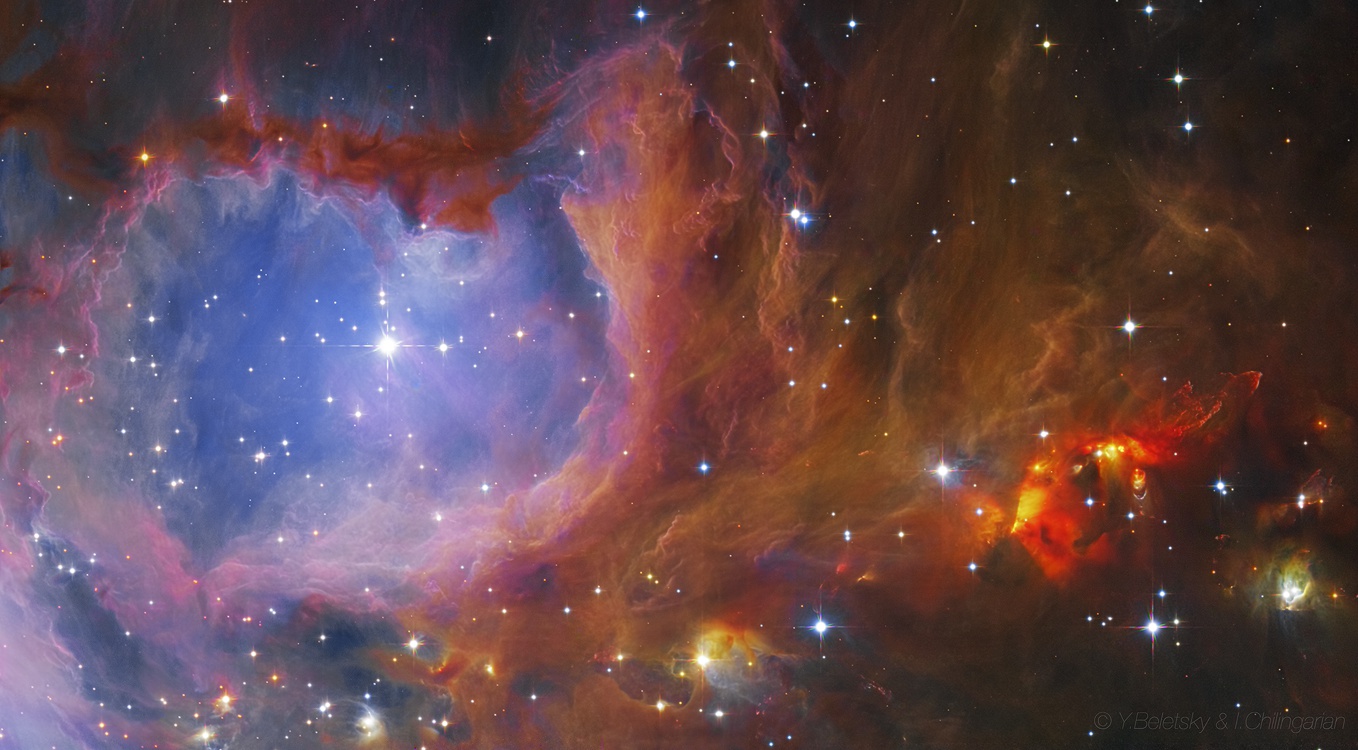
メシエ43は、しばしば画像化されるものの、あまり言及されることはありませんが、それ自体が大きな星形成領域です。これは、より大きく有名な隣接するメシエ42、大オリオン星雲を含む、ガスと塵からなる星形成複合体の一部にすぎません。実際、大オリオン星雲自体はこのシーンの下端に位置しています。メシエ43のクローズアップは、チリのアンデス山脈にあるラス・カンパナス天文台の6.5メートル・マゼラン望遠鏡2基のうちの1基で近赤外線装置の性能をテストしているときに撮影されました。合成画像は、通常は見えない赤外線波長を青、緑、赤の色に変換しています。可視光では隠されている星間塵の洞窟を覗き込む近赤外線画像は、この複合体領域にある低温の褐色矮星を研究するためにも使用できます。有名な隣人とともに、メシエ43はオリオン座の巨大分子雲の端、約1,500光年離れたところに位置しています。その距離では、この視野は約5光年に及ぶ。
原文(English)
Often imaged but rarely mentioned, Messier 43 is a large star forming region in its own right. It's just part of the star forming complex of gas and dust that includes the larger, more famous neighboring Messier 42, the Great Orion Nebula. In fact, the Great Orion Nebula itself lies off the lower edge of this scene. The close-up of Messier 43 was made while testing the capabilities of a near-infrared instrument with one of the twin 6.5 meter Magellan telescopes at Las Campanas Observatory in the Chilean Andes. The composite image shifts the otherwise invisible infrared wavelengths to blue, green, and red colors. Peering into caverns of interstellar dust hidden from visible light, the near-infrared view can also be used to study cool, brown dwarf stars in the complex region. Along with its celebrity neighbor, Messier 43 lies about 1,500 light-years away, at the edge of Orion's giant molecular cloud. At that distance, this field of view spans about 5 light-years.
\ この感動を宇宙仲間にシェア /
宇宙をXでシェア
© Yuri Beletsky / APOD