ブライスキャニオンに広がる虹と光線
Rainbows and Rays over Bryce Canyon
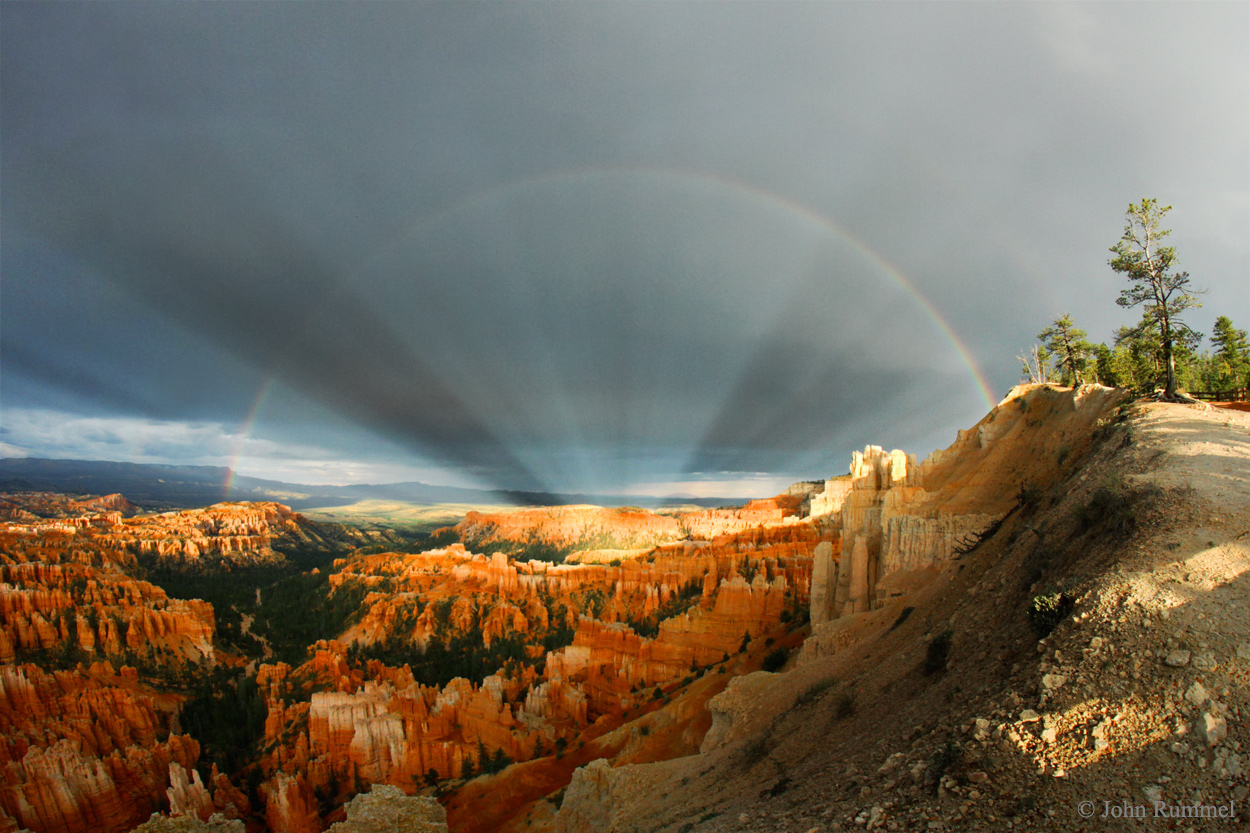
ブライスキャニオンで何が起こっているのでしょうか?今月初めに撮影された一枚の写真に、2つの異なる光学的現象が捉えられています。どちらの現象も、太陽が撮影者の真後ろにあることが条件でした。最も身近な現象は、一般的な虹です。これは、沈む太陽から撮影者の頭上を流れる太陽光が、峡谷の手前の雨粒によって散乱することで発生します。よく見ると、最初の虹の上にもう一つ虹が現れています。より稀で、おそらくより印象的なのは、峡谷の上空の地平線から放射状に伸びる光線です。これらは反薄明光線と呼ばれ、雲の切れ間から差し込む太陽光が空を巡り、太陽から180度離れた地点で収束することで生じます。幾何学的に、この反太陽点は虹の中心と正確に一致する必要があります。アメリカ合衆国ユタ州にあるブライスキャニオン自体には、フードゥーと呼ばれる古代の堆積岩の尖塔が絵のように美しく連なっています。APOD編集者が講演:8月8日(土)、キーウィーノー科学技術フェスティバルにて
原文(English)
What's happening over Bryce Canyon? Two different optical effects that were captured in one image taken earlier this month. Both effects needed to have the Sun situated directly behind the photographer. The nearest apparition was the common rainbow, created by sunlight streaming from the setting sun over the head of the photographer, and scattering from raindrops in front of the canyon. If you look closely, even a second rainbow appears above the first. More rare, and perhaps more striking, are the rays of light that emanate out from the horizon above the canyon. These are known as anticrepuscular rays and result from sunlight streaming though breaks in the clouds, around the sky, and converging at the point 180 degrees around from the Sun. Geometrically, this antisolar point must coincide with the exact center of the rainbows. Located in Utah, USA, Bryce Canyon itself contains a picturesque array of ancient sedimentary rock spires known as hoodoos. APOD Editor to Speak: Saturday, August 8 at Keweenaw Science & Engineering Festival
\ この感動を宇宙仲間にシェア /
宇宙をXでシェア
© John Rummel / APOD