フォボス:火星の運命の衛星
Phobos: Doomed Moon of Mars
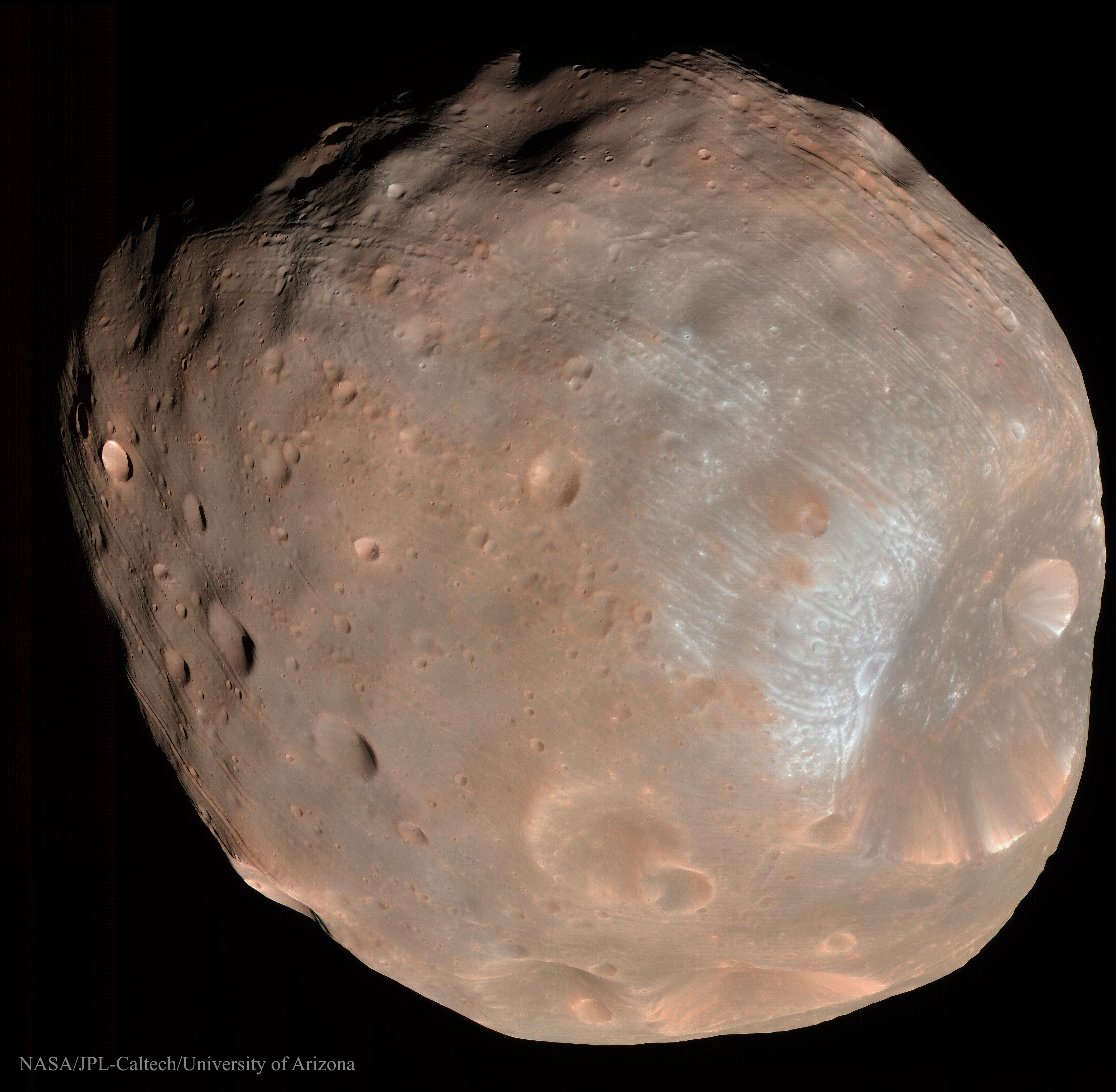
この衛星は滅びる運命にある。ローマ神話の戦いの神にちなんで名付けられた赤い惑星火星には、フォボスとダイモスという2つの小さな衛星があり、その名前はギリシャ語で恐怖とパニックを意味する言葉に由来している。これらの火星の衛星は、火星と木星の間の小惑星帯、あるいは太陽系のさらに遠い領域から来た小惑星が捕獲されたものかもしれない。より大きな衛星であるフォボスは、ロボット探査機マーズ・リコネッサンス・オービターが撮影した、1ピクセルあたり約7メートルの解像度で記録されたこの見事なカラー画像では、確かにクレーターだらけの小惑星のような物体として写っている。しかし、フォボスは火星に非常に近い軌道を周回しており、月が40万キロメートルであるのに対し、表面から約5,800キロメートル上空を周回しているため、重力潮汐力がフォボスを引きずり下ろしている。最近の分析によると、長い溝は潮汐によって引き起こされる全体的な引き伸ばし、つまりフォボスの異なる面にかかる火星の重力の差によって生じた可能性がある。これらの溝は、フォボスが火星の周囲に残された破片の環へと崩壊していく初期段階を示している可能性がある。APODをフォローするには、Facebook、Google Plus、またはTwitterをご覧ください。
原文(English)
This moon is doomed. Mars, the red planet named for the Roman god of war, has two tiny moons, Phobos and Deimos, whose names are derived from the Greek for Fear and Panic. These martian moons may well be captured asteroids originating in the main asteroid belt between Mars and Jupiter or perhaps from even more distant reaches of the Solar System. The larger moon, Phobos, is indeed seen to be a cratered, asteroid-like object in this stunning color image from the robotic Mars Reconnaissance Orbiter, recorded at a resolution of about seven meters per pixel. But Phobos orbits so close to Mars - about 5,800 kilometers above the surface compared to 400,000 kilometers for our Moon - that gravitational tidal forces are dragging it down. A recent analysis of the long grooves indicates that they may result from global stretching caused by tides -- the differing force of Mars' gravity on different sides of Phobos. These grooves may then be an early phase in the disintegration of Phobos into a ring of debris around Mars. Follow APOD on: Facebook, Google Plus, or Twitter
\ この感動を宇宙仲間にシェア /
宇宙をXでシェア
© NASA / APOD