南のふたご座
Geminids of the South
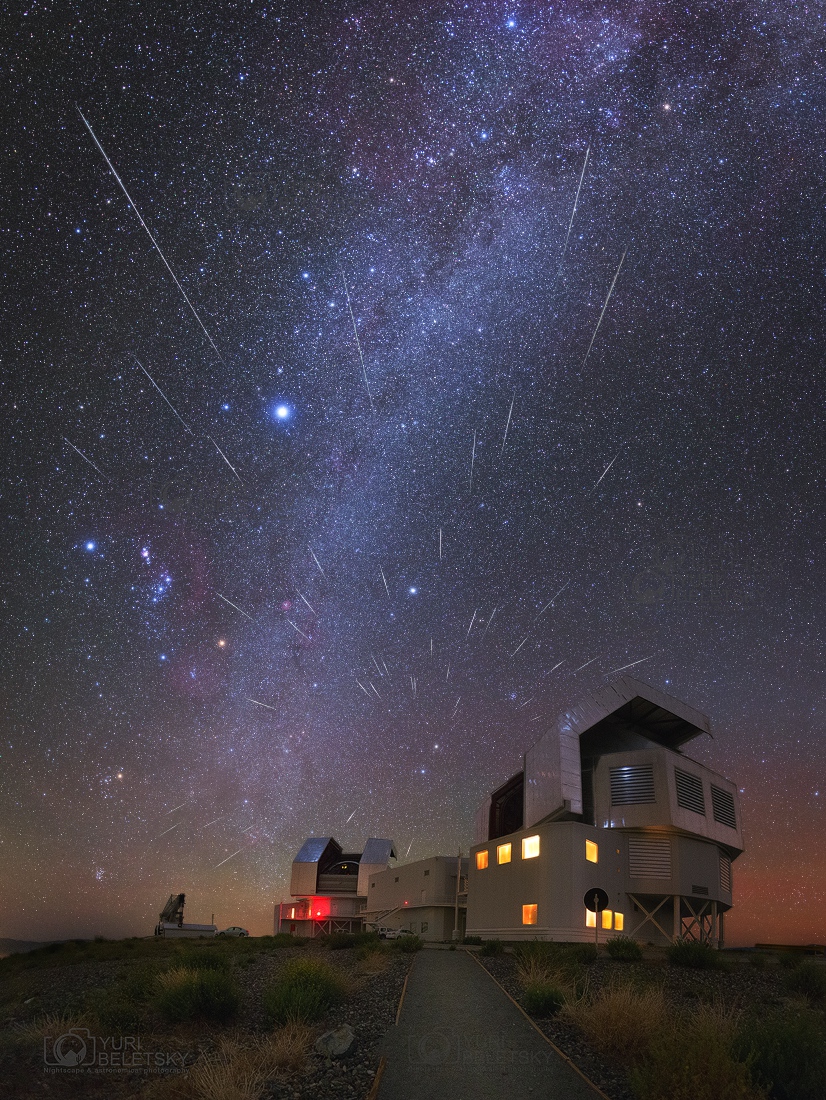
地球の恒例のふたご座流星群は期待を裏切らず、12月14日の夜明け前にピークを迎えました。このとき、地球は活発な小惑星3200ファエトンの塵の中を突き進んでいました。南半球の夜景に捉えられた流星群は、ふたご座の放射点から流れ出ています。この画像を作成するために、5時間にわたって流星の軌跡を記録した多くの個々のフレームが撮影されました。最終的な合成では、チリのカーネギー・ラス・カンパナス天文台の2つの6.5メートル・マゼラン望遠鏡の上にある星空に対して、それらが選択され、位置合わせされました。オリオン座のリゲルとシリウスは、天の川が天頂に向かって伸びるにつれて明るく輝いています。ふたご座の双子星カストルとポルックスの近くでは、流星群の放射点は低く、地平線近くにあります。放射点の効果は遠近法によるもので、平行な流星の軌跡は遠くで収束しているように見えます。ふたご座流星群の流星は、秒速約22キロメートルの速度で地球の大気圏に突入する。
原文(English)
rth's annual Geminid meteor shower did not disappoint, peaking before dawn on December 14 as our fair planet plowed through dust from active asteroid 3200 Phaethon. Captured in this southern hemisphere nightscape the meteors stream away from the shower's radiant in Gemini. To create the image, many individual frames recording meteor streaks were taken over period of 5 hours. In the final composite they were selected and registered against the starry sky above the twin 6.5 meter Magellan telescopes of Carnegie Las Campanas Observatory in Chile. Rigel in Orion, and Sirius shine brightly as the Milky Way stretches toward the zenith. Near Castor and Pollux the twin stars of Gemini, the meteor shower's radiant is low, close to the horizon. The radiant effect is due to perspective as the parallel meteor tracks appear to converge in the distance. Gemini's meteors enter Earth's atmosphere traveling at about 22 kilometers per second.
\ この感動を宇宙仲間にシェア /
宇宙をXでシェア
© Yuri Beletsky / APOD