太陽の閃光スペクトル
The Flash Spectrum of the Sun
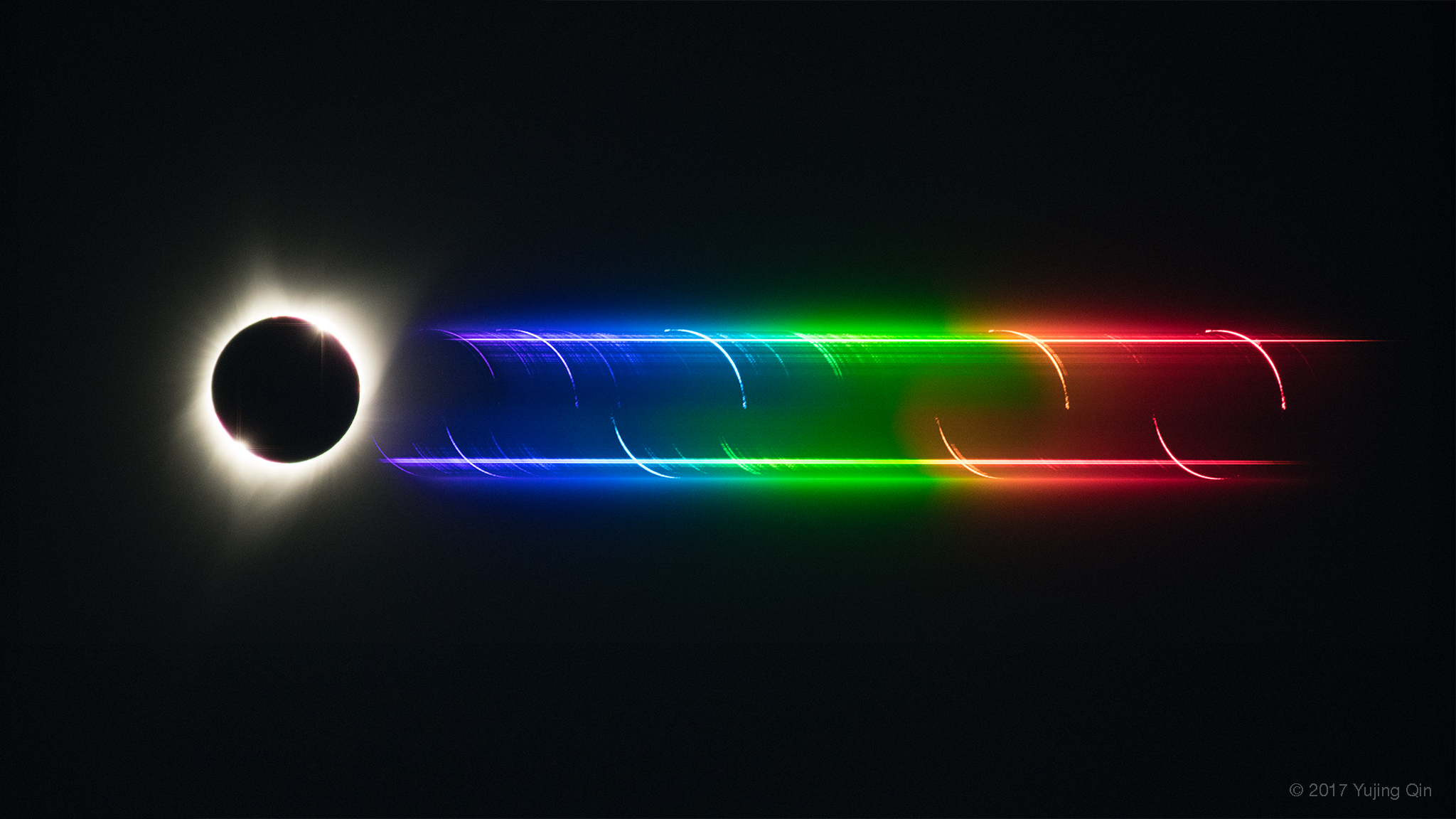
オレゴン州マドラスの澄み切った空の下で撮影されたこの色鮮やかな日食合成写真は、捉えどころのない太陽の彩層スペクトル、すなわち閃光スペクトルを捉えています。8月21日に望遠レンズと回折格子を用いて撮影された3枚の画像が、フレーム内で整列されています。左端に直接写っている太陽のダイヤモンドリングのような外観は、皆既日食の開始時と終了時に、最大食時の月の円盤のシルエットを挟んでいます。回折格子によって右方向の色のスペクトルに広がった太陽の光球スペクトルは、2本の連続した筋を描いています。これらは、通常は圧倒的な大きさの太陽の円盤がダイヤモンドリング状に垣間見えることに対応しています。しかし、個々の日食画像は、太陽彩層の薄くはかない弧に沿って原子から放出される光の各波長にも現れます。最も明るい画像、つまり最も強い彩層放射は、水素原子によるものです。右端には赤い水素アルファ線が、左には青と紫の水素系列の放射が写っています。その中間にある最も明るい黄色の発光は、ヘリウム原子によって引き起こされるものであり、ヘリウムは太陽の閃光スペクトルで初めて発見された元素である。
原文(English)
In clear Madras, Oregon skies, this colorful eclipse composite captured the elusive chromospheric or flash spectrum of the Sun. Only three exposures, made on August 21 with telephoto lens and diffraction grating, are aligned in the frame. Directly imaged at the far left, the Sun's diamond ring-like appearance at the beginning and end of totality brackets a silhouette of the lunar disk at maximum eclipse. Spread by the diffraction grating into the spectrum of colors toward the right, the Sun's photospheric spectrum traces the two continuous streaks. They correspond to the diamond ring glimpses of the Sun's normally overwhelming disk. But individual eclipse images also appear at each wavelength of light emitted by atoms along the thin, fleeting arcs of the solar chromosphere. The brightest images, or strongest chromospheric emission, are due to Hydrogen atoms. Red hydrogen alpha emission is at the far right with blue and purple hydrogen series emission to the left. In between, the brightest yellow emission is caused by atoms of Helium, an element only first discovered in the flash spectrum of the Sun.
\ この感動を宇宙仲間にシェア /
宇宙をXでシェア
© Yujing Qin / APOD