空に浮かぶあの光を見分ける方法
How to Identify that Light in the Sky
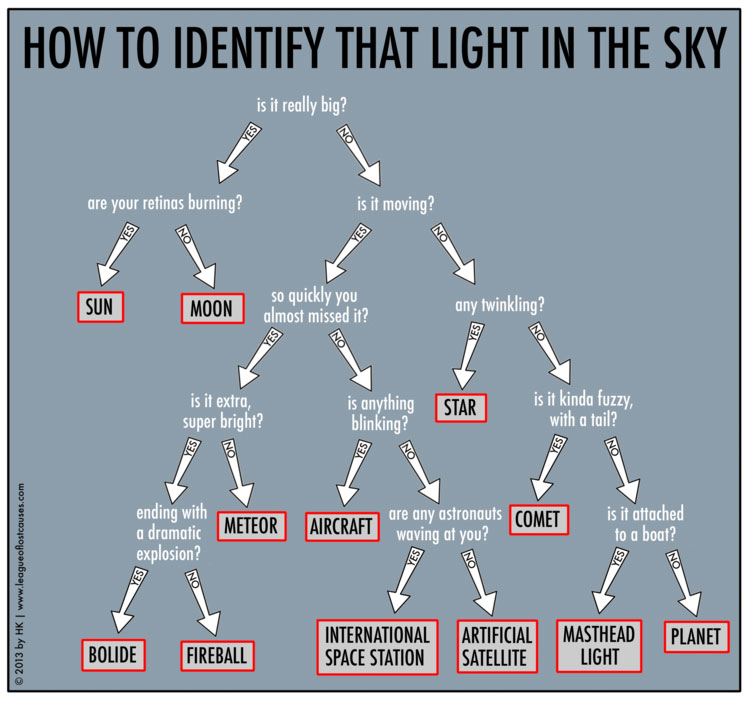
空に見えるあの光は何だろう?おそらく人類が抱く最も一般的な疑問の一つでしょう。いくつかの簡単な観察で答えが見つかるかもしれません。例えば、動いていたり点滅していたりするでしょうか?もしそうなら、そしてあなたが都市の近くに住んでいるなら、答えはたいてい飛行機です。飛行機は非常に多く、人工的な都市の明かりの騒音に負けないほど明るい星や人工衛星は少ないからです。そうでない場合、そしてあなたが都市から遠く離れた場所に住んでいるなら、その明るい光は金星や火星のような惑星である可能性が高いです。金星は夜明け前か夕暮れ後に地平線近くにしか見えません。地平線近くの遠くの飛行機の動きが遅いため、明るい惑星と見分けるのが難しい場合もありますが、それでも数分間の飛行機の動きから通常は判別できます。それでもまだ確信が持てない?掲載されている図表は、時にユーモラスですが、概ね正確な評価を示しています。熱心な天文愛好家は、おそらく間違いに気づき、丁寧な訂正をしてくれるでしょう。図表の翻訳:スペイン語、イタリア語、ポーランド語、タミル語、カンナダ語、ラトビア語、ノルウェー語
原文(English)
What is that light in the sky? Perhaps one of humanity's more common questions, an answer may result from a few quick observations. For example -- is it moving or blinking? If so, and if you live near a city, the answer is typically an airplane, since planes are so numerous and so few stars and satellites are bright enough to be seen over the din of artificial city lights. If not, and if you live far from a city, that bright light is likely a planet such as Venus or Mars -- the former of which is constrained to appear near the horizon just before dawn or after dusk. Sometimes the low apparent motion of a distant airplane near the horizon makes it hard to tell from a bright planet, but even this can usually be discerned by the plane's motion over a few minutes. Still unsure? The featured chart gives a sometimes-humorous but mostly-accurate assessment. Dedicated sky enthusiasts will likely note -- and are encouraged to provide -- polite corrections. Chart translations: Spanish, Italian, Polish, Tamil, Kannada, Latvian, and Norwegian
\ この感動を宇宙仲間にシェア /
宇宙をXでシェア
© HK (The League of Lost Causes) / APOD