皆既日食の層構造
Layers of a Total Solar Eclipse
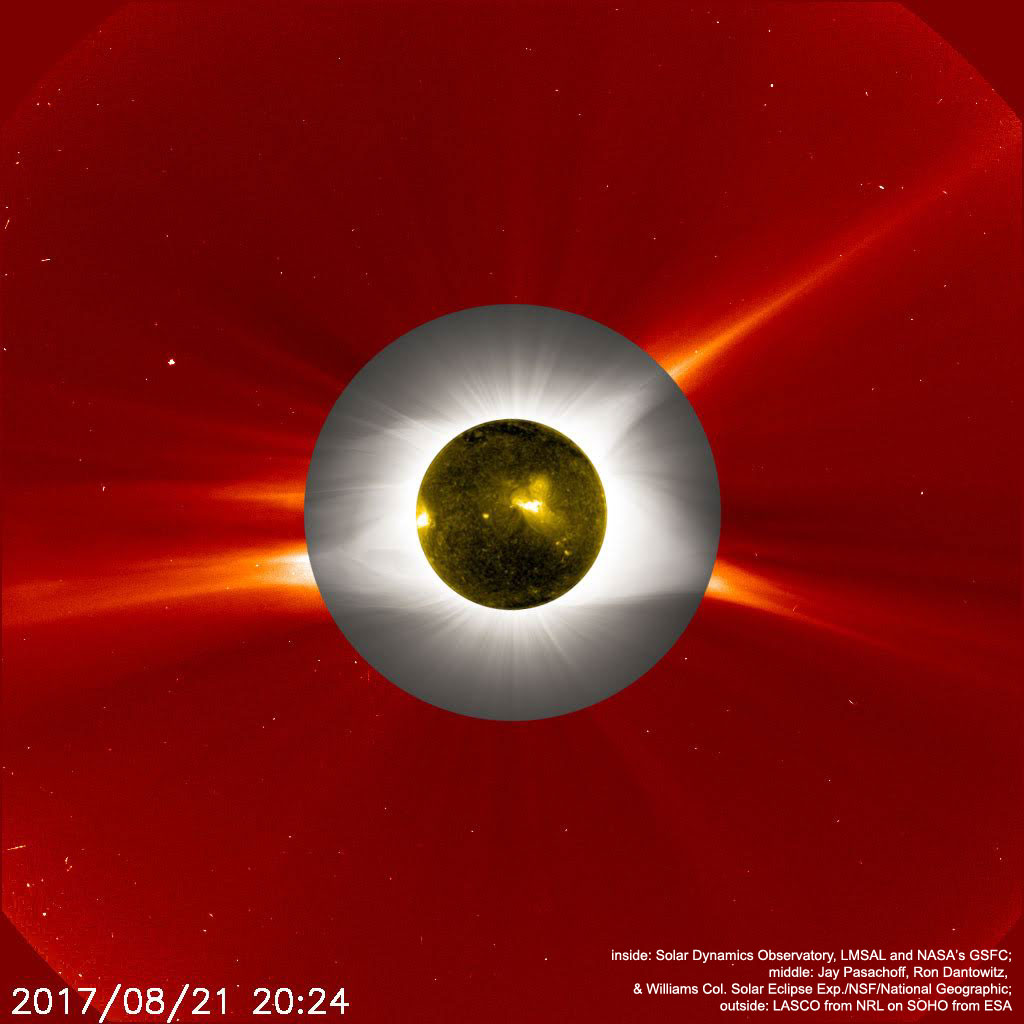
雨も雪も夜の闇も、宇宙空間にある宇宙船が太陽を観測するのを妨げることはできません。実際、地球から太陽に向かって150万キロメートル離れた位置にあるNASAの太陽圏観測衛星(SOHO)は、常に太陽の外層大気、つまりコロナを観測することができます。しかし、地球上の観測者が美しいコロナの筋や構造を見ることができるのは皆既日食の時だけです。皆既日食の間、月が圧倒的に明るい太陽表面を一時的に遮るからです。その時、太陽表面までコロナの活動を詳細に追跡することが可能になります。この合成画像の外側の層には、先月の皆既日食中にSOHOが遮ることなく観測した太陽コロナがオレンジ色で示されています。中央のドーナツ状の領域は、オレゴン州セーラムにあるウィリアムズ大学日食探査隊が記録したコロナです。同時に、内側の画像はNASAの地球周回軌道上の太陽力学観測衛星(SDO)によるもので、皆既日食の外側に位置していたため、極端紫外線で太陽の表面を撮影することができ、金色で示されている。
原文(English)
Neither rain, nor snow, nor dark of night can keep a space-based spacecraft from watching the Sun. In fact, from its vantage point 1.5 million kilometers sunward of planet Earth, NASA's SOlar Heliospheric Observatory (SOHO) can always monitor the Sun's outer atmosphere, or corona. But only during a total solar eclipse can Earth-based observers also see the lovely coronal streamers and structures - when the Moon briefly blocks the overwhelmingly bright solar surface. Then, it becomes possible to follow detailed coronal activity all the way down to the Sun's surface. In the outside layer of this composite image, SOHO's uninterrupted view of the solar corona during last month's eclipse is shown in orange hues. The middle, donut-shaped region is the corona as recorded by the Williams College Eclipse Expedition to Salem, Oregon. Simultaneously, the inner view is from NASA's Earth-orbiting Solar Dynamics Observatory, which, being outside of totality, was able to image the face of the Sun in extreme ultraviolet light, shown in gold.
\ この感動を宇宙仲間にシェア /
宇宙をXでシェア
© NASA / APOD