エクリプソサウルス・レックス
Eclipsosaurus Rex
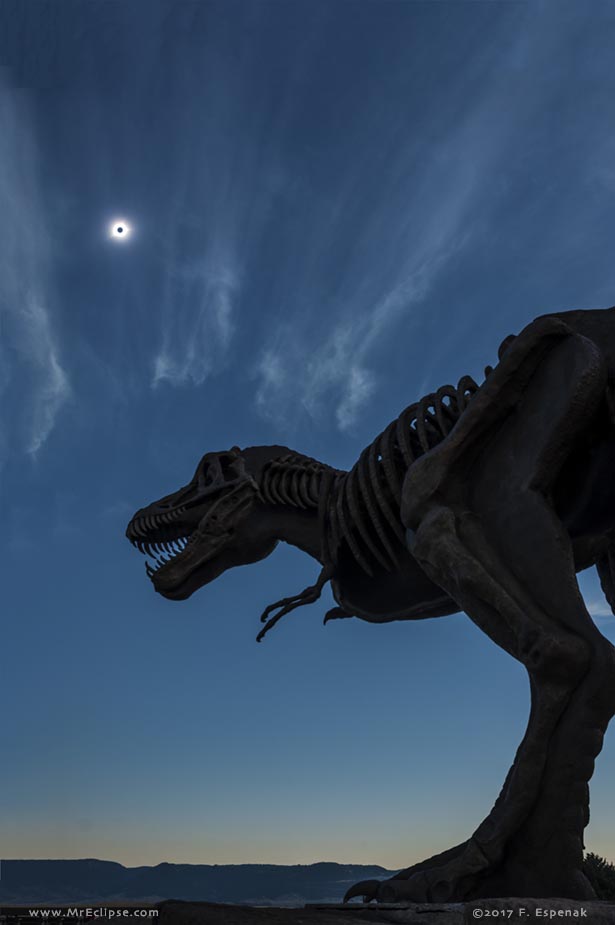
皆既日食が見られる時代に私たちは生きています。なぜなら、月の見かけの大きさが太陽の円盤をちょうど覆うことがあるからです。しかし、月は地球からゆっくりと遠ざかっています。潮汐摩擦により、その距離は年間約 1.5 インチ (3.8 センチメートル) ずつ増加していると測定されています。そのため、約 6 億年後には、月が十分に遠くなり、月の円盤が太陽を完全に覆うには小さすぎる時が来るでしょう。そうなると、せいぜい金環日食、つまり小さすぎる月のシルエットの円盤を囲む炎の輪が、私たちの美しい惑星の表面から見えるだけになります。もちろん、1 億年前は月はもう少し地球に近く、少し大きく見えました。そのため、恐竜の時代には皆既日食がより頻繁に起こっていました。ワイオミング州キャスパー大学のテイト地質博物館の前では、この恐竜の像が現代の皆既日食と一緒にポーズをとっています。 8月21日の皆既日食の際に彼の肖像を撮影するため、彼の真下に自動カメラが設置された。
原文(English)
We live in an era where total solar eclipses are possible because at times the apparent size of the Moon can just cover the disk of the Sun. But the Moon is slowly moving away from planet Earth. Its distance is measured to increase about 1.5 inches (3.8 centimeters) per year due to tidal friction. So there will come a time, about 600 million years from now, when the Moon is far enough away that the lunar disk will be too small to ever completely cover the Sun. Then, at best only annular eclipses, a ring of fire surrounding the silhouetted disk of the too small Moon, will be seen from the surface of our fair planet. Of course the Moon was slightly closer and loomed a little larger 100 million years ago. So during the age of the dinosaurs there were more frequent total eclipses of the Sun. In front of the Tate Geological Museum at Casper College in Wyoming, this dinosaur statue posed with a modern total eclipse, though. An automated camera was placed under him to shoot his portrait during the Great American Eclipse of August 21.
\ この感動を宇宙仲間にシェア /
宇宙をXでシェア
© MrEclipse.com / APOD