NGC 4993:歴史的な爆発が起きた銀河の故郷
NGC 4993: The Galactic Home of an Historic Explosion
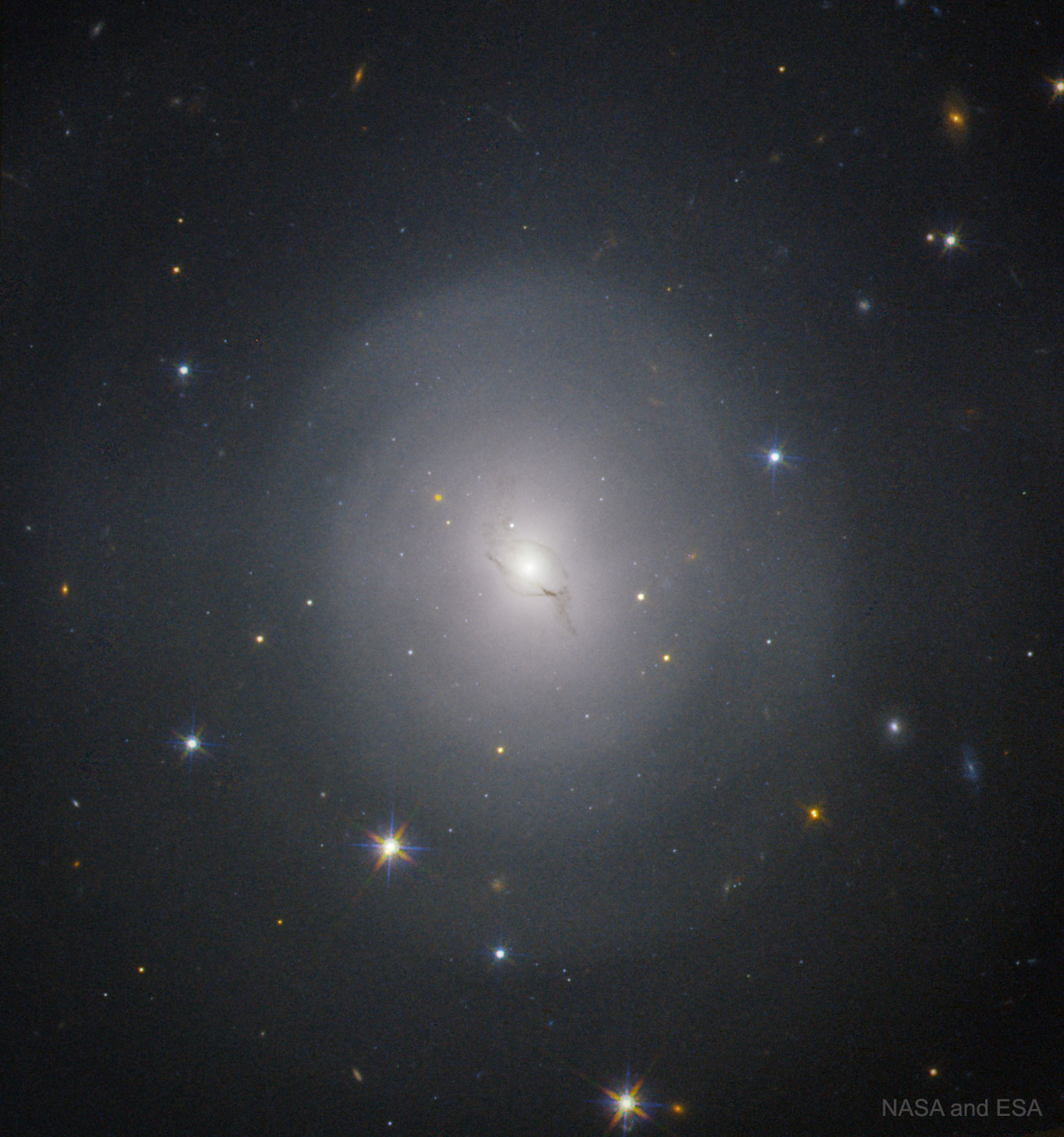
あの赤みがかった点――以前はそこにはありませんでした。銀河NGC 4993の中心の左上にある点です。見えますか?8月に発生した前例のない重力波イベントGW170817の光学的対応天体の可能性のある広範囲をスキャンしていたところ、この薄れゆく点の出現がすぐに歴史的に重要なものとなりました。この点によってGW170817の正確な位置が特定され、人類の主要な望遠鏡が重力波イベントの史上初の電磁波対応天体を調査することが可能になりました。このイベントは、2つの中性子星が合体した後に発生する元素形成爆発である短時間のガンマ線バーストキロノバであるという強力な証拠を示しています。ハッブル宇宙望遠鏡によるレンズ状銀河NGC 4993の特集画像は、発見されてから数日後の薄れゆく点を示しています。現在も継続中の分析では、爆発の物理学、生成された重元素の種類、重力波と光の速度の類似性、そして宇宙の距離スケールを決定するための新しい方法の較正などが行われている。GW170817に関する詳細:学術論文、データ、図表
原文(English)
That reddish dot -- it wasn't there before. It's the dot to the upper left of galaxy NGC 4993's center, do you see it? When scanning the large field of possible locations of an optical counterpart to the unprecedented gravitational wave event GW170817 in August, the appearance of this fading dot quickly became of historic importance. It pinpointed GW170817's exact location, thereby enabling humanity's major telescopes to examine the first ever electromagnetic wave counterpart to a gravitational wave event, an event giving strong evidence of being a short gamma-ray burst kilonova, the element-forming explosion that occurs after two neutron stars merge. The featured image of lenticular galaxy NGC 4993 by Hubble shows the fading dot several days after it was discovered. Analyses, continuing, include the physics of the explosion, what heavy elements formed, the similarity of the speeds of gravitational radiation and light, and calibrating a new method for determining the distance scale of our universe. More on GW170817: Journal articles, data, graphics
\ この感動を宇宙仲間にシェア /
宇宙をXでシェア
© NASA / APOD