最初の探検家
The First Explorer
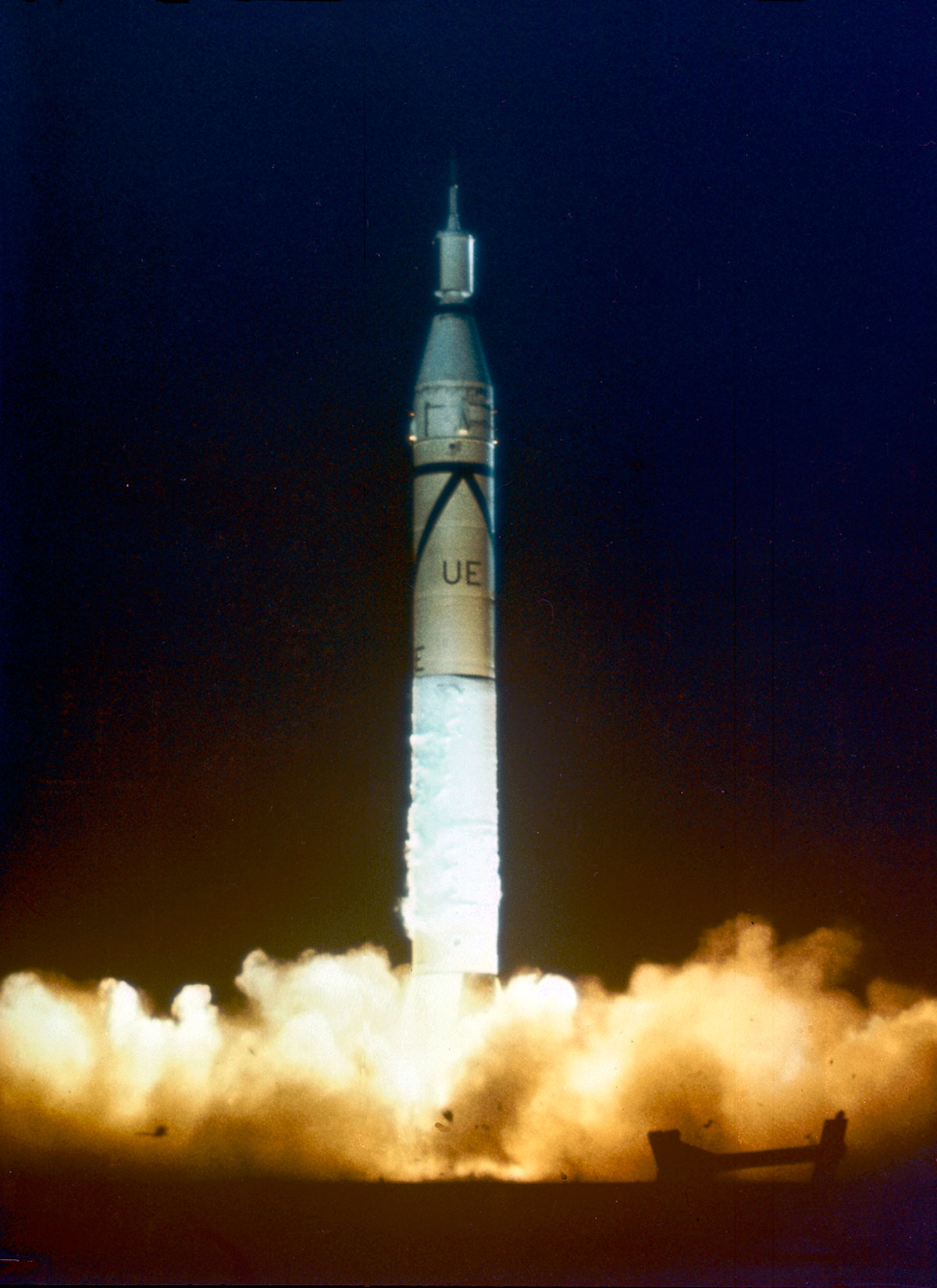
60年前の1958年1月31日、陸軍弾道ミサイル局はジュピターCロケットで初代エクスプローラー1号の打ち上げに成功しました。アメリカ合衆国の宇宙探査時代の幕開けとなったエクスプローラー1号は、重量30ポンドの衛星で、温度や微小隕石の衝突を測定する機器に加え、ジェームズ・A・ヴァン・アレンが設計した宇宙空間の電子とイオンの密度を測定する実験装置を搭載していました。ヴァン・アレンの実験による測定結果は、地球を周回する2つの高エネルギー電子とイオンの帯が磁気圏に捕捉されているという、当時としては予想外かつ驚くべき発見につながりました。現在ヴァン・アレン放射線帯として知られるこれらの領域は、地球低軌道の外側、内側磁気圏に位置しています。エクスプローラー1号は1958年2月28日に送信を停止しましたが、1970年3月まで軌道上に留まりました。
原文(English)
Sixty years ago, on January 31, 1958, the First Explorer was successfully launched by the Army Ballistic Missile Agency on a Jupiter-C rocket. Inaugurating the era of space exploration for the United States, Explorer I was a thirty pound satellite that carried instruments to measure temperatures, and micrometeorite impacts, along with an experiment designed by James A. Van Allen to measure the density of electrons and ions in space. The measurements made by Van Allen's experiment led to an unexpected and then startling discovery of two earth-encircling belts of high energy electrons and ions trapped in the magnetosphere. Now known as the Van Allen Radiation belts, the regions are located in the inner magnetosphere, beyond low Earth orbit. Explorer I ceased transmitting on February 28, 1958, but remained in orbit until March of 1970.
\ この感動を宇宙仲間にシェア /
宇宙をXでシェア
© NASA / APOD