インサイトが撮影した火星からの最初の画像
InSight's First Image from Mars
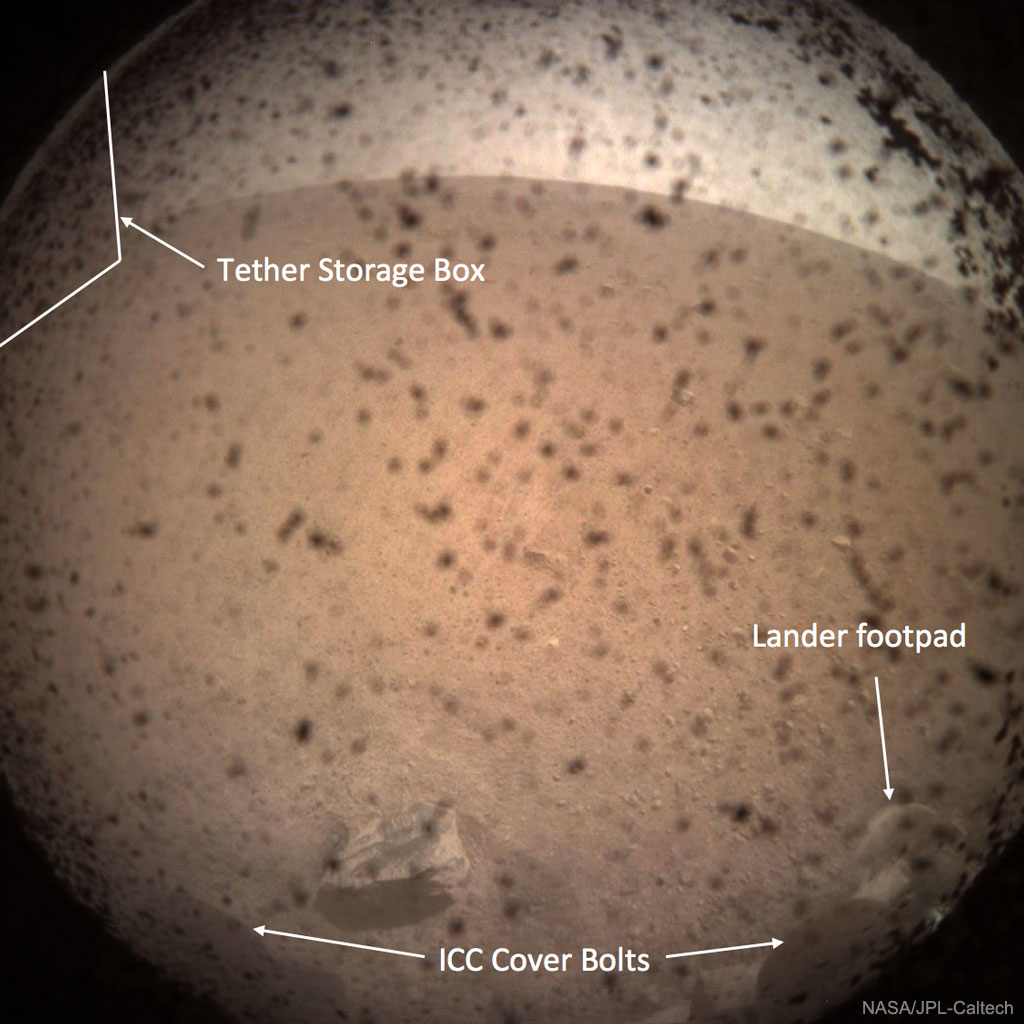
火星へようこそ、NASAインサイト。昨日、NASAのロボット探査機インサイトは、太陽系内を6か月かけて旅した後、火星に劇的な着陸を果たしました。時速2万キロメートルから約7分で停止する必要があったインサイトは、耐熱シールド、パラシュート、そして最後にロケットを展開し、最大8Gの減速と摂氏1500度まで加熱しました。掲載されている画像は、インサイトが火星で撮影した最初の画像であり、探査機が火星に軟着陸し、機能するのに十分な速度を落としたことを示す喜ばしい証拠です。最終降下中、インサイトのロケットが巻き上げた塵が、機器コンテキストカメラのレンズキャップに付着しているのが確認できます。斑点状の塵の向こうには、着陸機の下部にあるカバーボルトや右下にある着陸脚パッドなど、着陸機の部品が見えます。錆びたような赤い土壌には小さな岩が点在し、画像上部の弧は火星の地平線で、陸と空を隔てている。今後数週間で、インサイト探査機は地鳴りを検知する地震計を含む複数の科学機器を展開する予定だ。これらの機器によって、火星内部に関する前例のないデータが得られると期待されている。火星内部は、火星だけでなく地球の形成に関する手がかりを秘めていると考えられている領域である。
原文(English)
Welcome to Mars, NASA Insight. Yesterday NASA's robotic spacecraft InSight made a dramatic landing on Mars after a six-month trek across the inner Solar System. Needing to brake from 20,000 km per hour to zero in about seven minutes, Insight decelerated by as much as 8 g's and heated up to 1500 degrees Celsius as it deployed a heat shield, a parachute, and at the end, rockets. The featured image was the first taken by InSight on Mars, and welcome proof that the spacecraft had shed enough speed to land softly and function on the red planet. During its final descent, InSight's rockets kicked up dust which can be seen stuck to the lens cap of the Instrument Context Camera. Past the spotty dirt, parts of the lander that are visible include cover bolts at the bottom and a lander footpad on the lower right. Small rocks are visible across the rusty red soil, while the arc across the top of the image is the Martian horizon dividing land and sky. Over the next few weeks InSight will deploy several scientific instruments, including a rumble-detecting seismometer. These instruments are expected to give humanity unprecedented data involving the interior of Mars, a region thought to harbor formation clues not only about Mars, but Earth.
\ この感動を宇宙仲間にシェア /
宇宙をXでシェア
© NASA / APOD