コロナ・オーストラリスを越えて
Across Corona Australis
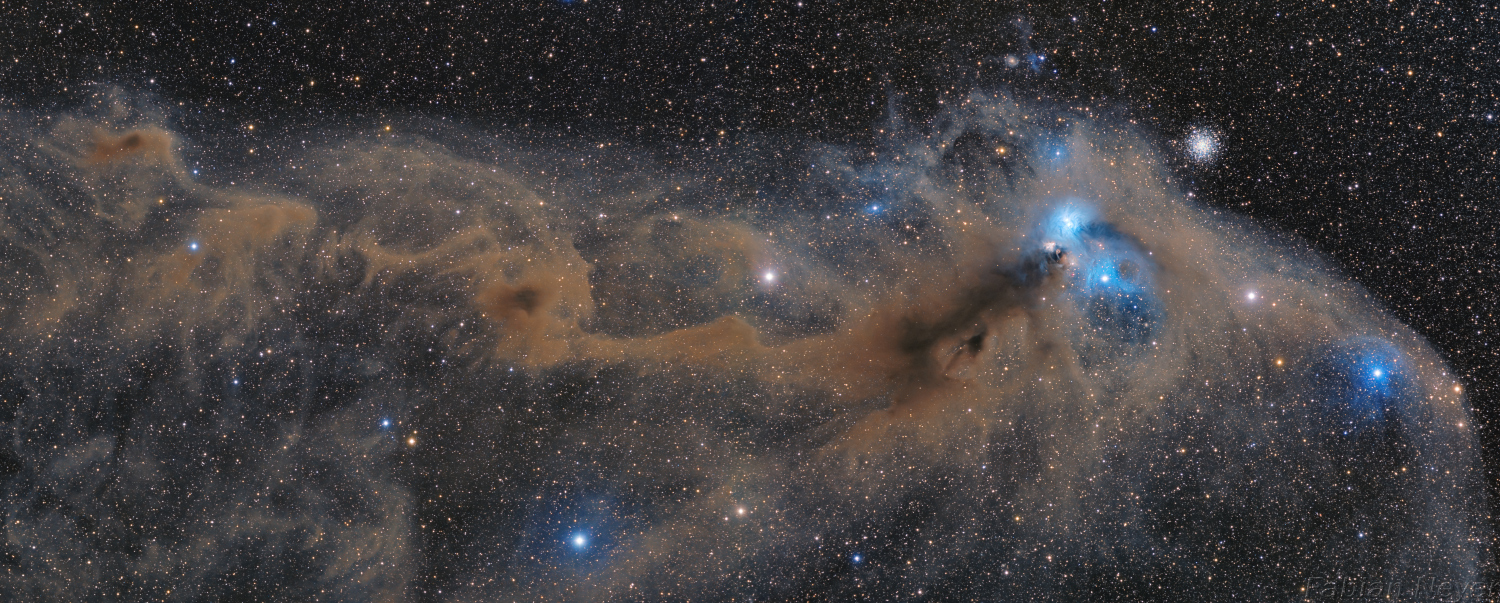
南冠座の北端付近にあるこの広角望遠鏡パノラマでは、宇宙塵の雲が星々の豊かな領域を覆っています。500光年未満の距離にあるこれらの密度の高い雲は、天の川のより遠方の背景の星からの光を効果的に遮っています。この視界全体は、雲の推定距離で約5度、つまり約45光年に及びます。右側には、NGC 6726、6727、6729、IC 4812としてカタログ化されている青みがかった反射星雲のグループがあります。特徴的な青色は、高温の星からの光が宇宙塵によって反射されることによって生じます。この塵はまた、まだ形成過程にある領域の星々を視界から遮っています。より小さな黄色の星雲NGC 6729は、若い変光星Rコロナエ・アウストラリスを取り囲んでいます。その下には、エネルギーの高い生まれたばかりの星に関連するハービッグ・ハロー(HH)天体として識別される弧とループがあります。壮大な球状星団NGC 6723は、星雲の右上方に位置しています。NGC 6723は星雲群の一部のように見えますが、その古代の星々は実際には約3万光年も離れたところにあり、みなみのかんむり座の塵雲の若い星々のはるか彼方にあります。
原文(English)
Cosmic dust clouds are draped across a rich field of stars in this broad telescopic panorama near the northern boundary of Corona Australis, the Southern Crown. Less than 500 light-years away the denser clouds effectively block light from more distant background stars in the Milky Way. The entire vista spans about 5 degrees or nearly 45 light-years at the clouds' estimated distance. Toward the right lies a group of bluish reflection nebulae cataloged as NGC 6726, 6727, 6729 and IC 4812. The characteristic blue color is produced as light from hot stars is reflected by the cosmic dust. The dust also obscures from view stars in the region still in the process of formation. Smaller yellowish nebula NGC 6729 surrounds young variable star R Coronae Australis. Below it are arcs and loops identified as Herbig Haro (HH) objects associated with energetic newborn stars. Magnificent globular star cluster NGC 6723 is above and right of the nebulae. Though NGC 6723 appears to be part of the group, its ancient stars actually lie nearly 30,000 light-years away, far beyond the young stars of the Corona Australis dust clouds.
\ この感動を宇宙仲間にシェア /
宇宙をXでシェア
© Fabian Neyer / APOD