太陽黒点のない2月
A February without Sunspots
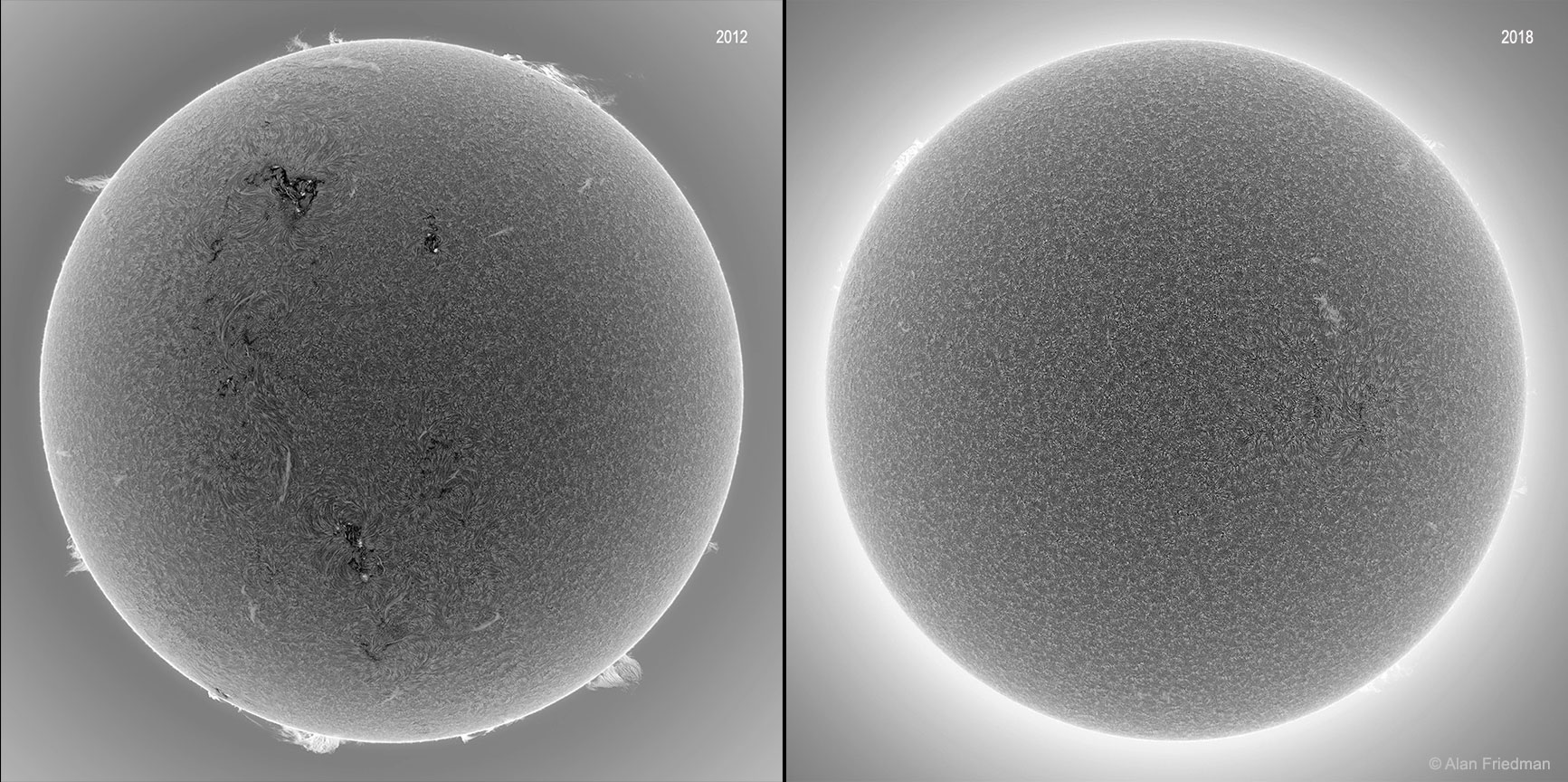
黒点はどこへ行ってしまったのでしょうか?先月、太陽を横切った黒点の総数は…ゼロでした。長期月平均をはるかに下回るこの太陽活動極小期において、太陽表面は11年前の前回の太陽活動極小期と同様に、異常なほど静穏化しています。このような静穏化は単なる視覚的な現象ではなく、太陽がわずかに暗くなり、太陽コロナの穴がより安定し、流出する太陽風の強度が低下することと相関しています。太陽風の減少は、地球の外層大気(熱圏)を冷却・収縮させ、地球周回衛星の抵抗を減少させます。左側の反転した白黒画像は、2012年の太陽活動極大期付近の活発な太陽表面を示しています。これに対し、右側の画像は、太陽活動極小期に入りつつあった昨年8月の太陽表面を示しており、すでに黒点が(数日間)見られなくなっています。この異常に静穏な太陽活動極小期の影響が研究されています。
原文(English)
Where have all the sunspots gone? Last month the total number of spots that crossed our Sun was ... zero. Well below of the long term monthly average, the Sun's surface has become as unusually passive this solar minimum just like it did 11 years ago during the last solar minimum. Such passivity is not just a visual spectacle, it correlates with the Sun being slightly dimmer, with holes in the Sun's corona being more stable, and with a reduced intensity in the outflowing solar wind. The reduced wind, in turn, cools and collapses Earth's outer atmosphere (the thermosphere), causing reduced drag on many Earth-orbiting satellites. Pictured in inverted black & white on the left, the Sun's busy surface is shown near solar maximum in 2012, in contrast to the image on the right, which shows the Sun's surface last August, already without spots (for a few days), as solar minimum was setting in. Effects of this unusually static solar minimum are being studied.
\ この感動を宇宙仲間にシェア /
宇宙をXでシェア
© Alan Friedman
(Averted Imagination) / APOD