M101方面の眺め
A View Toward M101
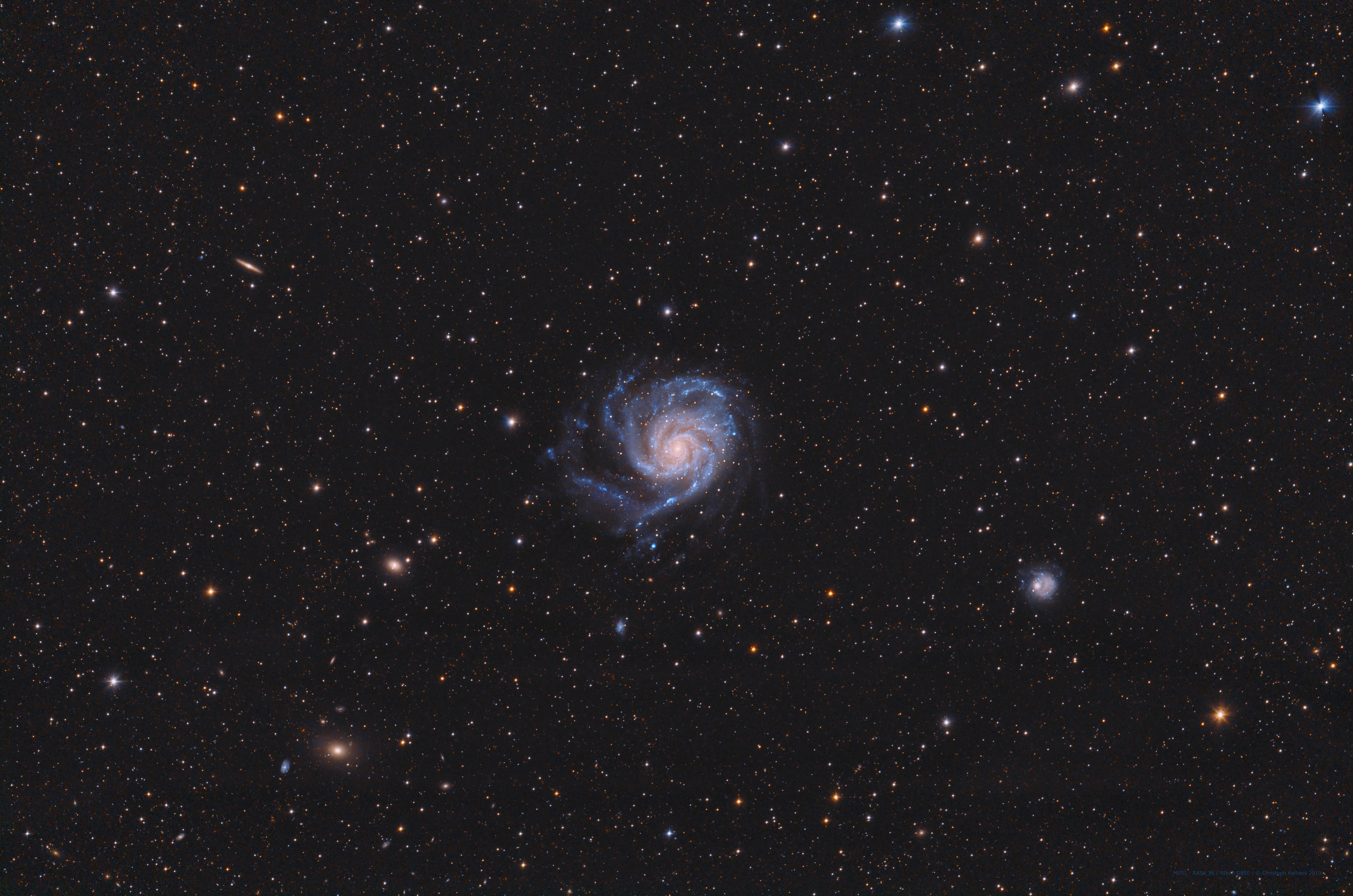
巨大で美しい渦巻銀河M101は、シャルル・メシエの有名なカタログの最後の方の項目の一つですが、決して劣ったものではありません。直径約17万光年のこの銀河は巨大で、私たちの天の川銀河のほぼ2倍の大きさです。M101は、19世紀のロス卿の大型望遠鏡「パーソンタウンのレヴィアサン」によって最初に観測された渦巻星雲の一つでもあります。M101は、より遠くの背景銀河、天の川銀河内の前景の星、そして伴銀河NGC 5474(右下)とともに、この現代の望遠鏡の視野を共有しています。天の川銀河の星の色は、この巨大な島宇宙からの星の光にも見られます。その中心部は、低温の黄色い星からの光が支配的です。壮大な渦巻腕に沿って、より高温の若い星の青い色が、遮蔽する塵の帯やピンク色の星形成領域と混ざり合っています。風車銀河としても知られるM101は、北天の星座であるおおぐま座の領域内に位置し、地球から約2300万光年離れている。伴銀河であるNGC 5474は、過去に主銀河であるM101との重力相互作用によって形状が歪められたと考えられている。
原文(English)
Big, beautiful spiral galaxy M101 is one of the last entries in Charles Messier's famous catalog, but definitely not one of the least. About 170,000 light-years across, this galaxy is enormous, almost twice the size of our own Milky Way galaxy. M101 was also one of the original spiral nebulae observed by Lord Rosse's large 19th century telescope, the Leviathan of Parsontown. M101 shares this modern telescopic field of view with more distant background galaxies, foreground stars within the Milky Way, and a companion dwarf galaxy NGC 5474 (lower right). The colors of the Milky Way stars can also be found in the starlight from the large island universe. Its core is dominated by light from cool yellowish stars. Along its grand design spiral arms are the blue colors of hotter, young stars mixed with obscuring dust lanes and pinkish star forming regions. Also known as the Pinwheel Galaxy, M101 lies within the boundaries of the northern constellation Ursa Major, about 23 million light-years away. Its companion NGC 5474 has likely been distorted by its past gravitational interactions with the dominant M101.
\ この感動を宇宙仲間にシェア /
宇宙をXでシェア
© Christoph Kaltseis / APOD