猫の目星雲の光学画像とX線画像
The Cat's Eye Nebula in Optical and X-ray
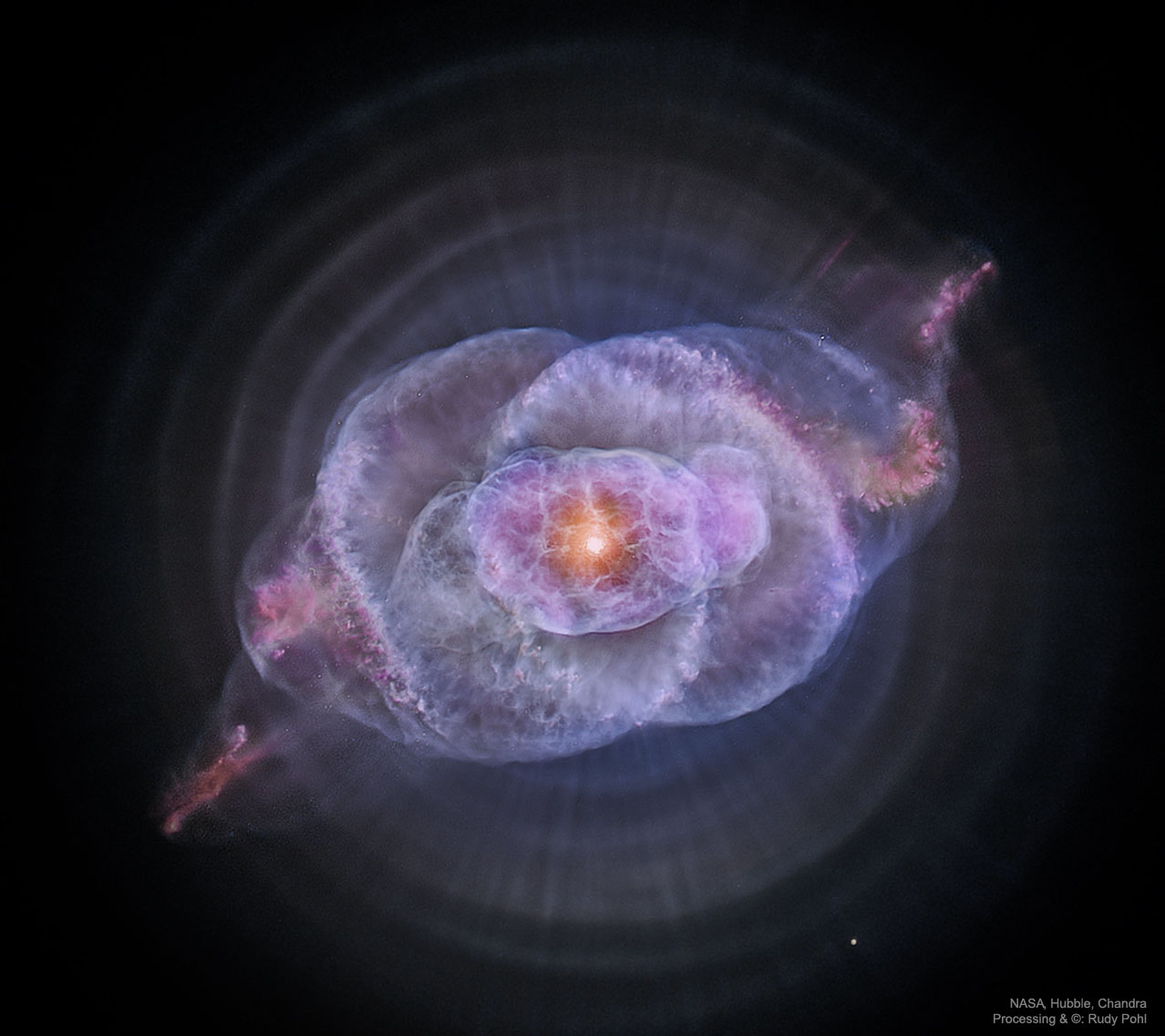
ある人には猫の目のように見えるかもしれません。またある人には、巨大な宇宙の巻貝のように見えるかもしれません。実際には、太陽のような恒星の寿命の終わりに近い、短くも輝かしい段階で放出されたガスで構成された、最も明るく、最も詳細な惑星状星雲の1つです。この星雲の中心にある死にゆく恒星は、一連の規則的な痙攣によって外側の層を剥ぎ取ることで、外側の円形の同心円状の殻を作り出した可能性があります。しかし、美しく複雑でありながら対称的な内部構造の形成については、まだ十分に解明されていません。掲載されている画像は、ハッブル宇宙望遠鏡でデジタル処理によって鮮明化された画像と、周回軌道上のチャンドラX線観測衛星が捉えたX線画像を合成したものです。この精巧な宇宙に浮かぶ彫像は、半光年以上にわたって広がっています。もちろん、この猫の目を見つめる人類は、約50億年後に惑星状星雲へと進化する運命にある太陽の運命をも見ているのかもしれません。
原文(English)
To some it looks like a cat's eye. To others, perhaps like a giant cosmic conch shell. It is actually one of brightest and most highly detailed planetary nebula known, composed of gas expelled in the brief yet glorious phase near the end of life of a Sun-like star. This nebula's dying central star may have produced the outer circular concentric shells by shrugging off outer layers in a series of regular convulsions. The formation of the beautiful, complex-yet-symmetric inner structures, however, is not well understood. The featured image is a composite of a digitally sharpened Hubble Space Telescope image with X-ray light captured by the orbiting Chandra Observatory. The exquisite floating space statue spans over half a light-year across. Of course, gazing into this Cat's Eye, humanity may well be seeing the fate of our sun, destined to enter its own planetary nebula phase of evolution ... in about 5 billion years.
\ この感動を宇宙仲間にシェア /
宇宙をXでシェア
© NASA / APOD